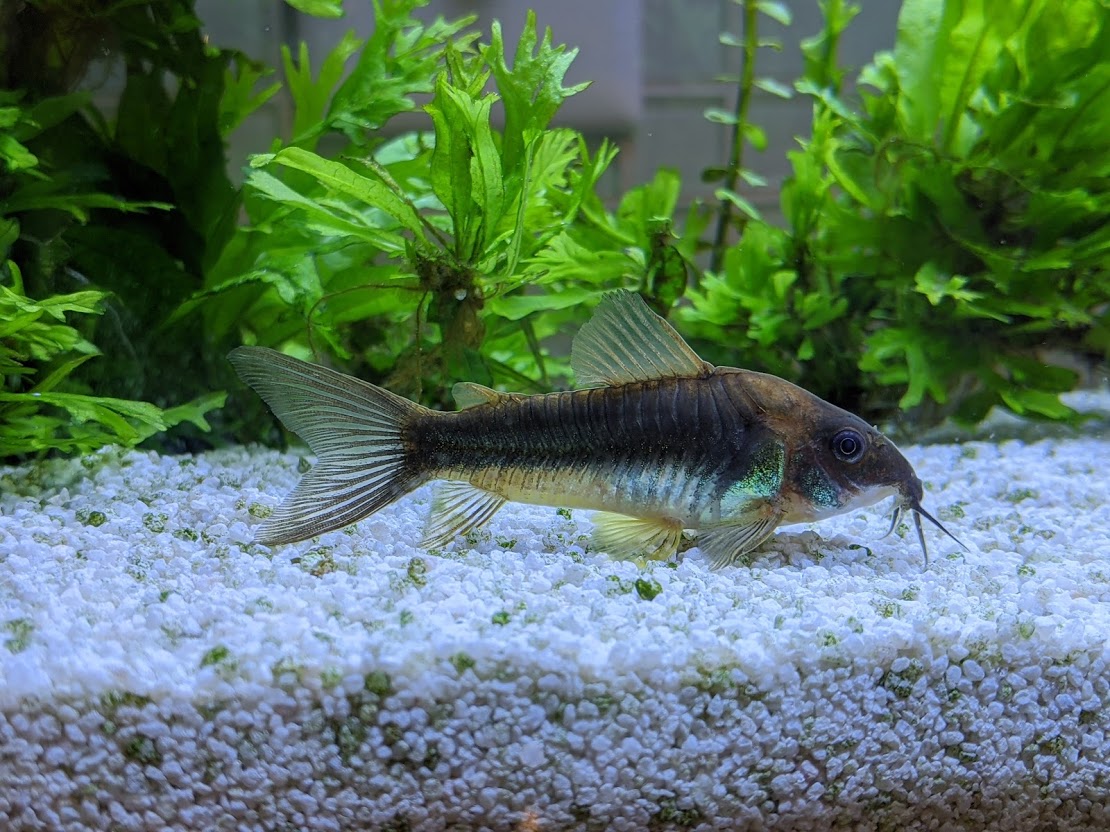
Corydoras aeneus — Bronze Corydoras
Corydoras splendens
Origin: Upper Amazon Basin in South America, including the Ucayali River, Ambiyacu River, and surrounding waters in Brazil, Peru, Ecuador, and Colombia
Also known as: Emerald Catfish, Green Corydoras, Short-nosed Brochis, Emerald Cory, Hi-fin Cory
Fact sheet
- Size
- 8 cm
- Lifespan
- 10 years
- Minimum tank size
- 100 L
- Temperature
- 22–28 °C
- pH
- 6–7.5
- Hardness GH
- 5–15 °dH
- Temperament
- Peaceful
- Social behavior
- Schooling
- Group size
- 6+ individuals
- Swimming zone
- Bottom
- Diet
- Omnivore
- Jumps out
- No
- Eats plants
- No
Overview
The most common armoured catfish in the hobby. Smaller than Brochis (up to 7 cm) with a bronze-green sheen. Readily bred in captivity and available in numerous colour forms.
Appearance
Shared with the species: Emerald Brochis
The body is covered in two rows of overlapping bony plates (scutes) typical of callichthyid catfish. The upper body displays a striking metallic green to blue-green iridescence that shifts in intensity with different lighting angles. The belly and lower fins are yellowish, while the dorsal, caudal, and adipose fins are translucent brownish. Females grow larger and more robust than males; females have a pinkish-white belly while males have a more yellowish one. Juveniles often show a mottled pattern before developing their full adult coloration.
Care
Shared with the species: Emerald Brochis
A minimum aquarium base of 120×45 cm (approximately 243 litres) is recommended for a proper group. The substrate should be fine sand or smooth rounded gravel to prevent barbel damage. The tank should be well-planted with areas of open swimming space. Water parameters: 22–28 °C, pH 5.0–8.0, hardness 2–15 dGH. As a facultative air-breather, the fish will occasionally surface to gulp air via a specialised intestinal section, so the water surface must remain unobstructed. Regular partial water changes are essential.
Feeding
Shared with the species: Emerald Brochis
Brochis splendens is an omnivorous bottom-feeder accepting a wide range of foods. Good options include sinking pellets, corydoras wafers, frozen bloodworms, Tubifex, and brine shrimp. Live worms are particularly appreciated. The fish should not be expected to survive solely on aquarium leftovers — targeted feeding with sinking foods is necessary to ensure all individuals receive adequate nutrition.
Compatibility
Shared with the species: Emerald Brochis
An excellent community fish for tanks with other peaceful species. Best kept in groups of 6 or more individuals for natural schooling behaviour. Compatible with most small non-aggressive tetras, livebearers, dwarf cichlids, and similar peaceful species. Does not disturb plants or tank mates. Not suitable with aggressive or predatory species that might intimidate the catfish.
Breeding
Shared with the species: Emerald Brochis
Breeding follows the typical corydoras pattern but is less frequently achieved. Conditioning on live foods and a partial water change with slightly cooler water can trigger spawning. The male fertilises eggs as the female holds them in her pelvic fin basket before placing them individually on plants, glass, or rocks near the water surface. Eggs hatch in approximately four days; fry become free-swimming about two days later. First foods: infusoria and baby brine shrimp nauplii.
Fun facts
Shared with the species: Emerald Brochis
Brochis splendens can breathe atmospheric air using a modified section of its gut, allowing it to survive in poorly-oxygenated water. The genus Brochis was revalidated in 2024 after a period of synonymy with Corydoras. Juveniles are sold under the trade name 'hi-fin cory' due to their proportionally large dorsal fin.