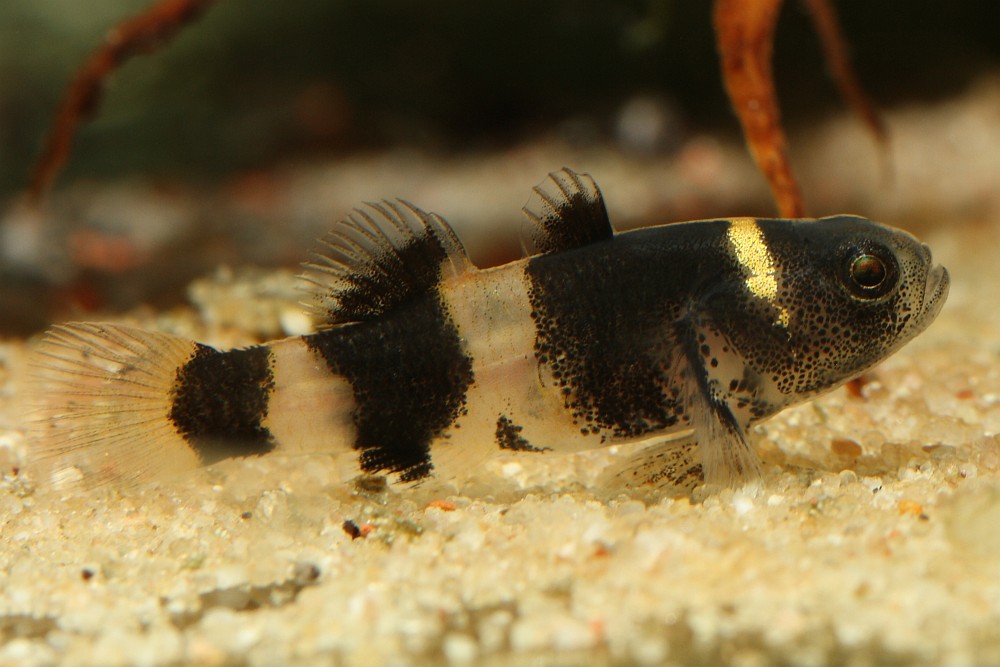
Fish
Bumblebee Goby
Brachygobius doriae
Origin: Java, Indonesia; possibly also Borneo and Sumatra. Found in brackish estuaries, mangroves, tidal rivers, and lower river reaches
Also known as: Bumblebee fish, golden-banded goby
Fact sheet
- Size
- 4 cm
- Lifespan
- 3 years
- Minimum tank size
- 40 L
- Temperature
- 24–30 °C
- pH
- 7–8.5
- Hardness GH
- 10–20 °dH
- Temperament
- Semi-aggressive
- Social behavior
- In pairs
- Swimming zone
- Bottom
- Diet
- Carnivore
- Jumps out
- No
- Eats plants
- No
Varieties
Overview
The Bumblebee Goby (Brachygobius xanthozonus) is a small, vividly-patterned goby from the brackish coastal waters of Java, Indonesia. Despite its name being widely applied in the aquarium trade, this specific species may rarely be the one actually sold — specimens marketed as 'bumblebee gobies' are more often B. doriae, B. nunus, or other related species, a confusion long noted by ichthyologists. Its striking black-and-yellow banded pattern, resembling a bumblebee, makes it one of the most recognisable nano fish in the hobby. Though relatively hardy in correct brackish conditions, it requires specialised care: it is strictly carnivorous, strongly prefers live foods, and requires slightly saline water for long-term immune function. It is best maintained in species-only or carefully planned brackish setups.
Appearance
The body is small and compact, reaching up to 3–4 cm. The colouration consists of alternating vivid yellow and black transverse bands — typically four black bands on a yellow background — closely resembling a bumblebee. The belly is paler. Males are noticeably slimmer when viewed from above, while females are broader and plumper, particularly when gravid. The pelvic fins are fused into a small suctorial disc. The anal fin is entirely black, which is a useful identification feature.
Care
Bumblebee gobies require slightly brackish water for long-term health, with a specific gravity of 1.005–1.008 (approximately 6–10 g/L of marine salt). Maintaining them in fully freshwater conditions leads to immune suppression and a shortened lifespan. A minimum aquarium of 40–60 litres is recommended, furnished with caves (clay pots, PVC pipes, coconut shells) and tolerant plants like Java fern or Java moss. Use a gentle sponge filter to avoid strong currents. Temperature 22–28 °C, pH 7.5–8.5. Regular partial water changes with appropriately mixed brackish water are essential.
Feeding
Bumblebee gobies are strictly carnivorous and typically refuse prepared or dried foods. The primary diet must consist of live or frozen bloodworms, live brine shrimp, live blackworms, and small crustaceans. Transitioning individuals from live to frozen foods requires considerable patience, and some individuals may never accept non-living food. Feeding live foods exclusively is entirely acceptable for the long-term health of the fish. Flake and pellet foods should not be expected.
Compatibility
Best kept as a species-only setup or with carefully chosen brackish-tolerant tankmates. Males are territorial and display aggression toward one another, so ample caves must be provided to reduce conflict. Suitable companions in a brackish aquarium include Mollies, and in larger setups, other small brackish gobies or Archerfish. Freshwater species cannot tolerate the salinity required by bumblebee gobies and should not be mixed.
Breeding
Breeding is achievable in captivity and is one of the highlights of keeping this species. Males become more intensely coloured during courtship and aggressively defend a chosen cave. The female deposits 150–200 eggs inside the cave, which the male guards and fans. Eggs hatch after approximately 7 days; fry become free-swimming 5–7 days later. First foods for fry include infusoria, baby brine shrimp nauplii, and vinegar eels. Males are identified by their slimmer build and brighter colours; females develop a visible ovipositor just before spawning.
Fun facts
Bumblebee gobies require brackish water for long-term health — purely freshwater keeping causes immune suppression and a shortened lifespan. The name 'Brachygobius xanthozonus' has been widely misapplied in aquarium literature for decades; most traded specimens are actually B. doriae or related species. Males become significantly more intensely coloured and boldly patterned during the breeding season.