Fish
Siamese Algae Eater
Crossocheilus oblongus
Origin: Thailand, Malaysia, Borneo
Also known as: SAE, Siamese Flying Fox, Crossocheilus siamensis
Fact sheet
- Size
- 15 cm
- Lifespan
- 10 years
- Minimum tank size
- 100 L
- Temperature
- 24–28 °C
- pH
- 6.5–7.5
- Hardness GH
- 5–15 °dH
- Temperament
- Peaceful
- Social behavior
- Schooling
- Swimming zone
- Bottom, Middle
- Diet
- Herbivore
- Jumps out
- Yes
- Eats plants
- No
Overview
The Siamese Algae Eater (Crossocheilus oblongus) is widely considered one of the most effective algae-eating fish in the hobby. Native to rivers across Thailand, Malaysia, and Borneo, it inhabits both fast-flowing mountain streams and slower lowland rivers rich in vegetation. It is uniquely known as one of the few fish that readily consumes black beard algae (Rhodophyta), which most other fish and invertebrates refuse. It also grazes on thread algae, green spot algae, and film algae without damaging healthy aquarium plants. Hardy and undemanding regarding water parameters, it adapts well to a wide range of conditions and coexists peacefully with most community fish. It is most active near the bottom and middle of the water column. Juveniles are notably more enthusiastic algae grazers than adults, which may begin to prefer prepared foods over time.
Appearance
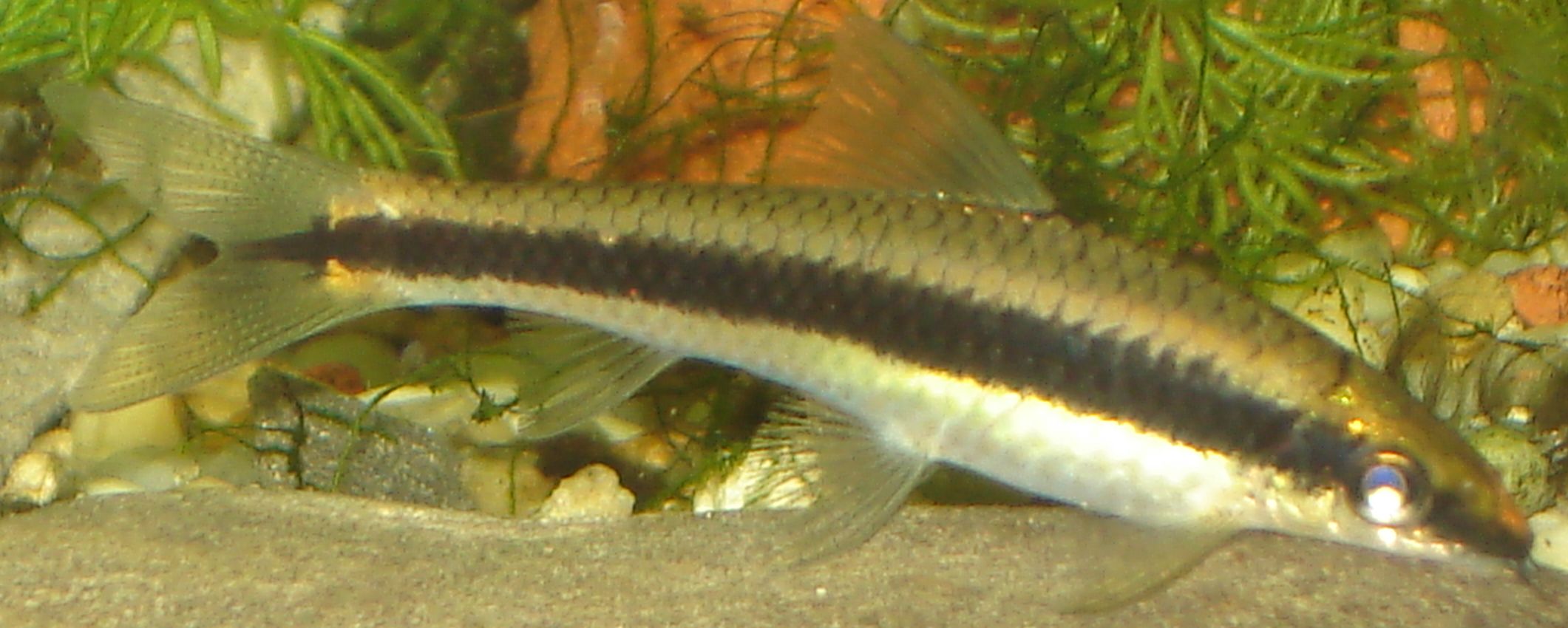
A slender, torpedo-shaped fish reaching up to 15 cm in length, slightly flattened ventrally. The body is silver to beige in color. The most distinctive feature is a bold black horizontal stripe running from the tip of the snout to the end of the caudal fin, continuing onto the middle rays of the tail — this distinguishes it from similar species like the Flying Fox. The belly is white, and fins are transparent. The downturned mouth bears fleshy lips adapted for scraping algae from surfaces. The stripe may fade or become less distinct when the fish is stressed.
Care
A tank of at least 100 liters is recommended, with good filtration and moderate current. Optimal parameters: temperature 24–28°C, pH 6.5–7.5, hardness 5–15 dGH. Provide driftwood, rocks, and dense planting for cover, along with open grazing areas. A tight-fitting lid is essential as these fish are prone to jumping. Best kept in groups of 4–6; solitary individuals become shy. Adults may show intraspecific territorial behavior, so a spacious tank with adequate hiding spots is important for group keeping.
Feeding
The primary diet consists of algae scraped from glass, rocks, and plant leaves. Readily consumes black beard algae, thread algae, and diatoms. Supplement with algae wafers, sinking flakes, blanched spinach, cucumber, and zucchini. Juveniles benefit from occasional live or frozen foods such as bloodworms and brine shrimp for proper growth. Overfeeding with regular fish food reduces their interest in algae.
Compatibility
A peaceful species that coexists well with most similarly sized fish. Compatible with tetras, danios, rasboras, livebearers, dwarf cichlids, and other cyprinids. Avoid housing with aggressive or very slow-moving species. Adult fish can be competitive with each other, so provide ample space and hiding spots when keeping multiple individuals.
Breeding
Breeding in captivity is extremely rare and not reliably documented for home aquariums. Like many cyprinids, they likely scatter eggs among plants during seasonal rains in the wild. Sexual dimorphism is minimal in juveniles; gravid females develop a noticeably rounded belly. Simulating seasonal changes — lower temperatures, increased water flow, and adjusted lighting — may help trigger spawning. Commercial production relies on hormonal induction at Southeast Asian fish farms.
Fun facts
One of the only fish known to eat black beard algae. Juveniles are far more active algae grazers than adults. Serves as a water quality indicator — when oxygen levels drop, it is among the first fish to surface. Closely resembles the Flying Fox (Epalzeorhynchos kalopterus); the black stripe extending onto the tail fin is the key distinguishing feature.