Fish
Flying Fox
Epalzeorhynchos kalopterus
Origin: Indonesia (Sumatra, Borneo, Java), Thailand, Malay Peninsula
Also known as: False Siamese Algae Eater, Flying Fox Fish
Fact sheet
- Size
- 15 cm
- Lifespan
- 8 years
- Minimum tank size
- 150 L
- Temperature
- 24–26 °C
- pH
- 6–7.5
- Hardness GH
- 5–12 °dH
- Temperament
- Semi-aggressive
- Social behavior
- Solitary
- Swimming zone
- Bottom, Middle
- Diet
- Omnivore
- Jumps out
- Yes
- Eats plants
- No
Overview
The Flying Fox (Epalzeorhynchos kalopterus) is a large cyprinid native to fast-flowing rivers and streams of Southeast Asia. It inhabits clear, well-oxygenated mountain and foothill streams rich in driftwood and rocky substrate. Frequently confused with the Siamese Algae Eater, it is a distinctly different species with notably different temperament. Juveniles graze algae actively, but adults transition to an omnivorous diet. Adult fish become territorial and aggressive toward conspecifics and fish with similar appearance. Keeping it successfully requires experience and a spacious, well-furnished tank. Its striking coloration — a bold lateral stripe and dark-edged fins — makes it popular despite its challenging personality.
Appearance
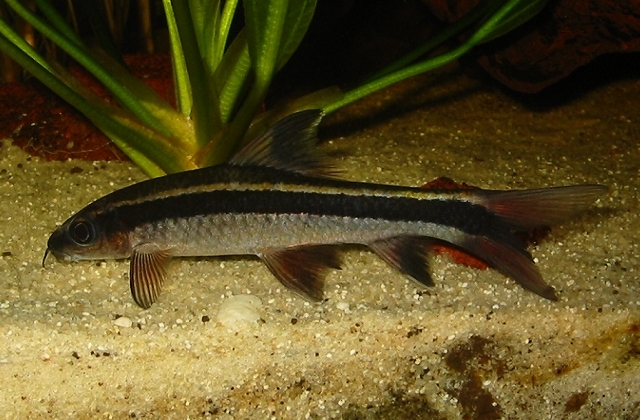
A slender, streamlined fish reaching up to 15 cm in length. Base coloration is golden-brown to bronze. A wide black horizontal stripe runs from the snout to the tail, above which sits a narrower gold stripe. All fins are partially or fully darkened with black margins — the key distinction from the Siamese Algae Eater, which has clear fins. Two small rostral barbels are present. The tail fin is forked. The underside is pale whitish.
Care
Requires a tank of at least 150 liters with strong filtration and moderate flow. Temperature 24–26°C, pH 6.0–7.5, hardness 5–12 dGH. Provide numerous hiding spots — driftwood, caves, dense planting — to reduce territorial conflicts. Best kept singly. Never house with other Epalzeorhynchos species or fish of similar appearance, as they are treated as rivals. A tight-fitting lid is essential.
Feeding
Omnivorous. Diet includes algae scraped from surfaces, detritus, and small invertebrates. In the aquarium, readily accepts spirulina tablets, vegetable flakes, blanched spinach, cucumber, and live or frozen foods such as tubifex, bloodworms, and brine shrimp. Juveniles are more herbivorous; adults prefer a varied diet with higher protein content.
Compatibility
Challenging in community tanks. Aggressive toward conspecifics, other Flying Foxes, and fish bearing a similar black stripe. May harass and fin-nip slow-moving or long-finned fish. Relatively peaceful with active mid-sized species such as danios, larger tetras, and barbs. A spacious tank with clearly defined territorial zones is essential for successful keeping.
Breeding
Breeding in captivity is very rarely documented. Like other large Southeast Asian cyprinids, they likely spawn in flowing water, scattering eggs among gravel and plants. Sexual dimorphism is subtle; females are larger and fuller-bodied than males. Simulating the rainy season — raising temperature, increasing flow, and performing frequent water changes — may encourage spawning. Commercial breeding uses hormonal stimulation.
Fun facts
Often sold mislabeled as the Siamese Algae Eater, causing buyer confusion. Distinguished from the SAE by its dark, black-edged fins. Undergoes a marked personality shift with age: relatively peaceful as a juvenile, it becomes a territorial tank boss as an adult. Conflicts among multiple individuals are inevitable without sufficient space.