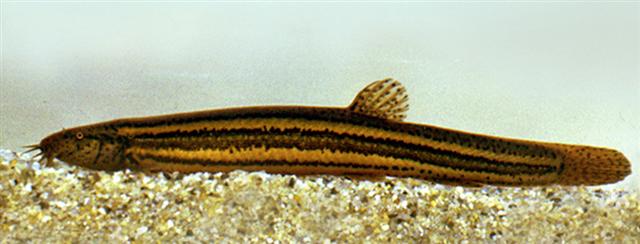
Fish
Weather Loach
Misgurnus fossilis
Origin: Europe and Asia: from France to Siberia and China, inhabiting lowland river basins
Also known as: Pond loach, European weatherfish, Misgurnus fossilis
Fact sheet
- Size
- 30 cm
- Lifespan
- 10 years
- Minimum tank size
- 100 L
- Temperature
- 5–25 °C
- pH
- 6–8
- Hardness GH
- 5–15 °dH
- Temperament
- Peaceful
- Social behavior
- Schooling
- Swimming zone
- Bottom
- Diet
- Omnivore
- Jumps out
- Yes
- Eats plants
- No
Overview
The Weather Loach (Misgurnus fossilis) is a widespread member of the Cobitidae family, inhabiting slow-moving, muddy rivers, ponds, marshes, and ditches across Europe and western Asia. It is exceptionally resilient: capable of intestinal respiration by gulping air at the surface, allowing survival in waters with extremely low oxygen content. It is famous for predicting weather changes — before storms or pressure drops, it dramatically increases activity, responding to barometric pressure changes, which gave rise to its common name. Hardy across a very wide temperature range (0–30°C), it overwinters buried in substrate. Primarily nocturnal, it burrows into soft sediment and is most active at dusk and dawn.
Appearance
The body is cylindrical, strongly elongated, and eel-like, reaching 20–35 cm in length. The small head bears a downturned mouth surrounded by 10 barbels (4 pairs plus 2 unpaired). Coloration is yellow-brown with dark brown spots and longitudinal stripes. The belly is yellowish or pinkish. Scales are tiny and nearly invisible; the body is coated in mucus. Fins are low and rounded. The tail fin is rounded without a notch.
Care
A tank of 100–120 liters for 2–3 fish. Temperature 5–25°C, optimally 15–22°C. pH 6.0–8.0, hardness 5–15 dGH. Soft substrate (fine sand or peat mix) at least 5–7 cm deep is essential — the fish spends much time buried. Provide hiding spots from roots, rocks, and pipes. Moderate filtration. Tight lid required. Sensitive to sudden temperature swings; allow time for acclimatization. Not recommended with very small fish.
Feeding
Omnivorous bottom feeder. In the wild it eats worms, insect larvae, crustaceans, and detritus. In the aquarium it accepts sinking tablets, bottom-feeder pellets, bloodworms, tubifex, earthworms, and blanched vegetables. Actively sifts through substrate in search of food. Feed in the evening or at night. Not prone to obesity when fed a varied diet.
Compatibility
A peaceful, calm species. Gets along well with most similarly sized fish — carps, bream, other loaches, and goldfish. Not recommended with very small fish or shrimp, which it may accidentally swallow. Conspecifics are tolerated well; can be kept in groups. Suitable for cold-water aquariums and ponds alongside goldfish.
Breeding
Spawning occurs in spring when temperature rises above 18°C. Females are larger than males; during spawning season the second ray of the pectoral fin thickens in males. Small greenish eggs are deposited on aquatic plants near the water surface. Incubation takes 8–10 days at 20°C. Fry are tiny and feed on infusoria. Remove adults after spawning. Rarely bred in home aquariums; a pond setup is more successful.
Fun facts
Historically kept by European peasants as a living barometer — in a jar of water, increased activity warned of approaching storms. Can breathe through its intestines and skin in addition to gills. Remarkably resilient: can cross land to find new water bodies. Prized as a food fish and in traditional medicine across Asia.