Fish
Mosquitofish
Gambusia affinis
Origin: Eastern United States (Mississippi basin, Gulf Coast states); introduced worldwide
Also known as: Western Mosquitofish, Gambusia, Gambusia affinis
Fact sheet
- Size
- 6 cm
- Lifespan
- 3 years
- Minimum tank size
- 40 L
- Temperature
- 18–28 °C
- pH
- 7–8
- Hardness GH
- 10–20 °dH
- Temperament
- Semi-aggressive
- Social behavior
- Schooling
- Swimming zone
- Top, Middle
- Diet
- Omnivore
- Jumps out
- Yes
- Eats plants
- No
Overview
The Mosquitofish (Gambusia affinis) is a small livebearer of the Poeciliidae family, native to eastern US waterways. It is globally renowned as a biological mosquito control agent: a single fish can consume up to 100–300 mosquito larvae per day. For this purpose, it was introduced to dozens of countries during the 20th century, making it one of the world's most widely distributed invasive species. In the Soviet Union, millions were bred and released into water bodies across the Caucasus, Central Asia, and southern Russia to combat malaria, playing a significant role in eradicating the disease. In the aquarium hobby it is kept as an undemanding starter fish, though males can be aggressive and both sexes may fin-nip tankmates.
Appearance
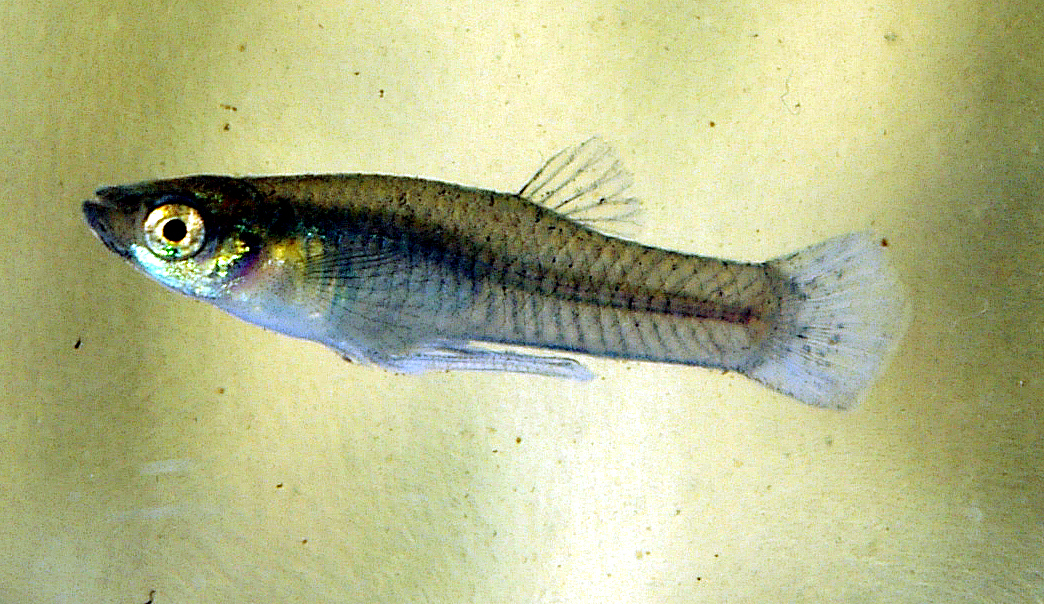
Sexual dimorphism is pronounced. Females reach 6–7 cm; males only 3.5 cm. The body is stout and laterally compressed with a broad head. Coloration is plain: silvery grey with a yellowish tint, pale belly. A dark gravid spot is visible near the anal fin on females. The male's anal fin is modified into a gonopodium (intromittent organ). Fins are short and rounded.
Care
Undemanding. Tank of 40–60 liters. Temperature 18–28°C, optimally 22–26°C. pH 7.0–8.0, hardness 10–20 dGH. Tolerates slightly brackish water. Prefers dense plant cover that gives females refuge from persistent males. Moderate filtration. Tank must be covered. Aeration is advisable. Does not require special conditions; highly disease-resistant. One of the easiest species for beginners.
Feeding
Omnivorous with a strong preference for insects and their larvae. Accepts virtually any small food in the aquarium: flakes, pellets, live or frozen daphnia, brine shrimp, and bloodworms. Especially enjoys hunting insect larvae at the water surface. Feed twice daily. A purely plant-based diet slows growth and reduces fecundity. Food particles must be small due to the fish's small mouth.
Compatibility
Males are aggressive toward other males and may persistently chase females; a ratio of 1 male to 2–3 females reduces stress. Both sexes may nip the fins of slow, long-finned fish. Compatible with other livebearers — guppies, swordtails, mollies, and platies — and with small cyprinids. Avoid very small or very large tankmates.
Breeding
Livebearer. The female carries fry for 3–5 weeks at 24–26°C. Each brood yields 10–80 large, fully formed fry. Males reach sexual maturity at 4–6 weeks; females at 6–8 weeks. Very prolific: under favorable conditions a female gives birth every 4–6 weeks. Adults eat fry — dense plant cover or a separate breeding tank is needed to raise young.
Fun facts
Officially listed among the world's 100 worst invasive species by the IUCN, as it displaces native fish and amphibians. Nevertheless, it continues to be used in malaria control programs in some developing countries. In the Soviet Union it saved thousands of lives by eliminating malaria mosquito populations in the Caucasus and Central Asia.