Fish
Gastromyzon Hillstream Loach
Gastromyzon punctulatus
Origin: Borneo (rivers of northern and western Kalimantan, Malaysia, Brunei)
Also known as: Borneo hillstream loach, spotted hillstream loach, sucker loach
Fact sheet
- Size
- 7 cm
- Lifespan
- 8 years
- Minimum tank size
- 80 L
- Temperature
- 20–26 °C
- pH
- 6.5–7.5
- Hardness GH
- 5–12 °dH
- Temperament
- Peaceful
- Social behavior
- Schooling
- Swimming zone
- Bottom
- Diet
- Herbivore
- Jumps out
- No
- Eats plants
- No
Overview
Gastromyzon (Gastromyzon spp.) is a small, bottom-dwelling fish of the family Gastromyzontidae, native to fast-flowing mountain streams of Borneo with exceptionally clean, cold, highly oxygenated water. The body is dorsoventrally flattened — an adaptation for life on rocks and glass in swift currents. The pectoral and pelvic fins form a suction disc enabling the fish to cling to any hard surface. It feeds on biofilm and diatom algae scraped from substrate. In the aquarium it requires specific conditions: powerful aeration, strong flow, pristine water quality, and numerous rock arrangements. It is sensitive to water pollution and low oxygen. Under proper conditions it is hardy and long-lived.
Appearance
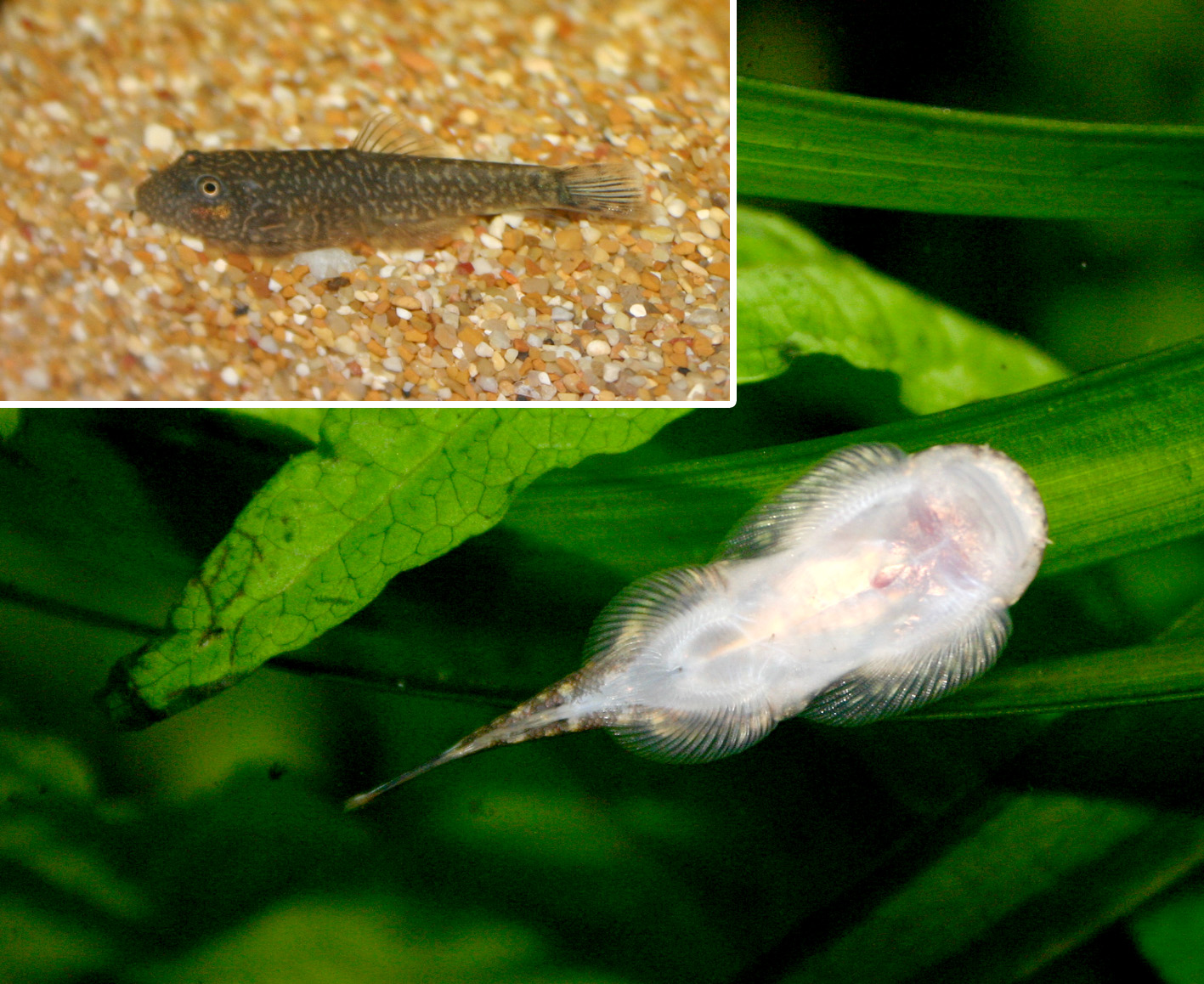
The body is flat, wide, and 5–7 cm long, resembling a disc or tadpole — broad and dorsolaterally compressed with horizontally oriented paired fins. Dorsal coloration is brown-beige with a symmetrical pattern of cream and black spots and lines that camouflages the fish among biofilm-covered rocks. The belly is pale. The mouth is inferior with adhesive lips. The tail fin is forked.
Care
A tank of 80–100 liters with a powerful pump or filter providing strong flow (7–10 tank volumes/hour). Temperature 20–26°C, pH 6.5–7.5, hardness 5–12 dGH, maximum dissolved oxygen. Essential: many rocks, pebbles, and driftwood for shelter and landscape variety. The fish clings to both vertical and horizontal surfaces. Plants are optional, but Java moss is welcome as a biofilm substrate. Regular 25–30% weekly water changes are critical.
Feeding
Primarily herbivorous. The main food source is biofilm (periphyton) and diatoms grazed from rocks and glass. Supplement with spirulina and algae wafers, blanched spinach, cucumber, and zucchini. Occasionally accepts small live foods. Maintaining a steady growth of biofilm in the aquarium is important.
Compatibility
A peaceful species. Gets along well with other calm, small fish — danios, rasboras, small tetras, and Corydoras. Males may compete for territorial spots on rocks; keep groups of 5–6 with ample hiding spaces. Not suitable for tanks with slow flow or elevated temperatures.
Breeding
Breeding in the aquarium is rarely documented but possible. Males differ from females by more developed cheek spines and a broader head. Spawning occurs in crevices and caves among rocks. Eggs are large and adhesive. Incubation lasts several weeks. Fry are tiny and feed on biofilm. Very stable, high water quality is required for successful reproduction.
Fun facts
Gastromyzon can move along vertical glass panes and even upside down on the water surface. In the wild they inhabit waterfalls and rapids where no other fish survive. They are important water quality indicators in Borneo's natural ecosystems. Despite their unusual appearance, they are active and fascinating to observe.