Fish
Pearl Cichlid
Geophagus brasiliensis
Origin: Brazil (Atlantic coastal rivers from Espírito Santo to Rio Grande do Sul); Uruguay
Also known as: Brazilian eartheater, Geophagus brasiliensis, pearlscale eartheater
Fact sheet
- Size
- 28 cm
- Lifespan
- 10 years
- Minimum tank size
- 250 L
- Temperature
- 20–28 °C
- pH
- 6–7.5
- Hardness GH
- 5–15 °dH
- Temperament
- Semi-aggressive
- Social behavior
- In pairs
- Swimming zone
- Bottom, Middle
- Diet
- Omnivore
- Jumps out
- No
- Eats plants
- No
Overview
Geophagus brasiliensis, the Pearl Cichlid, is one of the most widely kept and distributed cichlids of South America. Unlike most eartheaters, it is not an Amazonian species but inhabits rivers of Brazil's Atlantic coast and Uruguay. It colonizes an unusually wide range of habitats: fast and slow rivers, still water bodies, coastal lagoons, and even mildly brackish estuaries. This ecological versatility makes it tolerant of harder, neutral water unlike its blackwater relatives. It is a substrate spawner — unusual among the more commonly kept Geophagus species, most of which are mouthbrooders. A good choice for experienced aquarists seeking their first eartheater, it is among the most regularly available Geophagus in the trade.
Appearance
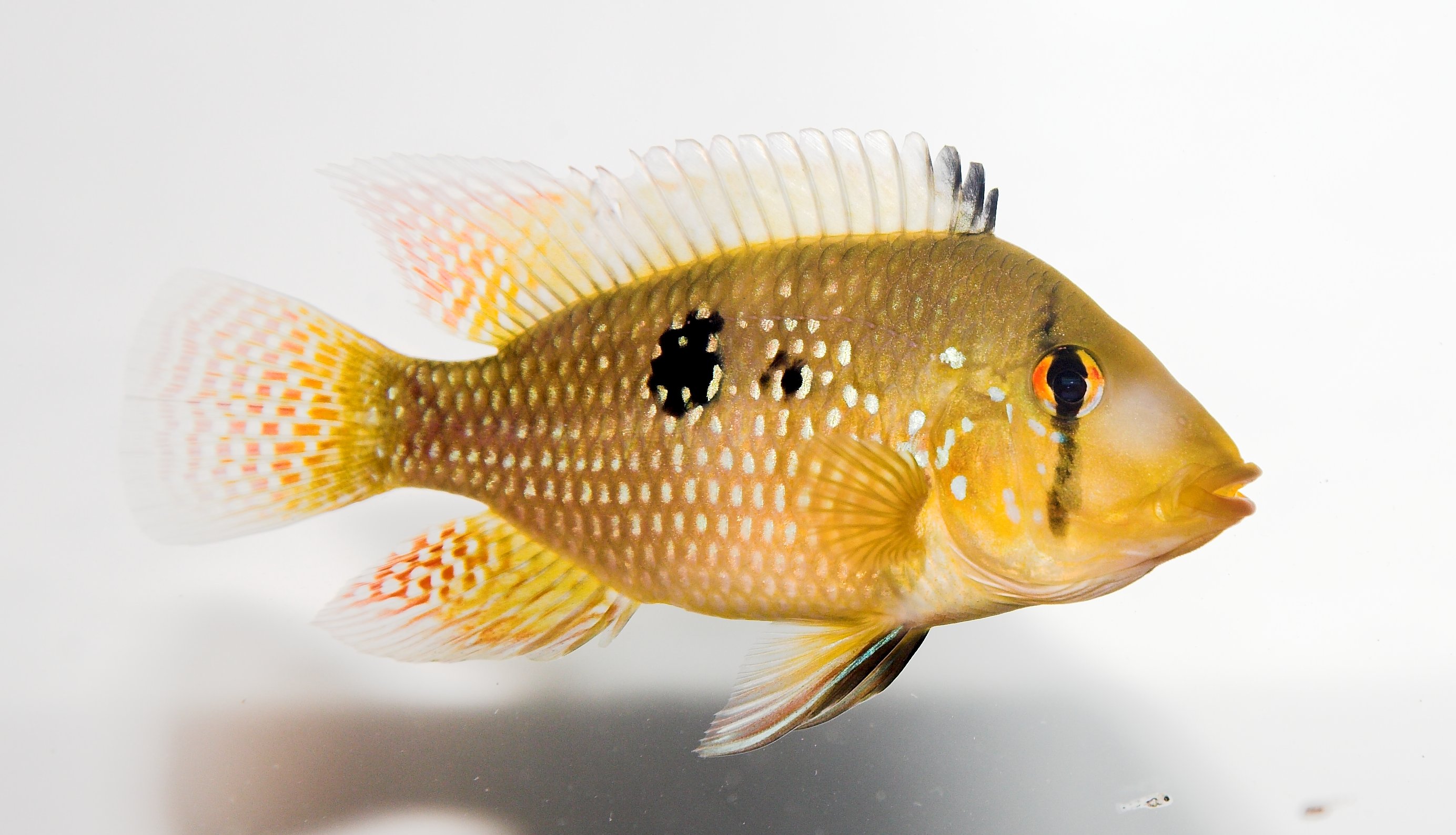
A deep-bodied, laterally compressed fish reaching 20–28 cm. Coloration is variable: resting fish are silvery-green with a bluish sheen; numerous iridescent blue and green scales across the body create the characteristic pearl-like pattern. A dark lateral blotch is clearly visible. During spawning or stress, dark vertical bars appear across the body. Cheeks are bluish with an iridescent sheen. Fins are dark with blue spots.
Care
A tank of 250–300 liters for a pair. Temperature 20–28°C (one of the most cold-tolerant Geophagus). pH 6.0–7.5, hardness 5–15 dGH. Sandy or fine gravel substrate. Driftwood and rocks for shelter and spawning. Strong filtration. Regular 25–30% weekly water changes. Plants will inevitably be uprooted and undermined; use species attached to driftwood (Anubias, ferns).
Feeding
Omnivorous detritivore. Sifts substrate for organic matter, invertebrates, and seeds. In the aquarium it accepts quality mid-sized cichlid pellets, bloodworms, tubifex, brine shrimp, daphnia, blanched peas, and zucchini. Avoid overfeeding with animal protein to prevent obesity. Feed twice daily.
Compatibility
Relatively aggressive for its size. During breeding, both sexes actively defend territory. Compatible with other large, robust South American species: large tetras, loricariids, and mid-sized cichlids. Do not keep with small fish or delicate species. Best kept as a dedicated pair in a species tank.
Breeding
A substrate spawner — the only commonly kept Geophagus with this breeding strategy. The female deposits eggs on a cleaned flat rock or driftwood; both parents guard the clutch and fry. Eggs are large and yellowish, 200–600 per spawn. Larvae hatch in 2–3 days and remain in a pit for 5–7 more days. Free-swimming fry are fed brine shrimp nauplii and finely crushed flakes. Parental instinct is well developed.
Fun facts
One of very few Geophagus that are substrate spawners rather than mouthbrooders. Possesses remarkable ecological plasticity: found in clear rivers, mountain streams, and brackish estuaries. In coastal Brazilian cities it has successfully colonized urban canals and polluted water bodies.