Fish
Croaking Gourami
Trichopsis vittata
Origin: Found across Southeast Asia: Thailand, Vietnam, Cambodia, and Indonesia (Java, Sumatra). Inhabits rice paddies, slow-moving rivers, ponds, and marshy areas with soft to moderately hard water and abundant aquatic vegetation.
Also known as: Striped gourami, Trichopsis vittata
Fact sheet
- Size
- 7 cm
- Lifespan
- 4 years
- Minimum tank size
- 40 L
- Temperature
- 22–28 °C
- pH
- 6–7.5
- Hardness GH
- 5–15 °dH
- Temperament
- Peaceful
- Social behavior
- In pairs
- Swimming zone
- Middle, Top
- Diet
- Carnivore
- Jumps out
- Yes
- Eats plants
- No
Overview
The Croaking Gourami is a small labyrinth fish named for its ability to produce distinctive croaking-squeaking sounds using its pectoral fins — the only gourami genus with well-developed vocal communication. The fish regularly rises to the surface to gulp atmospheric air. A peaceful and undemanding species, well suited to community and planted tanks.
Appearance
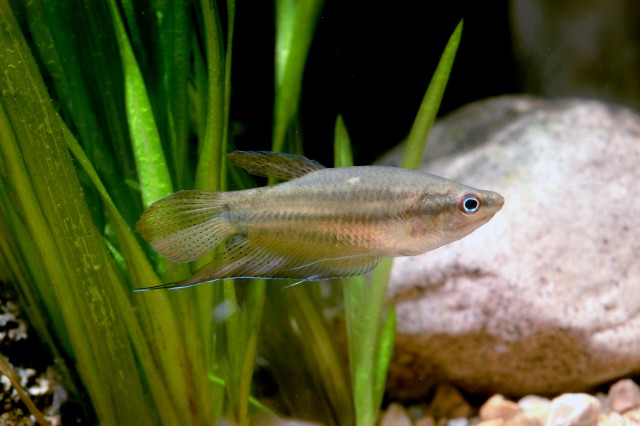
Reaches 6–7 cm. The body is elongated and slightly compressed. Coloration: silvery-beige background with two dark brown horizontal stripes running the length of the body. Eyes are large with a reddish-orange iris. Males are slightly more vibrant than females.
Care
Tank of 40 liters with a tight-fitting lid. Soft to moderately hard water: pH 6.0–7.5, GH 5–15, temperature 22–28 °C. Dense planting, quiet zones, gentle current. Weekly 20–25% water changes.
Feeding
Accepts dry flakes, pellets, live and frozen bloodworms, brine shrimp, tubifex, daphnia. Feed twice daily in small portions.
Compatibility
Peaceful; coexists calmly with other species. Pairs well with tetras, rasboras, small danios, and corydoras. Avoid large, aggressive, or fin-nipping neighbors.
Breeding
Male builds a bubble nest at the water surface. Eggs hatch in 24–36 hours. Fry are free-swimming in 2–3 days; first foods are infusoria and brine shrimp nauplii.
Fun facts
The only gourami that 'talks' — producing sounds via pectoral fins during courtship and male rivalry. The labyrinth organ allows survival in critically oxygen-depleted water.