Fish
Moonlight Gourami
Trichopodus microlepis
Origin: Native to Thailand and Cambodia. Inhabits tropical swamps, slow-moving backwaters, shallow ponds, and reservoirs with abundant vegetation, soft, slightly acidic water, and gentle currents.
Also known as: Moonbeam gourami, silver gourami; syn. Trichopodus microlepis
Fact sheet
- Size
- 15 cm
- Lifespan
- 5 years
- Minimum tank size
- 150 L
- Temperature
- 26–30 °C
- pH
- 6–7.5
- Hardness GH
- 5–12 °dH
- Temperament
- Peaceful
- Social behavior
- In pairs
- Swimming zone
- Middle, Top
- Diet
- Omnivore
- Jumps out
- No
- Eats plants
- No
Overview
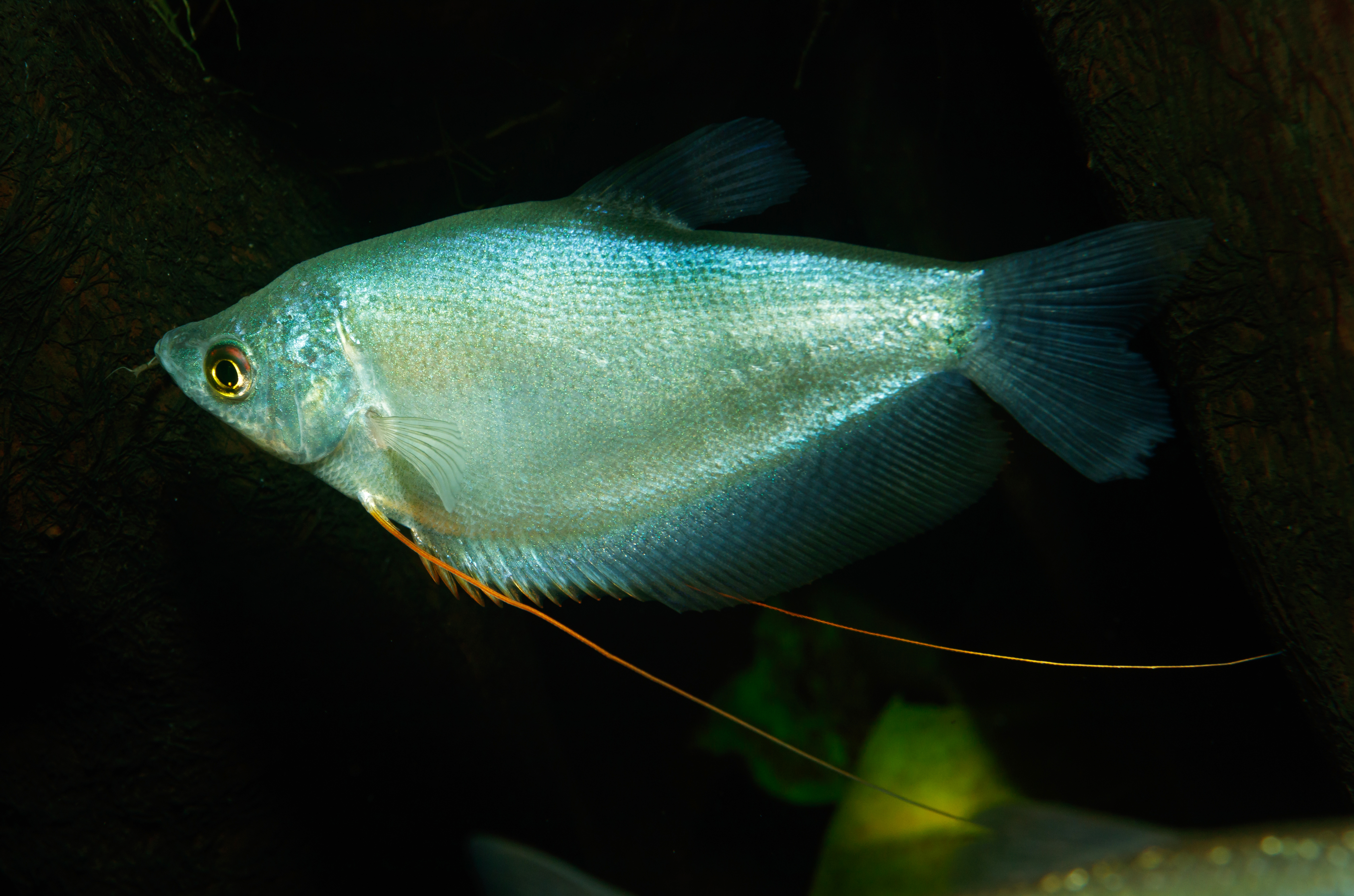
The moonlight gourami is a large and elegant labyrinth fish first described by Günther in 1861. Its scientific name microlepis means 'small-scaled', reflecting a characteristic feature of the species. The fish's silvery body with a pearlescent sheen resembles moonlight reflected on water — hence its common name. It reaches up to 15 cm in length. The moonlight gourami has a calmer and more timid temperament compared to the three-spot gourami, making it well-suited for community aquariums with other large, peaceful fish. The species requires slightly higher temperatures than most gouramis. It prefers calm water with dense vegetation, floating plants, and hiding places. Males become visually striking during the breeding season — they build impressive bubble nests and display vibrant coloration during courtship. The species is appropriate for experienced beginners.
Appearance
The body is large, moderately elongated, and laterally compressed. The scales are very fine, giving the body a uniform silvery-pearlescent surface with a slight greenish iridescence. No dark spots or stripes are present, distinguishing the moonlight gourami from most other gouramis. The ventral fins are thread-like: orange or reddish in males, yellowish or white in females. The male's dorsal fin is pointed and elongated. Fins are semi-transparent. Under proper lighting, the body shimmers like a moonlit surface.
Care
A minimum aquarium volume of 150 liters for a pair. Temperature 26–30 °C, pH 6.0–7.5, GH 5–12. Soft, slightly acidic water is most suitable. Moderate filtration without strong current is required. Floating plants are essential for a species that builds bubble nests. Dark substrate and subdued lighting enhance the silver coloration. Sensitive to water quality — weekly water changes of 20–25% are recommended. A tight-fitting lid is necessary to allow atmospheric air breathing. The fish may startle easily at sudden movements.
Feeding
An omnivore. In the wild feeds on insects, small invertebrates, algae, and plant debris. In the aquarium accepts flake and pellet foods. Live and frozen foods (bloodworm, brine shrimp, daphnia) are welcomed. Vegetable supplements are beneficial. Feed twice daily in small portions. Fish may initially be cautious about unfamiliar foods.
Compatibility
A peaceful species suitable for community aquariums with other large, calm fish. Good tankmates include large tetras, danios, rasboras, swordtails, and barbs. Avoid housing with very small fish that could be swallowed. Males may clash with each other. Do not house with aggressive species. A pair or small group is the ideal arrangement.
Breeding
Spawning is triggered by raising the temperature to 28–30 °C and lowering the water level. The male builds a large bubble nest. After spawning (300–1000 eggs), the female is removed. Eggs incubate for 24–48 hours and larvae begin free-swimming on day 3–5. Feed with infusoria, then baby brine shrimp. Remove the male after fry start swimming freely.
Fun facts
The moonlight gourami has the finest scales of any Trichopodus species — a fact reflected in its species epithet microlepis. It is considered more sensitive to water quality than the three-spot or gold gourami. In the wild, populations are declining due to wetland drainage and habitat loss.