Fish
Marble Gourami
Trichopodus trichopterus var. marble
Origin: A selectively bred colour variety of the three-spot gourami, native to Southeast Asia — Vietnam, Thailand, Malaysia, and Indonesia. The wild form inhabits swamps, rice paddies, and slow-moving rivers.
Also known as: Marble three-spot gourami; syn. Trichopodus trichopterus var. marble
Fact sheet
- Size
- 15 cm
- Lifespan
- 5 years
- Minimum tank size
- 120 L
- Temperature
- 22–28 °C
- pH
- 6–8
- Hardness GH
- 5–20 °dH
- Temperament
- Semi-aggressive
- Social behavior
- Solitary
- Swimming zone
- Middle, Top
- Diet
- Omnivore
- Jumps out
- No
- Eats plants
- No
Overview
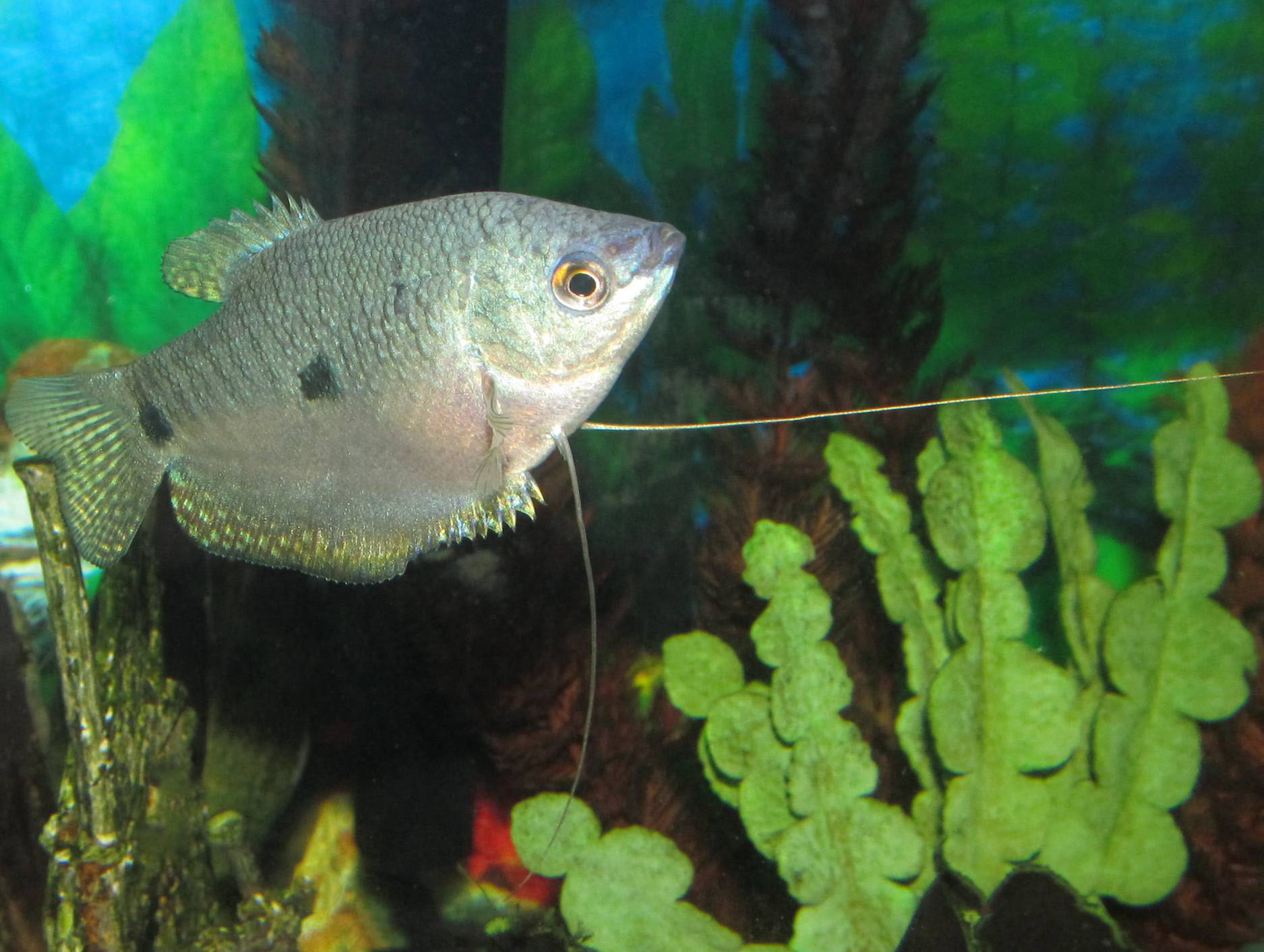
The marble gourami is an aquarium colour form of the three-spot gourami (Trichopodus trichopterus), characterized by an irregular marble-like pattern of dark and light patches on the body and fins. Like the gold form, the marble gourami does not exist in the wild and is a product of aquarium selective breeding. The fish reaches 12–15 cm in length with a stocky build and hardy constitution. The labyrinth organ allows it to breathe atmospheric air. The marble gourami is well-suited for beginners as it adapts to a wide range of water parameters and has no special requirements. Males can show aggression toward other males of the same species and toward fish with similar body shapes, so it is recommended to keep only one male per tank or ensure sufficient space. The pattern of each individual is unique — like a fingerprint.
Appearance
The body is moderately elongated and laterally compressed. The pattern consists of irregular dark gray, black, and white patches on a silvery-white background, creating a marble effect. The three characteristic dark spots (two on the flank, one at the tail base) may be faintly visible against the marbled background. The ventral fins are thread-like and yellowish. The male's dorsal fin is pointed. The pattern is unique to each individual.
Care
Minimum aquarium volume of 120 liters. Temperature 22–28 °C, pH 6.0–8.0, GH 5–20. The fish is hardy and adapts to a wide range of water conditions. Moderate filtration. Floating and rooted plants and hiding spots are beneficial. A tight-fitting lid is essential. Weekly water changes of 20–30%. Avoid strong current. Keep only one male or provide a very large tank. Dark substrate enhances the contrast of the pattern.
Feeding
An omnivore. Accepts flakes, pellets, and live or frozen foods. Particularly fond of bloodworm, brine shrimp, and daphnia. Vegetable supplementation is beneficial. Feed twice daily. The fish feeds readily at the surface and in the mid-water. Avoid overfeeding as the species is prone to obesity.
Compatibility
Males are aggressive toward other males of the same species and toward similarly shaped fish. Suitable tankmates include large tetras, barbs, danios, swordtails, and corydoras. Do not house with small fish, bettas, or other aggressive labyrinth fish. Long-finned fish may suffer from fin-nipping.
Breeding
Spawning follows the same pattern as the three-spot gourami. The male builds a bubble nest. The female is removed after spawning. The male guards the nest. Fry swim freely on day 3–4. First food is infusoria, then baby brine shrimp. Offspring may show various patterns — from marbled to nearly uniform.
Fun facts
Each marble gourami's pattern is unique, like a fingerprint. The marble coloration is an unstable genetic variant, and offspring from one pair may display diverse patterns ranging from highly marbled to almost plain. The species was among the first labyrinth fish imported to Europe in the late 19th century.