Fish
Pygmy Croaking Gourami
Trichopsis pumila
Origin: Southeast Asia: Vietnam, Cambodia, Thailand, and Sumatra (Indonesia). Inhabits shallow swamps, rice paddies, slow streams, and ponds with dense vegetation, soft acidic water, and abundant leaf litter.
Also known as: Dwarf croaking gourami, sparkling gourami; syn. Trichopsis pumila
Fact sheet
- Size
- 4 cm
- Lifespan
- 3 years
- Minimum tank size
- 40 L
- Temperature
- 24–28 °C
- pH
- 5.5–7
- Hardness GH
- 3–10 °dH
- Temperament
- Peaceful
- Social behavior
- Schooling
- Swimming zone
- Middle, Top
- Diet
- Omnivore
- Jumps out
- No
- Eats plants
- No
Overview
The pygmy croaking gourami is one of the smallest members of the family Osphronemidae, reaching only 3–4 cm in length. Its species name pumila derives from the Latin word meaning 'dwarf'. The fish is known for its ability to produce distinct croaking and crackling sounds using specialized muscles and the swim bladder, which gave rise to the common name 'croaking gourami'. These sounds are most noticeable during spawning, when males communicate with each other and with females. Despite its tiny size, the pygmy croaking gourami displays curious and active behavior. It is well-suited for nano aquariums and aquascapes with small, peaceful tankmates. The species is somewhat more demanding of water quality than larger gouramis and prefers soft, slightly acidic water.
Appearance
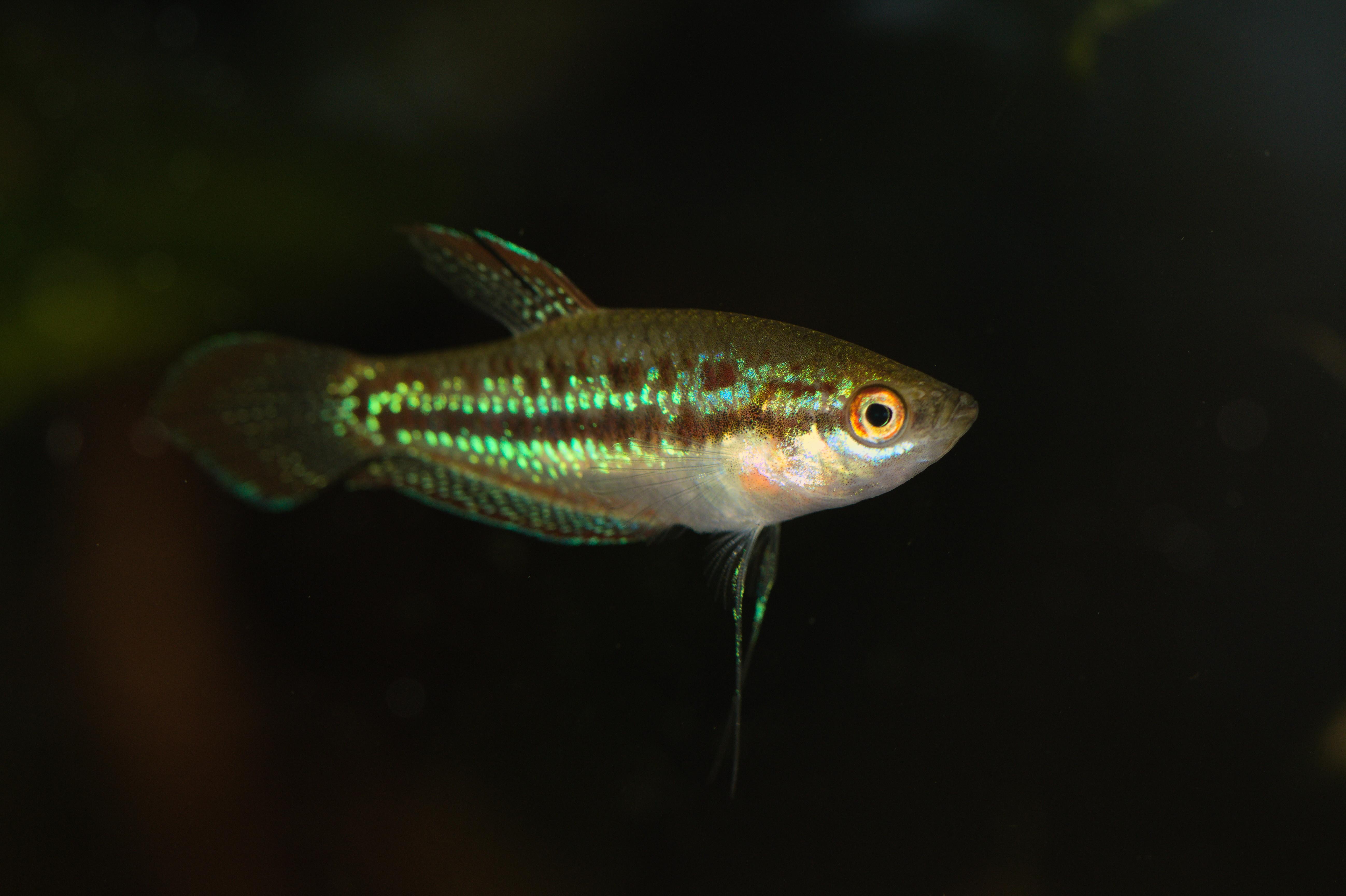
The body is very small, elongated, and laterally compressed. The base color is yellowish-brown or beige with two or three dark horizontal stripes along the body. The fins are decorated with rows of blue, green, or red dots that shimmer under proper lighting. The ventral fins are thread-like. The eyes are large with a reddish iris — a characteristic feature of the species. Males have more pointed dorsal and anal fins. Female coloration is somewhat paler.
Care
A minimum of 30–40 liters for a group. Temperature 24–28 °C, pH 5.5–7.0, GH 3–10. Soft, slightly acidic water closely matching natural conditions is ideal. Dense plant growth, floating plants, and hiding places from leaves and driftwood are essential. Very gentle or no current. Sensitive to nitrates — frequent small water changes are recommended. Ideal for nano aquascapes. A tight-fitting lid is essential.
Feeding
An omnivore with a preference for small live foods. The mouth is very small — all food must be of appropriate size. Prefers baby brine shrimp, cyclops, small daphnia, infusoria, and micro worms. Accepts small flakes and micro pellets. Feed twice daily in small portions. Frozen and live foods maintain optimal fish condition.
Compatibility
A peaceful nano aquarium fish. Excellent tankmates include microrasboras, harlequin rasboras, celestial pearl danios, pygmy corydoras, otocinclus, and small characins. Do not house with large or aggressive fish. Coexists well with shrimp (except very small juveniles that may be eaten). Several males can coexist in a spacious nano tank with ample hiding spots.
Breeding
The male builds a small bubble nest. The pair spawns beneath the nest. Eggs (50–200) are placed into the nest by the male. After spawning the female may be removed. Fry hatch in 24–36 hours. The male guards eggs and larvae. First food is infusoria, then baby brine shrimp. Fry survival improves in a separate breeding tank.
Fun facts
The pygmy croaking gourami is one of the few fish species that produces audible sounds in the aquarium. The croaking sounds are generated by the contraction of specialized muscles around the swim bladder. Despite its tiny size, males actively defend territory during breeding. The species is often overlooked in favor of its larger relatives, despite its remarkable beauty and behavior.