Fish
Chocolate Gourami
Sphaerichthys osphromenoides
Origin: Malay Peninsula, Sumatra, and Borneo (Indonesia and Malaysia). Inhabits peat swamp forests (blackwater), slow dark rivers with extremely soft, ultra-acidic water rich in humic acids.
Also known as: Syn. Sphaerichthys osphromenoides
Fact sheet
- Size
- 6 cm
- Lifespan
- 5 years
- Minimum tank size
- 80 L
- Temperature
- 26–30 °C
- pH
- 4–6.5
- Hardness GH
- 0–5 °dH
- Temperament
- Peaceful
- Social behavior
- Schooling
- Swimming zone
- Middle
- Diet
- Omnivore
- Jumps out
- No
- Eats plants
- No
Overview
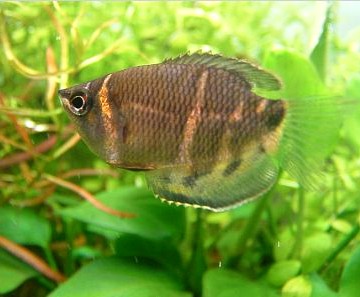
The chocolate gourami is one of the most demanding and specialized aquarium fish in the labyrinth fish family. The species was described by Bleeker in 1852. The brown body with creamy vertical bands inspired its common name. The fish inhabits the unique conditions of peat forest pools in Southeast Asia — so-called 'blackwater' environments that are extremely poor in dissolved minerals, with pH below 5, and stained dark brown by tannins and humic acids from decomposing leaf litter. Replicating these conditions in the aquarium is the key requirement for successful husbandry. The fish reaches 6 cm and lives peacefully, preferring hiding spots in the lower and middle levels of the aquarium. The chocolate gourami is a challenging species recommended exclusively for experienced aquarists capable of maintaining extremely soft, acidic water reliably.
Appearance
The body is small, compact, deep-bodied, and moderately compressed. The base color is dark brown or chocolate brown. Three to five creamy-white or yellowish vertical bars cross the body. The lower edges of fins may have a thin pale margin. Fins are brown and semi-transparent. The ventral fins are thread-like. Males and females are similar in appearance; females are slightly deeper-bodied. Breeding females show a noticeably swollen throat as they mouthbrood the eggs.
Care
One of the most demanding aquarium species. A minimum aquarium volume of 80 liters. Temperature 26–30 °C. Water parameters are critical: pH 4.0–6.0, GH 0–4, KH 0–2. Water must be essentially demineralized, enhanced with Indian almond leaf extract, driftwood, or peat filtration. Do not use untreated hard tap water. Very gentle current. A leaf litter bed (almond or oak leaves) on the substrate. Subdued lighting. Regular 10–15% water changes with prepared water. Not recommended for beginners.
Feeding
A selective feeder. In the wild consumes small invertebrates, insect larvae, and small crustaceans. In the aquarium frequently refuses dry foods. The best foods are live or frozen brine shrimp, cyclops, small bloodworm, and small daphnia. Can be gradually acclimated to freeze-dried foods. Feed twice daily in small portions. Dietary variety is critical to health.
Compatibility
A peaceful fish that should be kept with similarly small, calm inhabitants of a blackwater aquarium. Excellent tankmates include small characins (neon tetras, cardinal tetras), rasboras, and pygmy corydoras. Avoid active and large fish. Shrimp may threaten fry. Ideally keep as a species-only tank or a themed blackwater biotope.
Breeding
A mouthbrooder: the female incubates the fertilized eggs (10–40) in her mouth. Eggs are large; incubation lasts 10–14 days. Released fry are already large enough to accept baby brine shrimp. Breeding is extremely difficult due to the strict water parameter requirements. Successfully spawned only by very experienced aquarists.
Fun facts
The chocolate gourami is a mouthbrooder — one of the few labyrinth fish with this reproductive strategy. The species inhabits water resembling very weak tea in composition. It is sensitive to copper in any concentration. Among hobbyists it is considered one of the most challenging labyrinth fish to keep successfully.