Fish
Garra Rufa
Garra rufa
Origin: Middle East: Turkey (Kangal province and the Sivas river basin), Syria, Iraq, Iran, and Jordan. Inhabits fast-flowing mountain rivers with rocky bottoms and clean, well-oxygenated water.
Also known as: Doctor fish, reddish log sucker, Kangal fish; syn. Garra rufa
Fact sheet
- Size
- 14 cm
- Lifespan
- 7 years
- Minimum tank size
- 100 L
- Temperature
- 15–28 °C
- pH
- 6.5–8
- Hardness GH
- 5–20 °dH
- Temperament
- Peaceful
- Social behavior
- Schooling
- Swimming zone
- Bottom, Middle
- Diet
- Omnivore
- Jumps out
- Yes
- Eats plants
- No
Overview
Garra rufa is a small member of the family Cyprinidae that gained international fame in recent decades as the 'doctor fish' in spa treatments — it nibbles dead skin cells from the skin of humans immersed in tanks. In nature it inhabits mountain rivers of the Middle East, feeding on algae and organic deposits by rasping them from rocks. The species was described by Heckel in 1843. In the aquarium hobby, Garra rufa is kept as an unusual species for specialist or biotope tanks. The fish reaches 14 cm in length, is active, and prefers well-oxygenated water with moderate current. The species is relatively undemanding but requires stable water parameters. In the wild it forms large schools. In the aquarium it is best kept in groups of five or more; lone individuals become timid.
Appearance
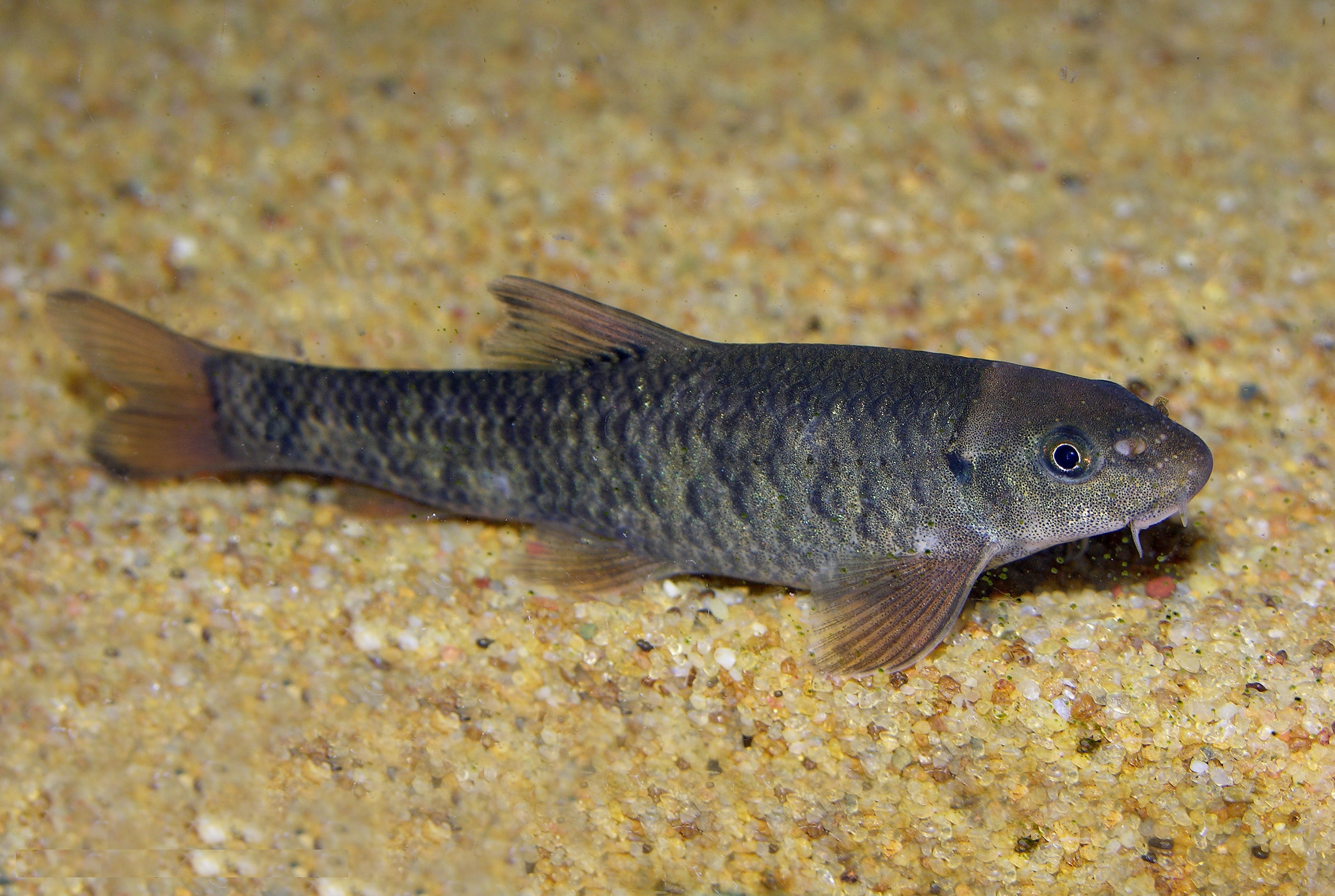
The body is elongated, cylindrical, and covered in fine scales. Coloration is silvery-olive or brownish, with a lighter belly. A dark lateral band may be present. The mouth is inferior with flattened lips — typical of fish that rasp algae from rocks. The lower lip has a rostral cap — a cartilaginous process used for suction. Fins are small and transparent or lightly pigmented. The caudal fin is forked. Some individuals develop tubercles on the head during breeding season.
Care
A minimum aquarium volume of 100 liters for a group. Temperature 15–28 °C, pH 6.5–8.0, GH 5–20. The fish tolerates a wide temperature range, including relatively cool water around 15 °C. Good aeration and moderate to strong current for oxygenation are required. Rocky or gravel substrate. Hiding places (rocks, caves, driftwood). Sensitive to nitrate accumulation. Weekly water changes of 25–30%. The fish may jump — a tight-fitting lid is essential.
Feeding
An omnivore leaning toward herbivory. In the wild feeds on algae, biofilm, and organic detritus scraped from rocks. In the aquarium it consumes algal growth from glass, rocks, and decorations. The core diet should be herbivore-specific foods, spirulina, and blanched vegetables (spinach, zucchini, cucumber). Also accepts flakes and small amounts of live food. Feed 2–3 times daily.
Compatibility
A peaceful schooling fish. Coexists well with danios, other cyprinids, rasboras, small cichlids, and corydoras. Not recommended with very small fish or large predators. Inter-specific aggression is low when kept in groups. Compatible with snails.
Breeding
Rarely spawns in the aquarium. Spawning requires simulation of seasonal conditions. Exact spawning parameters in captivity are poorly documented. Commercial reproduction is achieved with hormonal injections. Eggs are bottom-dwelling and adhesive.
Fun facts
Garra rufa is widely used in cosmetic fish spa salons ('ichthyotherapy'), especially in Turkey, Japan, and China. The procedure is debated from hygienic and animal welfare perspectives. In several countries the use of this fish in spas is banned by sanitary regulations. The species is listed as Vulnerable on the IUCN Red List.