Fish
Red Head Tapajos Geophagus
Geophagus sp. "Red Head Tapajos"
Origin: Brazil, Tapajós River basin, Pará state. Inhabits slow side channels, flooded forests, and shoreline areas with soft, slightly acidic water and a sandy bottom.
Also known as: Redhead geophagus, Red Head Tapajos eartheater; trade name Geophagus sp. "Red Head Tapajos"
Fact sheet
- Size
- 20 cm
- Lifespan
- 10 years
- Minimum tank size
- 200 L
- Temperature
- 26–30 °C
- pH
- 6–7.5
- Hardness GH
- 3–10 °dH
- Temperament
- Semi-aggressive
- Social behavior
- Harem
- Swimming zone
- Bottom, Middle
- Diet
- Omnivore
- Jumps out
- No
- Eats plants
- No
Overview
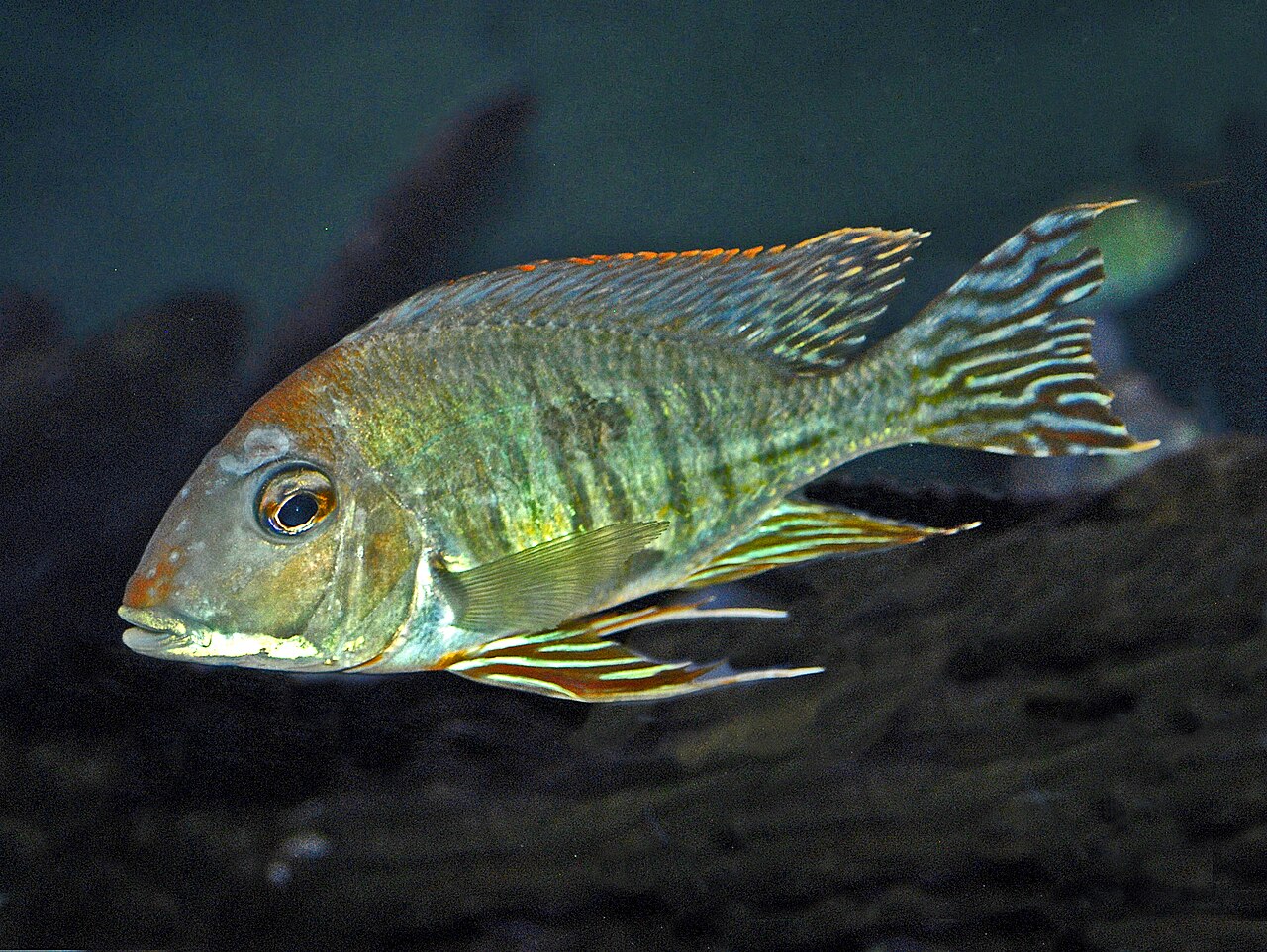
The Red Head Tapajos geophagus is one of the most beautiful and sought-after South American cichlids in the hobby. The species has not been formally described and continues to be sold under its trade name 'Red Head Tapajos'. Its taxonomic status remains under discussion: the fish is related to Geophagus surinamensis but differs morphologically and genetically. Adult individuals develop a spectacular red-orange 'cap' on the head from which the name derives. The body reaches 15–20 cm. Geophagus is a typical sand-sifter: the fish takes mouthfuls of substrate, sifts it for food particles, and expels it through the gill openings. This behavior requires a soft sandy substrate and a deep substrate layer. The fish has a comparatively peaceful temperament for a cichlid, though males become territorial during spawning. Recommended for experienced aquarists owing to size and behavioral requirements.
Appearance
The body is large, deep, laterally compressed, typical of geophagus species. The base coloration is silvery-gray or greenish, with iridescent blue and green scales across the body. The defining feature is a vivid red-orange or scarlet pigmentation on the head, especially pronounced in adult males. Blue, green, and orange spangling adorns the body and fins. The unpaired fins are elongated and display multicolored banding. Males are larger and more brilliantly colored, with more elongated fins. Females are slightly smaller.
Care
A minimum aquarium volume of 200 liters for a pair; 300–400 liters for a group. Temperature 26–30 °C, pH 6.0–7.5, GH 3–10. Soft to moderately hard water. A deep layer (5–10 cm) of fine river sand is essential — the fish constantly sifts the substrate. Powerful filtration is required as the fish produces a heavy bio-load. Weekly water changes of 25–30%. Hiding places of rocks and driftwood. Large plants in pots or with protected roots can be used. Compatible with other peaceful cichlids.
Feeding
An omnivore leaning toward detritivory. Sifts substrate in search of small organisms. In the aquarium accepts cichlid pellets, live and frozen bloodworm, brine shrimp, squid, and tubifex. A vegetable component is important: spirulina, spinach, peas. Dietary variety is necessary for vivid coloration. Feed twice daily. Do not overfeed.
Compatibility
A relatively peaceful cichlid. Excellent tankmates include other peaceful geophagus species, large peaceful tetras, plecos, ancistrus, and mid-sized characins. Avoid very small fish that may be swallowed. Several males can coexist given sufficient space. Do not house with aggressive cichlids.
Breeding
Red Head Tapajos is a biparental mouthbrooder: the female deposits eggs on the substrate, then both parents collect the fertilized eggs into their mouths and incubate them for 10–14 days. Released fry are large and, when threatened, return to the parents' mouths for protection for several weeks afterward. Spawning in the aquarium is very achievable under good conditions.
Fun facts
The Red Head Tapajos geophagus belongs to the group of 'eartheater' cichlids: the name Geophagus translates as 'earth eater'. The fish can sift several liters of substrate per day. The red 'cap' develops only in adult individuals — juveniles lack it entirely. The species has not been formally described by science and is sold exclusively under a trade name.