Fish
Malabar Danio
Devario malabaricus
Origin: The Malabar danio comes from southern India and Sri Lanka, where it lives in clear, fast-flowing streams and rivers with rocky beds and well-oxygenated water. It occurs in the foothills of the Malabar Coast, which gives the species its name.
Also known as: Devario malabaricus, Malabar Devario
Fact sheet
- Size
- 11 cm
- Lifespan
- 5 years
- Minimum tank size
- 120 L
- Temperature
- 22–26 °C
- pH
- 6.5–7.5
- Hardness GH
- 5–15 °dH
- Temperament
- Peaceful
- Social behavior
- Schooling
- Group size
- 6+ individuals
- Swimming zone
- Middle, Top
- Diet
- Omnivore
- Jumps out
- Yes
- Eats plants
- No
Overview
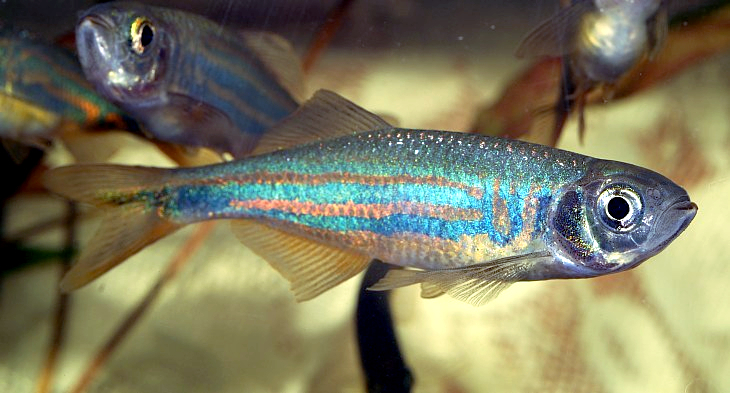
The Malabar danio is a large, fast, and hardy schooling fish, among the most active of the danios. Its silvery-blue colour with longitudinal stripes and its easy care have long made it an aquarium favourite. It is a powerful swimmer that needs room, so keep a group of at least 6 in a long tank. Its size and energy suit it to medium and larger peaceful companions. It adapts readily to varied water but prefers clean, oxygen-rich water with current.
Appearance
The body is elongated and moderately deep, reaching 10–12 cm. The base colour is silvery-blue with a greenish sheen; blue and golden longitudinal stripes run along the body, brightest toward the rear. Fins are translucent with a faint yellow tint. Males are slimmer and more colourful; females are larger and fuller. Small barbels sit by the mouth.
Care
A long tank of at least 120 L with open swimming space and a tight lid is needed. Temperature 22–26 °C, pH 6.5–7.5, hardness GH 5–15. Strong filtration with current, aeration, and 25–30% weekly water changes are essential. Plant the sides and back, leaving the centre open.
Feeding
A hearty omnivore. It accepts flakes, pellets, and live or frozen foods — bloodworm, daphnia, brine shrimp, and glassworm. In nature it actively hunts insects at the surface. Occasional vegetable foods are beneficial. Feed once or twice daily.
Compatibility
Peaceful but very active. It mixes well with medium active species — barbs, rainbowfish, larger rasboras, peaceful cichlids, and catfish. It may harass small or slow tankmates. Always keep a shoal of at least 6, or it becomes nervous.
Breeding
Breeding is straightforward with space. Place a pair or group in a spawning tank with soft water and a protective mesh over the bottom. Eggs are scattered among plants and over the substrate; remove the adults after spawning. Fry hatch in 2–3 days; first foods are infusoria and brine shrimp nauplii.
Fun facts
The species name malabaricus refers to India's Malabar Coast. The Malabar danio is one of the largest members of the danio group. It makes powerful dashes and jumps easily from an open tank.