Fish
Dwarf Halfbeak
Dermogenys pusilla
Origin: The dwarf halfbeak lives across Southeast Asia — Thailand, Malaysia, Indonesia, and neighbouring areas. It occupies the surface layers of slow rivers, canals, rice paddies, and brackish estuaries. It tolerates both fresh and slightly salty water well.
Also known as: Wrestling halfbeak, Dermogenys pusilla
Fact sheet
- Size
- 7 cm
- Lifespan
- 3 years
- Minimum tank size
- 60 L
- Temperature
- 24–28 °C
- pH
- 7–8
- Hardness GH
- 10–20 °dH
- Temperament
- Semi-aggressive
- Social behavior
- Harem
- Group size
- 5+ individuals
- Swimming zone
- Top
- Diet
- Carnivore
- Jumps out
- Yes
- Eats plants
- No
Overview
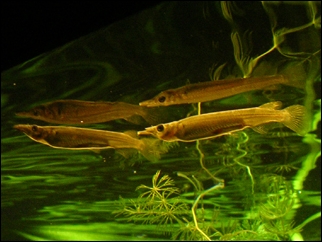
The dwarf halfbeak is an unusual livebearer with a greatly elongated lower jaw resembling a beak. It stays right at the surface, picking off fallen insects. Males are territorial and perform striking 'wrestling' bouts, locking jaws together — hence the name wrestling halfbeak. It is not the easiest fish to keep: it is sensitive to water quality and needs stable parameters. Keep it in a group with more females in a tank with an open surface and floating plants.
Appearance
The body is thin and elongated, 5–7 cm (females larger than males). Colour is silvery-greenish, darker on the back and pale below. The key feature is the elongated, fixed lower jaw against a short upper jaw. In males the beak tip and the anal fin (gonopodium) are often tinged red or orange. The fins are small and set well back on the body.
Care
A tank of at least 60 L with a large surface area, low water level, and a tight lid, as the fish are skittish and jump. Temperature 24–28 °C, pH 7.0–8.0, hardness GH 10–20; a little added salt is beneficial. It needs gentle flow, floating plants for cover, and stable parameters with regular changes.
Feeding
A largely insectivorous species. It feeds only at the surface, preferring live or frozen fruit flies, bloodworm, daphnia, small insects, and brine shrimp nauplii. It takes dry food reluctantly. Feed small portions once or twice daily.
Compatibility
Peaceful toward other species, but males squabble among themselves. Keep one male with several females, or a roomy group. Companions can be calm midwater fish that do not compete for the surface. Avoid active or large fish that frighten the halfbeaks.
Breeding
A livebearer. The female gestates fry for 4–8 weeks and delivers 10–30 relatively large young. Keep the gravid female in a calm tank heavily planted with floating plants. Fry stay at the surface from birth and accept brine shrimp nauplii and small fruit flies.
Fun facts
The jaw-locking of males is a genuine territorial contest that earns the species its 'wrestling halfbeak' name. The lower jaw grows throughout life. The species thrives equally in fresh and brackish water.