Fish
Sixbar Distichodus
Distichodus sexfasciatus
Origin: The sixbar distichodus comes from Central Africa — the Congo River basin and Lake Tanganyika. It inhabits large rivers and shoreline zones with driftwood and vegetation. It is a large fish of African waters that grows to a substantial size.
Also known as: Sixbar distichodus, Six-banded distichodus, Distichodus sexfasciatus
Fact sheet
- Size
- 40 cm
- Lifespan
- 10 years
- Minimum tank size
- 540 L
- Temperature
- 22–26 °C
- pH
- 6–7.5
- Hardness GH
- 5–20 °dH
- Temperament
- Semi-aggressive
- Social behavior
- Solitary
- Swimming zone
- Middle, Bottom
- Diet
- Herbivore
- Jumps out
- No
- Eats plants
- Yes
Overview
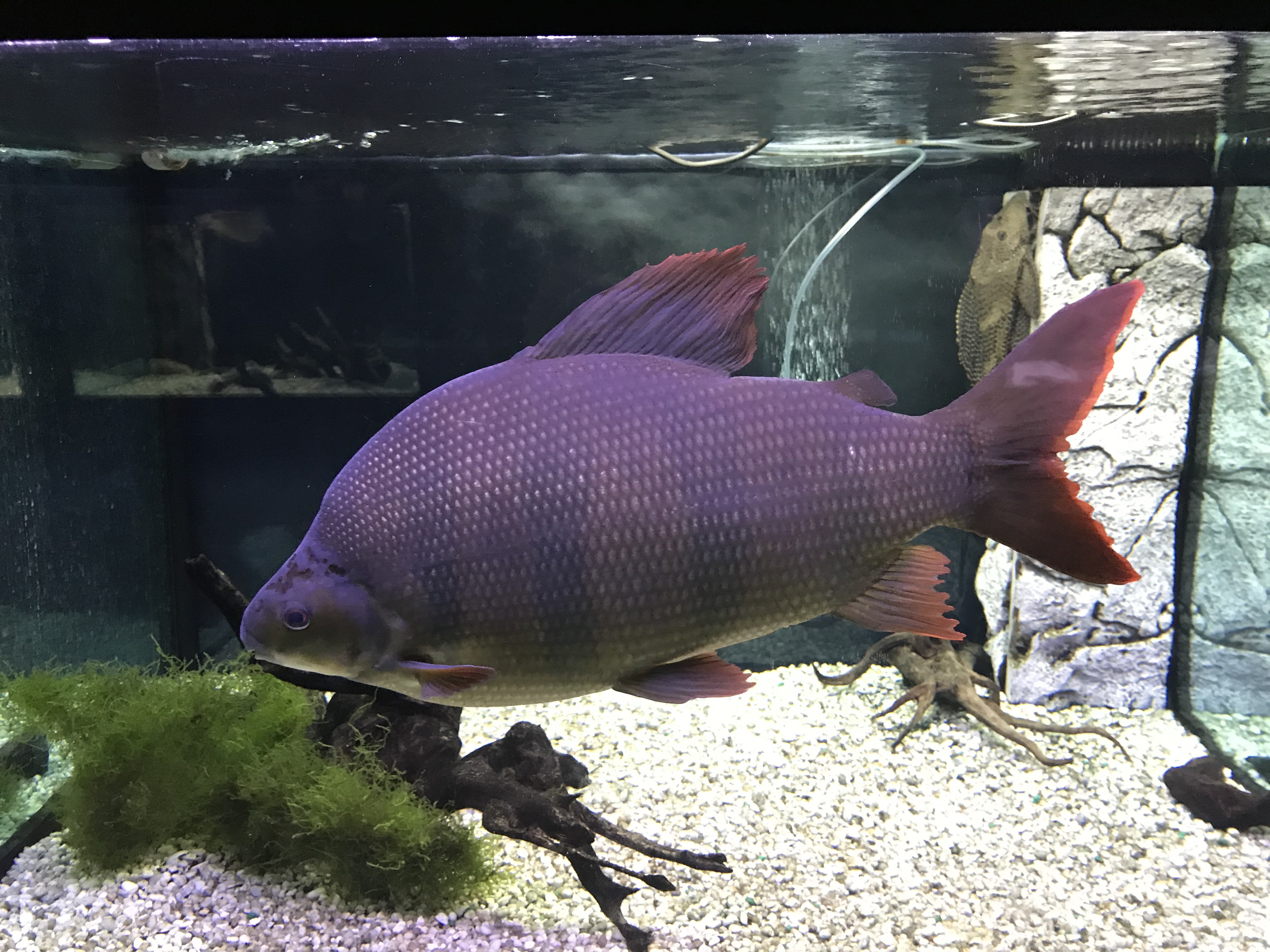
The sixbar distichodus is a large, colourful African fish that is often underestimated as a juvenile. Young fish are strikingly orange-red with black vertical bars, but with age the fish darkens, grows to 40 cm, and becomes territorial. It is a committed vegetarian that grazes on live plants, so it is unsuited to a planted tank. An adult needs a very large aquarium with a hardscape of rocks and driftwood. It suits only experienced keepers able to provide space and powerful filtration.
Appearance
The body is deep and disc-shaped, laterally compressed, up to 40 cm in adults. Juveniles are bright orange-red with six black vertical bars and red fins. With age the base darkens to brownish-olive and the bars fade. The head is small with a small mouth adapted for rasping vegetation. Sexual dimorphism is weak.
Care
An adult needs a tank of at least 500–540 L with a base of at least 150×60 cm. Temperature 22–26 °C, pH 6.0–7.5, hardness GH 5–20. Powerful filtration, strong aeration, and large regular water changes are needed, as the species is sensitive to nitrite. Decorate with large smooth rocks and driftwood; live plants will be eaten.
Feeding
A largely herbivorous species. The diet is based on vegetable flakes and sinking pellets plus blanched courgette, spinach, lettuce, and spirulina. Supplement with frozen bloodworm and brine shrimp. Excess animal protein is harmful. Feed once or twice daily.
Compatibility
Territorial and quarrelsome with age, poorly suited to a community tank. Juveniles can live with large robust tankmates, but an adult is often kept alone. Do not combine with small or slow fish. A group of adults is feasible only in a very large volume.
Breeding
It very rarely breeds in captivity, hindered by its large size and territoriality. Reliable accounts of home breeding are almost nonexistent; in nature spawning falls in the rainy season. For the hobby aquarium breeding is essentially unattainable.
Fun facts
The contrast between the bright juvenile and the drab adult is the classic reason people buy the distichodus unaware of its eventual size. The small mouth is perfectly adapted for rasping algae and plants. The species can live more than 10 years.