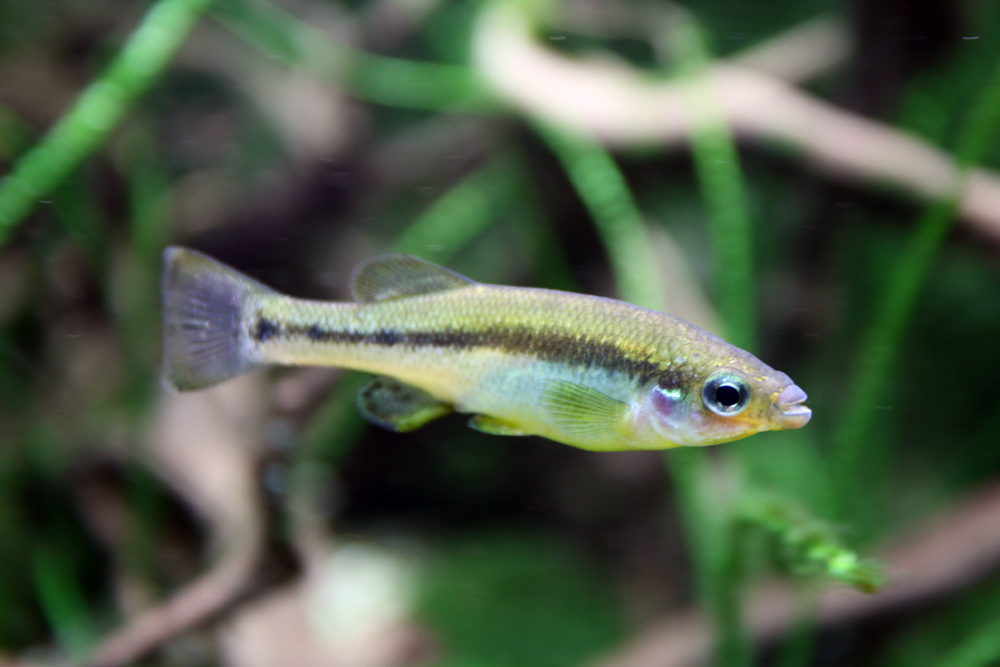
Fish
Xantus' Splitfin
Ilyodon xantusi
Origin: Xantus' splitfin comes from central Mexico, on the Pacific slope of the states of Colima and Jalisco. It inhabits flowing rivers and streams with clean, cool, well-oxygenated water. The species is named after the naturalist János Xántus, who first collected these fish.
Also known as: Xantus' splitfin, Ilyodon xantusi, Ilyodon furcidens
Fact sheet
- Size
- 9 cm
- Lifespan
- 4 years
- Minimum tank size
- 100 L
- Temperature
- 20–26 °C
- pH
- 7–8
- Hardness GH
- 10–20 °dH
- Temperament
- Semi-aggressive
- Social behavior
- Schooling
- Group size
- 6+ individuals
- Swimming zone
- Middle
- Diet
- Omnivore
- Jumps out
- Yes
- Eats plants
- No
Overview
Xantus' splitfin is a livebearer of the family Goodeidae, less known than guppies and mollies but interesting for its origin and behaviour. It is an active, hardy temperate fish that needs cool, flowing, oxygen-rich water. Unlike poeciliids, female goodeids do not store sperm, so each brood requires a new mating. The species is relatively peaceful, but males are active and may chase females, so keep a group with more females. It is a good fish for a species or coolwater aquarium.
Appearance
The body is elongated and sturdy, up to 8–9 cm (females larger than males). Colour is silvery-olive with a bluish sheen and a dark longitudinal stripe; in males the fins and tail often carry a yellow edge and brighter colour. As in all goodeids, the front rays of the male's anal fin are slightly separated (an andropodium) rather than fused into a gonopodium. Sexual dimorphism shows in size and brightness.
Care
A tank of at least 100 L with open space and moderate current. Temperature 20–26 °C (no warmer than 26 °C in summer, with a cooler period beneficial in winter) — the fish likes cool water; pH 7.0–8.0, hardness GH 10–20. Strong aeration, good filtration, and frequent water changes are needed (the species is sensitive to water quality). Plants and driftwood give cover to females.
Feeding
An omnivore leaning vegetarian — in nature it feeds mainly on algae. In the aquarium offer vegetable flakes and spirulina pellets, blanched vegetables, and live or frozen food in moderation. Excess fatty animal food is harmful. Feed once or twice daily.
Compatibility
Relatively peaceful but active. It mixes well with other goodeids, rainbowfish, and other lovers of cool flowing water. Males may court females persistently, so keep a group with more females. Avoid slow-moving or long-finned species.
Breeding
A livebearer. The female gestates fry for 6–8 weeks and delivers 10–40 large young that are born with remnants of feeding structures (trophotaenia). Females do not store sperm — each brood needs a new mating. The fry are large and take vegetable foods and brine shrimp nauplii at once.
Fun facts
The goodeids, to which Ilyodon belongs, are livebearers that evolved independently of the poeciliids. Embryos feed through special outgrowths — trophotaeniae, a kind of umbilical structure. Many goodeids, including Ilyodon, are endangered in the wild, and aquarists help conserve their gene pool.