Fish
Mudskipper
Periophthalmus barbarus
Origin: Mudskippers inhabit the intertidal zones, mangrove forests, and mudflats of tropical Africa, Asia, and Australia. They live at the water's edge in the brackish water of estuaries, spending much of their time out of the water.
Also known as: Mudskipper, Periophthalmus
Fact sheet
- Size
- 15 cm
- Lifespan
- 5 years
- Minimum tank size
- 100 L
- Temperature
- 25–30 °C
- pH
- 7.5–8.5
- Hardness GH
- 10–25 °dH
- Temperament
- Semi-aggressive
- Social behavior
- Schooling
- Group size
- 3+ individuals
- Swimming zone
- Bottom
- Diet
- Carnivore
- Jumps out
- Yes
- Eats plants
- No
Overview
The mudskipper is an extraordinary amphibious fish that spends most of its time on land, moving over mud and rocks on muscular pectoral fins. It breathes through its skin and mouth lining while holding a store of water in its gill chambers, and its large bulging eyes give nearly all-round vision. It needs not an ordinary aquarium but a paludarium (aqua-terrarium) with land areas, shallow brackish water, and high humidity. It is a territorial but utterly fascinating fish to watch. Its care requires specific set-up and suits dedicated aquarists.
Appearance
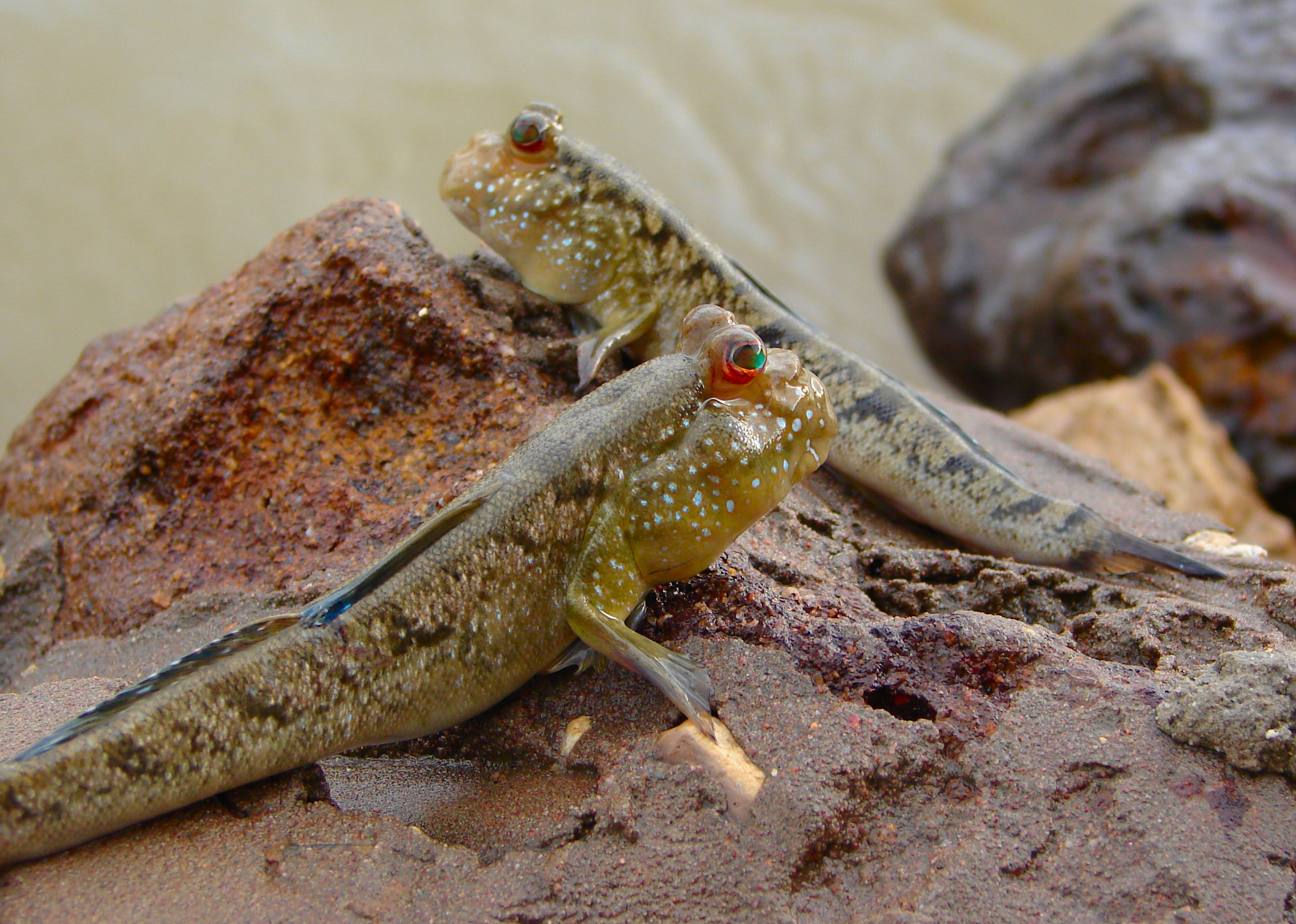
The body is elongated, brown-grey with dark flecks and spots, 10–15 cm depending on species. The eyes are large and bulging, set on top of the head and able to move independently. The pectoral fins are strong, positioned like 'legs' for moving on land. The dorsal fins are often tall and brightly coloured, raised by males in display.
Care
A paludarium is needed with ample land areas (driftwood, rocks, gentle banks) and shallow brackish water (salt 5–20 ‰). Water and air temperature 25–30 °C, high humidity, pH 7.5–8.5, hardness GH 10–25. A tight, warm lid is essential: skippers climb out and are sensitive to dry, cold air. Provide filtration and regular changes of salted water.
Feeding
An insectivorous predator. It takes live and frozen foods — crickets, mealworms, earthworms, bloodworm, small shrimp, and pieces of fish and crab meat. It often takes food more readily on land than in the water. Feed small portions every other day.
Compatibility
Territorial toward its own kind, especially males. Keep a group in a spacious paludarium with several land areas to reduce clashes. It is incompatible with ordinary fish because of its amphibious lifestyle and brackish water. A species paludarium is best.
Breeding
Breeding in captivity is difficult and rare. Males dig burrows in the mud where the female lays eggs; the male guards the clutch in an air chamber of the burrow. Breeding requires deep muddy substrate and an accurate imitation of the tidal cycle, hard to achieve at home.
Fun facts
Mudskippers can 'walk' and even hop across land, pushing off with tail and pectoral fins. They breathe through the skin and the lining of the mouth and throat, carrying a water reserve in their gills. The large eyes retract periodically to moisten, substituting for the absent eyelids.