Fish
Rusty Cichlid
Iodotropheus sprengerae
Origin: Iodotropheus is endemic to Lake Malawi in East Africa. It belongs to the mbuna group — rock-dwelling cichlids of the lake's rocky shoreline zones with hard, alkaline, mineral-rich water and abundant cover among the stones.
Also known as: Rusty cichlid, Lavender mbuna, Iodotropheus sprengerae
Fact sheet
- Size
- 10 cm
- Lifespan
- 8 years
- Minimum tank size
- 150 L
- Temperature
- 24–28 °C
- pH
- 7.6–8.6
- Hardness GH
- 10–25 °dH
- Temperament
- Semi-aggressive
- Social behavior
- Harem
- Group size
- 4+ individuals
- Swimming zone
- Middle, Bottom
- Diet
- Omnivore
- Jumps out
- Yes
- Eats plants
- Yes
Overview
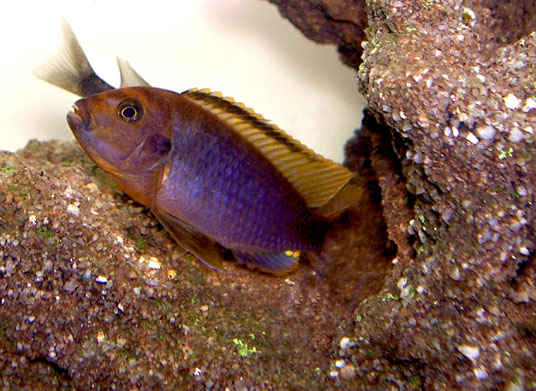
The rusty cichlid is one of the most peaceful and hardy mbuna of Lake Malawi, making it a good choice for getting started with African cichlids. Colour ranges from lavender-brown to rusty-purple with a metallic sheen that intensifies in dominant males. It is an active, territorial fish that needs hard alkaline water and a rocky layout with plenty of hiding places. Compared with other mbuna it is less aggressive, but it is still best kept in a group with more females. It mouthbroods its eggs, showing care for its young.
Appearance
The body is typical mbuna — elongated and sturdy, 8–10 cm long. Colour runs from lavender-brown to rusty-purple with small glittering scales; dominant males are brighter and darker with a stronger purple sheen. The male's anal fin carries egg-spot releasers. Sexual dimorphism is weak, which makes sexing difficult.
Care
A tank of at least 150 L with a rocky layout forming caves and hiding places, over firm substrate. Temperature 24–28 °C, pH 7.6–8.6, hardness GH 10–25 — hard and alkaline water. Strong filtration, good aeration, and 25–30% weekly water changes are needed. Malawi cichlids often dig up and graze plants, so choose tough-leaved species.
Feeding
An omnivore leaning vegetarian. The diet is based on quality Malawi-cichlid flakes and pellets with spirulina, blanched vegetables, and algae wafers. Offer frozen brine shrimp and bloodworm in moderation. Excess fatty protein causes bloat ('Malawi bloat'). Feed small portions once or twice daily.
Compatibility
One of the most peaceable mbuna, but still territorial. It mixes well with other moderately aggressive Malawi cichlids of similar size. Keep a group with more females (one male to 2–3 females) to spread the male's attention. Do not combine with small or timid fish.
Breeding
The female is a mouthbrooder. After spawning on a rock or in a cave she takes the fertilised eggs into her mouth and incubates them for 3–4 weeks without feeding. She then releases fully formed fry, which dart back into her mouth when threatened. Breeding is easy with correct water parameters.
Fun facts
The name 'rusty cichlid' comes from its characteristic rusty-purple tone. Iodotropheus is one of the best mbuna for beginners thanks to its relatively calm temperament. Like all Malawians it is sensitive to soft acidic water — it needs hard and alkaline conditions.