Fish
Reedfish
Erpetoichthys calabaricus
Origin: The reedfish comes from West and Central Africa — slow rivers, swamps, and estuaries from Nigeria to the Congo basin. It lives in warm, soft, organic-rich water with dense vegetation and gentle flow, often in slightly brackish stretches.
Also known as: Ropefish, Snake fish, Erpetoichthys calabaricus
Fact sheet
- Size
- 40 cm
- Lifespan
- 15 years
- Minimum tank size
- 200 L
- Temperature
- 22–28 °C
- pH
- 6–7.5
- Hardness GH
- 5–20 °dH
- Temperament
- Semi-aggressive
- Social behavior
- Solitary
- Swimming zone
- Bottom
- Diet
- Carnivore
- Jumps out
- Yes
- Eats plants
- No
Overview
The reedfish is an ancient bichir-relative with a snake-like body, resembling an eel or a small serpent. It is a nocturnal scavenging predator that breathes atmospheric air with primitive lungs and can spend short periods out of water. It is peaceful toward fish too large to swallow but treats small tankmates as food. Famous as an escape artist, it squeezes through any gap, so the tank must be sealed tight. A calm, long-lived, and highly unusual pet for a spacious aquarium.
Appearance
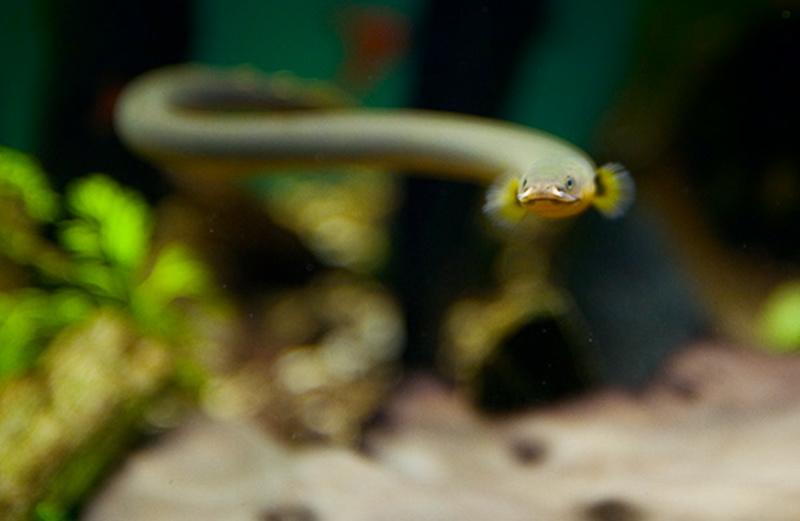
The body is strongly elongated and snake-like, up to 37–40 cm long, covered in tough ganoid scales. Colour is olive-green or brownish above, paler below. The dorsal fin is a row of separate small spines, and pelvic fins are absent. The head is small with tubular nostrils and tiny eyes; it navigates mainly by smell.
Care
A tank of at least 200 L with a large floor area, soft substrate, cover of driftwood, pipes, and plants, and ABSOLUTELY a tight, gap-free lid. Temperature 22–28 °C, pH 6.0–7.5, hardness GH 5–20. It needs free air space above the water for breathing, good filtration, and calm flow.
Feeding
A nocturnal predator. It takes live and frozen foods — earthworms, bloodworm, shrimp, and pieces of fish and mussel. It eats slowly, guided by smell, so it is easily underfed among fast fish. Feed in the evening after lights-out, 3–4 times a week.
Compatibility
Peaceful toward fish it cannot swallow. It mixes well with large calm species — big tetras, rainbowfish, cichlids, and large barbs. It eats small fish and shrimp. Several reedfish can be kept together — they often intertwine in cover.
Breeding
It breeds very rarely and with difficulty in captivity. In nature spawning is triggered by the rainy season and eggs are laid among plants. Reliable home-breeding methods are almost nonexistent, and most fish in trade are wild-caught.
Fun facts
The reedfish is one of the few living bichirs, an ancient group of ray-finned fish. Its lungs let it breathe air, survive low oxygen, and move over land in damp conditions. This is exactly why it readily escapes an uncovered tank.