Fish
Prussian Carp
Carassius gibelio
Origin: The Prussian carp is widespread across Eurasia — from Eastern Europe to Siberia and the Far East, and acclimatised almost everywhere. It inhabits still and slow-flowing waters — ponds, lakes, oxbows — with soft silty bottoms and plant thickets.
Also known as: Gibel carp, Silver Prussian carp, Carassius gibelio
Fact sheet
- Size
- 35 cm
- Lifespan
- 12 years
- Minimum tank size
- 200 L
- Temperature
- 4–28 °C
- pH
- 6.5–8
- Hardness GH
- 8–25 °dH
- Temperament
- Peaceful
- Social behavior
- Schooling
- Group size
- 4+ individuals
- Swimming zone
- Middle, Bottom
- Diet
- Omnivore
- Jumps out
- No
- Eats plants
- Yes
Overview
The Prussian carp is an exceptionally hardy coldwater fish, the direct wild ancestor of the goldfish. It is an undemanding omnivore that tolerates low oxygen, a wide temperature range, and pollution lethal to most fish. It is rarely kept in aquaria because of its size, but it is interesting as the forebear of ornamental breeds and as an example of resilience. It suits ponds and spacious coldwater aquariums.
Appearance
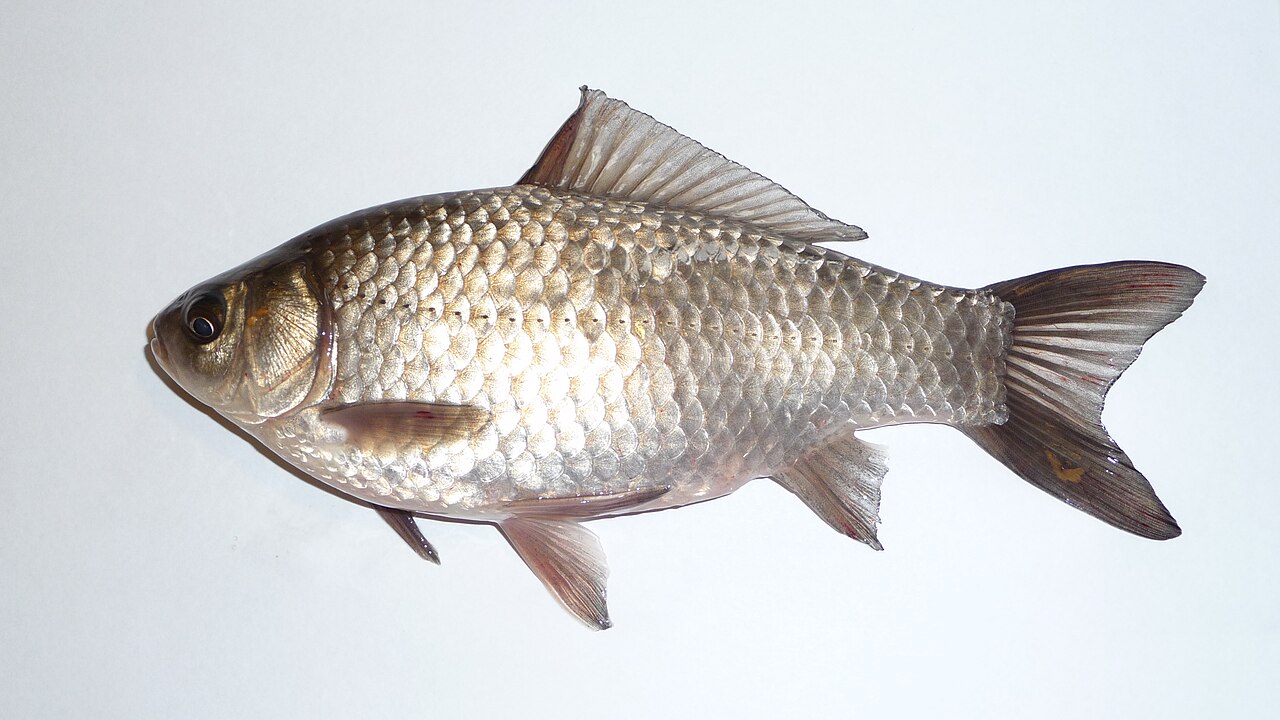
The body is deep and laterally compressed, usually 20–35 cm long (larger in ponds). Colour is silvery-grey with a greenish or bronze sheen on the back. The scales are large and the fins greyish. Unlike the crucian carp the body is deeper and more silvery. Sexual dimorphism is weak.
Care
A pond or tank of at least 200 L with powerful filtration and aeration. Temperature 4–28 °C (a coldwater species, optimum 15–24 °C), pH 6.5–8.0, hardness GH 8–25. It is very hardy but at high density needs clean water and regular changes. It digs the substrate and nibbles plants.
Feeding
An omnivore with an excellent appetite. It eats plant and animal food — pellets, live or frozen bloodworm, tubifex, plants, and detritus. It is prone to overeating and obesity, so feed moderately once or twice daily.
Compatibility
A peaceful but large and digging species. In a pond it mixes with goldfish, koi, and other coldwater fish. Small warm-water fish cannot be housed with it because of the temperature and size difference. Keep in a group.
Breeding
Spawning is in spring and summer as the water warms. The sticky eggs are scattered over plants. It is famous for gynogenesis: in many populations females dominate, and their eggs can develop under the influence of other cyprinids' sperm without genome fusion. It is prolific and quickly colonises waters.
Fun facts
The Prussian carp is the wild ancestor of all goldfish breeds, domesticated in China over a thousand years ago. Its capacity for gynogenesis lets all-female populations reproduce using the sperm of other species. It is one of Eurasia's most resilient freshwater fish.