Fish
Walking Catfish
Clarias batrachus
Origin: The walking catfish comes from Southeast Asia, has been widely spread by humans, and is invasive in places. It inhabits slow rivers, swamps, ditches, rice paddies, and drying pools with oxygen-poor water where other fish die.
Also known as: Clariid catfish, Magur, Clarias batrachus
Fact sheet
- Size
- 50 cm
- Lifespan
- 10 years
- Minimum tank size
- 400 L
- Temperature
- 20–26 °C
- pH
- 6–8
- Hardness GH
- 5–25 °dH
- Temperament
- Predator
- Social behavior
- Solitary
- Swimming zone
- Bottom
- Diet
- Carnivore
- Jumps out
- Yes
- Eats plants
- No
Overview
The walking catfish is a large, extremely hardy predatory catfish with a suprabranchial breathing organ that lets it breathe atmospheric air. It is famous for crawling out of water and 'walking' over land on its pectoral fins to move between water bodies. It is a voracious nocturnal predator that grows fast and needs a large tank kept alone. It suits only experienced keepers; many countries restrict the import and keeping of clariids by law because of their invasiveness.
Appearance
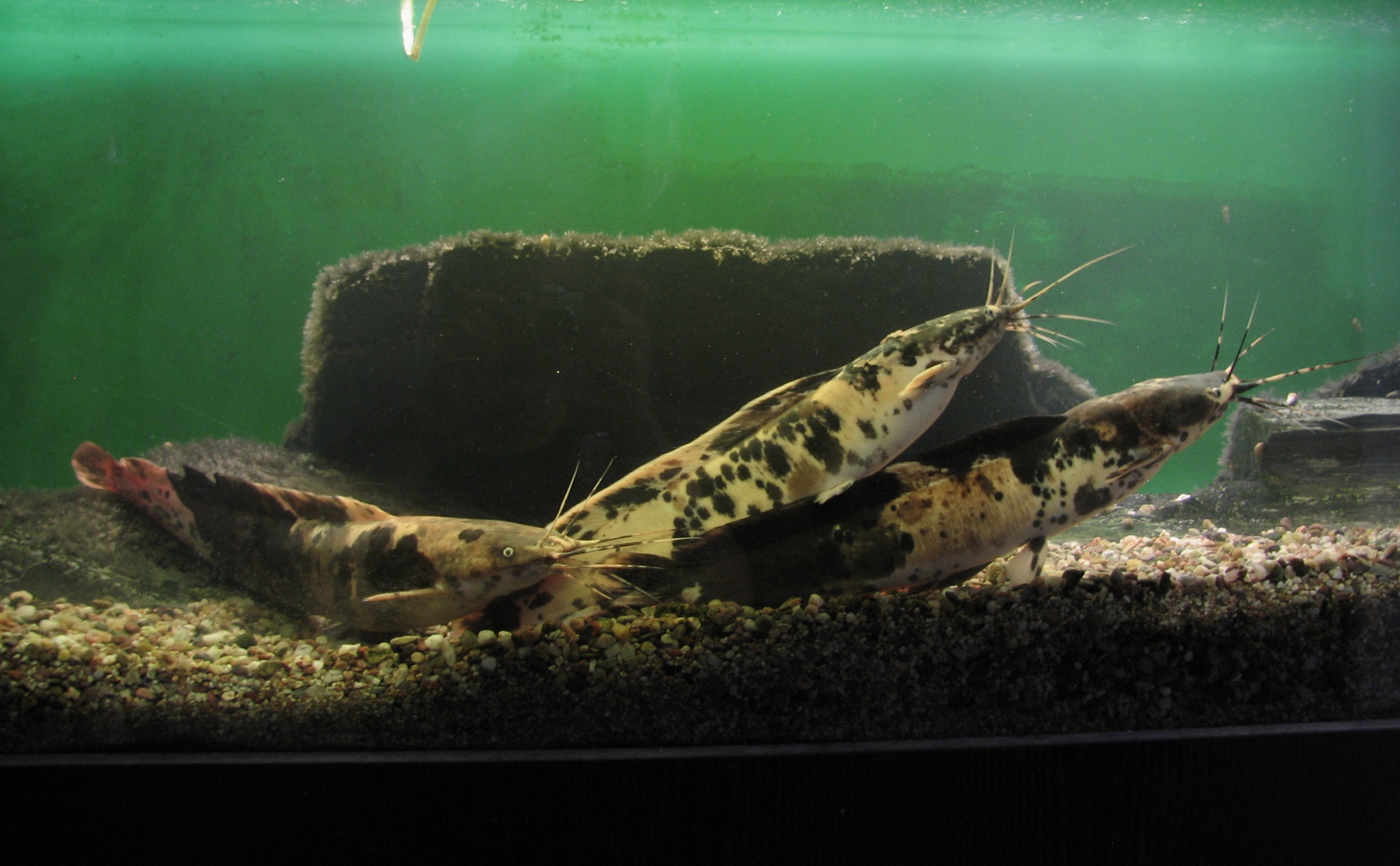
The body is elongated and eel-like, scaleless, 30–50 cm long in the aquarium (larger in the wild). Colour ranges from grey-brown to nearly black, and an albino (mottled-pink) form occurs. The head is broad and flattened with four pairs of long barbels. The long dorsal and anal fins run almost to the tail.
Care
A tank of at least 400 L with soft substrate, cover, and ABSOLUTELY a heavy, tightly closed lid — the catfish is strong and escapes easily. Temperature 20–26 °C, pH 6.0–8.0, hardness GH 5–25. Free air space above the water, powerful filtration, and regular water changes are needed. The species is undemanding about water quality.
Feeding
A voracious predator. It takes live and frozen foods — fish, shrimp, earthworms, pieces of seafood meat, and large sinking carnivore pellets. It is prone to overeating, so feed moderately 2–3 times a week. Do not feed mammalian meat.
Compatibility
A predator incompatible with most fish: it eats small and medium tankmates and may injure large ones. Keep it alone in a species tank. Its own kind are also aggressive toward each other. It is unsuitable for a community tank.
Breeding
In nature spawning occurs in the rainy season; a pair builds a nest in a burrow or among plants, and the male guards the clutch. In an ordinary aquarium it rarely breeds; in aquaculture it is bred with hormonal induction for food use.
Fun facts
The suprabranchial labyrinth organ lets the walking catfish breathe air and survive a pool drying out completely by burrowing into mud. Its ability to 'walk' over land has made it invasive in Florida and several countries. In Southeast Asia clariids are farmed on a large scale as food fish.