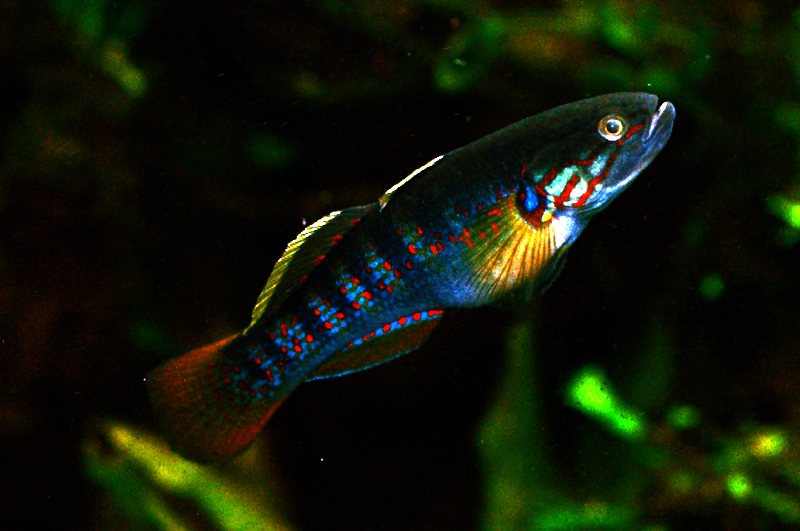
Fish
Purple-spotted Gudgeon
Mogurnda mogurnda
Origin: The purple-spotted gudgeon lives in fresh waters of northern Australia and southern New Guinea. It inhabits slow rivers, backwaters, and streams with cover of rocks, driftwood, and plants, in warm water with gentle flow.
Also known as: Northern purple-spotted gudgeon, Mogurnda mogurnda
Fact sheet
- Size
- 15 cm
- Lifespan
- 5 years
- Minimum tank size
- 110 L
- Temperature
- 22–28 °C
- pH
- 6.5–8
- Hardness GH
- 10–20 °dH
- Temperament
- Semi-aggressive
- Social behavior
- In pairs
- Swimming zone
- Bottom
- Diet
- Carnivore
- Jumps out
- Yes
- Eats plants
- No
Overview
The purple-spotted gudgeon is a stocky eleotrid (sleeper goby) with an ornate 'carpet' pattern of red and blue spots over an olive body. It is a territorial but not overly aggressive predator that keeps to the bottom and cover. The fish is intelligent, learns to recognise its owner over time, and forms pairs that care for their young. It is unsuitable with small fish, which it treats as food, but it is good for a species tank or a community of robust companions.
Appearance
The body is stocky and rounded, with a large head and big mouth, 12–17 cm long. The ground is olive-grey or brownish, scattered with red and bluish spots and dashes forming a carpet-like pattern; the fins are edged red and blue. Colour is brighter when spawning and displaying. Males are larger with a higher forehead.
Care
A tank of at least 110 L with sandy substrate, rocks, driftwood, and cover. Temperature 22–28 °C, pH 6.5–8.0, hardness GH 10–20. Keep flow gentle and light subdued. Good filtration and regular water changes are needed. A lid is essential — the fish can jump.
Feeding
A predator. It takes live and frozen foods — bloodworm, earthworms, shrimp, pieces of fish, and large insects. It takes dry food reluctantly. Feed once a day in small portions, avoiding overfeeding.
Compatibility
Territorial, especially toward its own kind and at the bottom. Keep as a pair or with robust, similarly sized fish — rainbowfish, large tetras, barbs, and armoured catfish. It eats small fish and shrimp. Group keeping needs space and cover.
Breeding
It forms pairs with parental care. The female lays sticky eggs on a rock or driftwood, and the male guards and fans the clutch. Fry hatch in 7–9 days. First foods are brine shrimp nauplii and small live food. Breeding is easy once a pair is formed.
Fun facts
Eleotrids (sleeper gobies) are not true gobies but a closely related group. The pattern of red and blue spots gives the species its Russian name 'carpet' gudgeon. Pairs often stay together for a long time and guard the clutch jointly.