Fish
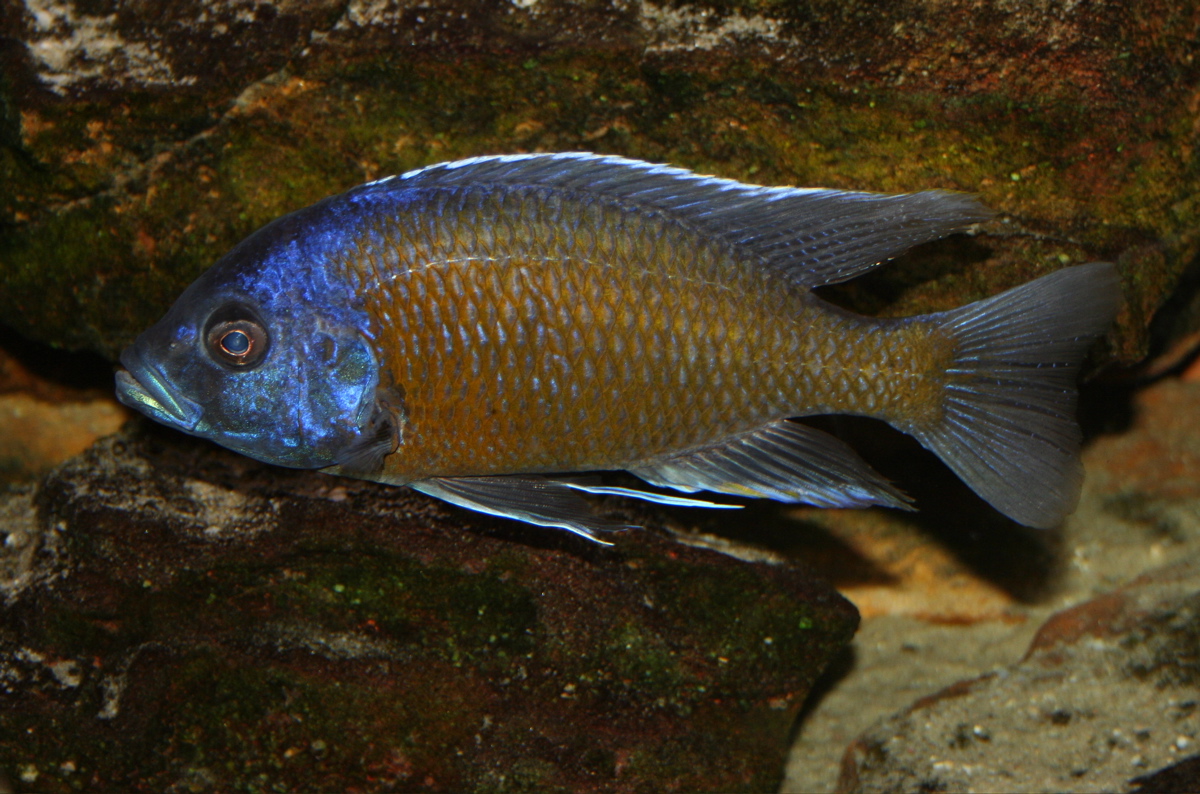
Kadango Red Fin
Copadichromis borleyi
Origin: The Kadango is a cichlid endemic to Lake Malawi in East Africa. The 'Kadango' form is named after a locality in the south-east of the lake. It inhabits the transition zones between rock and sand at moderate depth, where it feeds in open water.
Also known as: Copadichromis borleyi 'Kadango', Red Fin Borleyi
Fact sheet
- Size
- 18 cm
- Lifespan
- 9 years
- Minimum tank size
- 280 L
- Temperature
- 24–28 °C
- pH
- 7.4–8.6
- Hardness GH
- 10–25 °dH
- Temperament
- Semi-aggressive
- Social behavior
- Harem
- Group size
- 4+ individuals
- Swimming zone
- Middle
- Diet
- Omnivore
- Jumps out
- Yes
- Eats plants
- No
Overview
The Kadango is a striking Malawi cichlid of the 'utaka' group, which feed on plankton in open water. Dominant males take on a bright metallic-blue colour, while females and juveniles are silvery with red-orange fins, which is why the form is called Red Fin. It is a comparatively peaceable Malawi cichlid, kept as a harem in a spacious tank with hard, alkaline water. It mixes well with other small Malawi cichlids.
Appearance
The body is elongated and sturdy, up to 15 cm (females) and 18 cm (males). A dominant male glows metallic blue with a darker head; females and subordinate fish are silvery-grey with red or orange fins and three dark flank blotches. Large eyes and a protrusible mouth are adapted to catching plankton.
Care
A tank of at least 280 L with a sandy bottom, groups of rocks, and open swimming space. Temperature 24–28 °C, pH 7.4–8.6, hardness GH 10–25 — hard, alkaline water. Powerful filtration, good aeration, and 25–30% weekly water changes are needed. Cover reduces clashes between males.
Feeding
An omnivorous planktivore. The diet is based on quality Malawi-cichlid flakes and pellets plus frozen cyclops, brine shrimp, and mysis. It feeds mainly in midwater. Excess fatty protein causes bloat, so keep the diet balanced. Feed small portions once or twice daily.
Compatibility
A relatively peaceable Malawi cichlid. It mixes well with other utaka, aulonocara, and calm haplochromines of similar size. Keep as a harem — one male to 3–4 females — to reduce aggression. Do not combine with small fish or very aggressive mbuna.
Breeding
The female is a mouthbrooder. After the male's display and spawning on sand or rock, the female takes the eggs into her mouth and incubates them for 3 weeks without feeding, then releases the fry. Breeding is easy with a harem and correct water parameters.
Fun facts
'Utaka' are Malawi cichlids that feed on plankton in open water, unlike the rock-dwelling mbuna. The trade name Red Fin refers to the red-orange fins of females and juveniles. OB and Platinum colour lines exist and should not be crossed with the wild form.