Fish
Swordtail Characin
Corynopoma riisei
Origin: The swordtail characin inhabits rivers and streams of Trinidad, Colombia, and Venezuela in northern South America. It lives in clean, flowing water with vegetation and moderate current.
Also known as: Knight tetra, Corynopoma riisei
Fact sheet
- Size
- 6 cm
- Lifespan
- 5 years
- Minimum tank size
- 80 L
- Temperature
- 23–28 °C
- pH
- 6–7.5
- Hardness GH
- 5–20 °dH
- Temperament
- Peaceful
- Social behavior
- Schooling
- Group size
- 6+ individuals
- Swimming zone
- Middle, Top
- Diet
- Omnivore
- Jumps out
- Yes
- Eats plants
- No
Overview
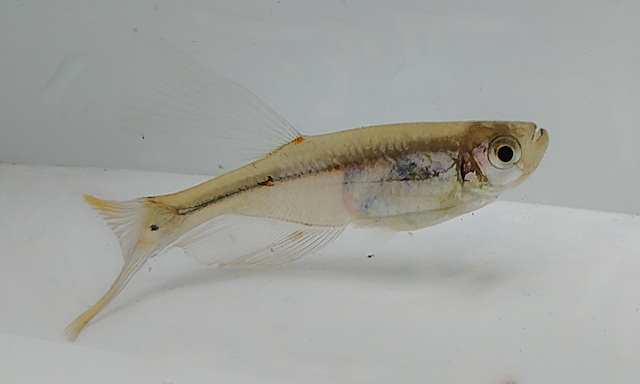
The swordtail characin is a small silvery characin famous for the remarkable courtship ornament of males: long gill-cover extensions with a paddle-like 'flag' at the tip. The male spreads these extensions and 'teases' the female with them, mimicking food, during courtship. It is a peaceful, active schooling fish for a community tank. It is notable for an unusual method of internal fertilisation, in which the female can store sperm and spawn fertilised eggs later.
Appearance
The body is slender and silvery with a faint sheen, 5–7 cm long (males larger because of the extensions). The key male feature is two long thread-like gill-cover extensions with a widened paddle ('oar') at the tip. The male's tail fin has an elongated lower lobe. Females are plainer and smaller.
Care
A tank of at least 80 L with plants, driftwood, and open swimming space. Temperature 23–28 °C, pH 6.0–7.5, hardness GH 5–20. Clean water, gentle flow, and regular water changes are needed. A lid is advisable. Diffuse light and dark substrate bring out the silvery colour.
Feeding
An omnivore. It takes small flakes and pellets and live or frozen daphnia, cyclops, brine shrimp nauplii, and small bloodworm. Feed once or twice daily in small portions.
Compatibility
A peaceful schooling fish. Excellent with other small characins, rasboras, danios, corydoras, and dwarf cichlids. Large or aggressive tankmates are unsuitable. Keep in groups of at least 6.
Breeding
Internal fertilisation is rare among characins. The male transfers sperm packets (spermatophores) to the female using modified rays; the female stores the sperm and spawns fertilised eggs later, scattering them over plants. Remove the adults; the fry hatch in 1–2 days.
Fun facts
The male uses the paddle-tipped gill-cover extensions as a lure, drawing in the female, who mistakes the 'flag' for food. It is one of the few characins with internal fertilisation. A female can produce several clutches after a single mating.