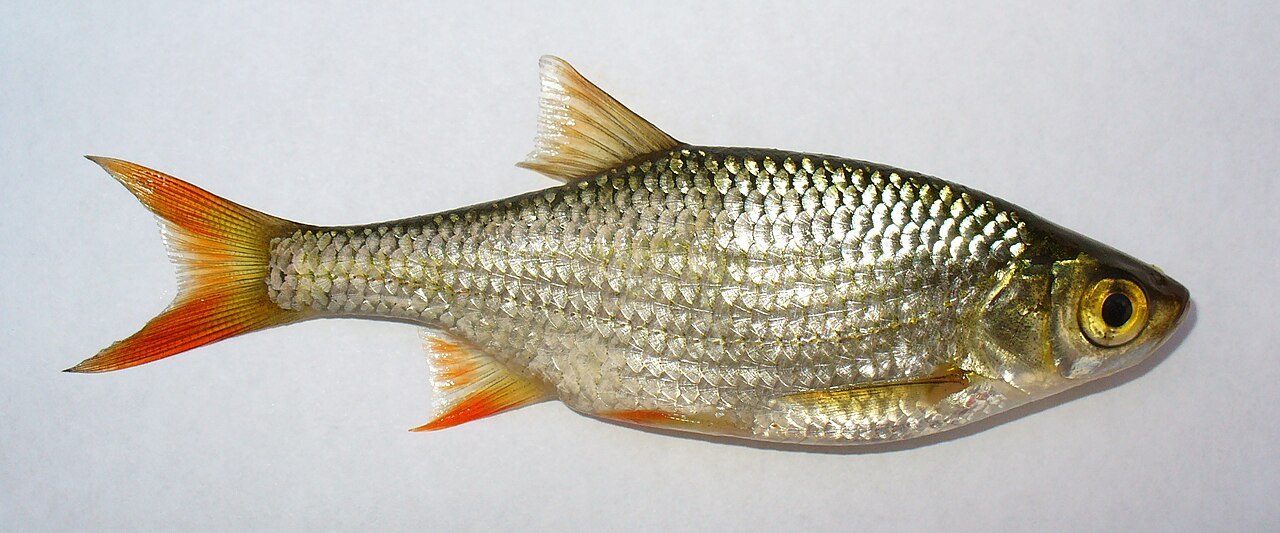
Fish
Common Rudd
Scardinius erythrophthalmus
Origin: The rudd is widespread in fresh waters of Europe and western Asia. It inhabits still and slow-flowing waters — lakes, ponds, oxbows, and river bays — with dense vegetation and soft bottoms.
Also known as: Rudd, Scardinius erythrophthalmus
Fact sheet
- Size
- 30 cm
- Lifespan
- 12 years
- Minimum tank size
- 400 L
- Temperature
- 4–24 °C
- pH
- 7–8
- Hardness GH
- 8–25 °dH
- Temperament
- Peaceful
- Social behavior
- Schooling
- Group size
- 5+ individuals
- Swimming zone
- Middle, Top
- Diet
- Omnivore
- Jumps out
- Yes
- Eats plants
- Yes
Overview
The rudd is a handsome European coldwater fish with a silvery body, a golden sheen, and bright red fins. It is a schooling omnivore leaning vegetarian that keeps to the middle and upper layers among plants. It is rarely kept in aquaria because of its size, but it is striking and interesting in ponds and large coldwater tanks. Hardy and undemanding, it tolerates cool water well.
Appearance
The body is moderately deep and laterally compressed, usually 15–30 cm long (to 45 cm). The back is brownish-green, the flanks silvery-gold, the belly pale; the fins are bright red or orange-red, and the eyes carry a red or orange spot. The mouth is upturned, adapted to taking food at the surface. Sexual dimorphism is weak.
Care
A pond or tank of at least 400 L with plants, open space, and powerful filtration. Temperature 4–24 °C (a coldwater species), pH 7.0–8.0, hardness GH 8–25. Good aeration, clean water, and regular water changes are needed. It likes plant thickets, which it partly grazes.
Feeding
An omnivore leaning vegetarian. It eats algae, soft plants, and also insects, their larvae, and small invertebrates. In the aquarium it takes pellets, vegetable foods, and live or frozen bloodworm. Feed once or twice daily.
Compatibility
A peaceful schooling fish. In a pond it mixes with goldfish, crucian carp, koi, tench, and other coldwater fish. Small warm-water fish cannot be kept with it because of the temperature and size difference. Keep in a group.
Breeding
Spawning is in spring and summer as the water warms to 15–18 °C. The fish scatter sticky eggs over plants in the shallows. It is prolific; the eggs develop over several days. In a pond it often breeds on its own.
Fun facts
The species name erythrophthalmus means 'red-eyed', for the red spot on the iris. The rudd readily hybridises with other cyprinids, such as the roach. In warm shallow bays it keeps near the surface, grazing on filamentous algae.