Fish
Redtail Catfish
Phractocephalus hemioliopterus
Origin: The redtail catfish inhabits the large rivers of the Amazon and Orinoco basins in South America. It lives in the main channel and deep pools of big rivers, where it hunts fish and other animals.
Also known as: Redtail catfish, Phractocephalus hemioliopterus
Fact sheet
- Size
- 100 cm
- Lifespan
- 20 years
- Minimum tank size
- 4000 L
- Temperature
- 23–28 °C
- pH
- 5.5–7.5
- Hardness GH
- 2–20 °dH
- Temperament
- Predator
- Social behavior
- Solitary
- Swimming zone
- Bottom
- Diet
- Carnivore
- Jumps out
- No
- Eats plants
- No
Overview
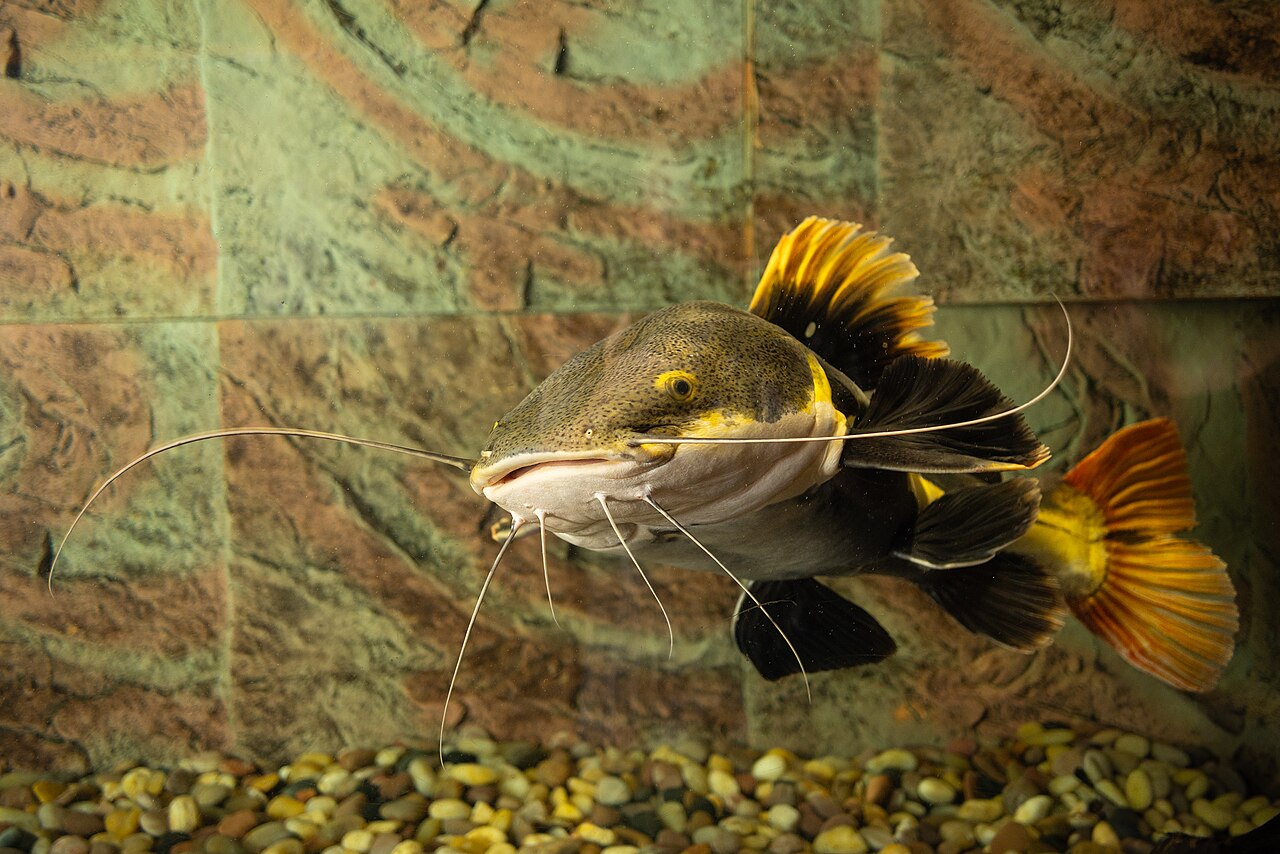
The redtail catfish is a huge predatory catfish with bright colouring: a dark back, a white flank stripe, and a red-orange tail. Juveniles look very appealing, which is why the fish is often bought without realising that it grows over a metre long and needs a tank of several thousand litres. It is a voracious predator that swallows anything that fits in its mouth. It suits only experienced keepers with enormous tanks or public systems; it cannot be kept in an ordinary home aquarium.
Appearance
The body is massive and elongated, with a broad flattened head and a large mouth, often 60–100 cm long in captivity (to 130 cm or more in the wild). The back is dark grey or brown, a yellow-white stripe runs along the flanks, and the belly is pale; the tail and dorsal fins are bright red-orange. There are three pairs of long barbels. Juveniles are brighter than adults.
Care
A tank or pool of at least 4000 L for an adult (juveniles temporarily in less), with extremely powerful filtration and a heavy lid. Temperature 23–28 °C, pH 5.5–7.5, hardness GH 2–20. Enormous open space, large decor the fish cannot shift, and big regular water changes are needed.
Feeding
A voracious predator. It takes large live and frozen foods — fish, shrimp, pieces of fish and squid fillet, earthworms, and special sinking pellets for large predators. It is prone to overeating, so feed 2–3 times a week. Do not feed mammalian meat.
Compatibility
Incompatible with almost anything: it swallows any fish that fits in its mouth, and that mouth is large. Keep it alone or with very large, similarly sized fish in enormous systems. It is categorically unsuitable for a community tank.
Breeding
It essentially does not breed in captivity because of its giant size and space needs. In nature spawning occurs in large rivers in the rainy season. Home breeding is unattainable.
Fun facts
The redtail catfish is one of the aquarium 'tank-buster' fish: an appealing juvenile grows into a giant with nowhere to house it. In its homeland it is a food fish and a sport-fishing target. Captive specimens over 20 years old are known.