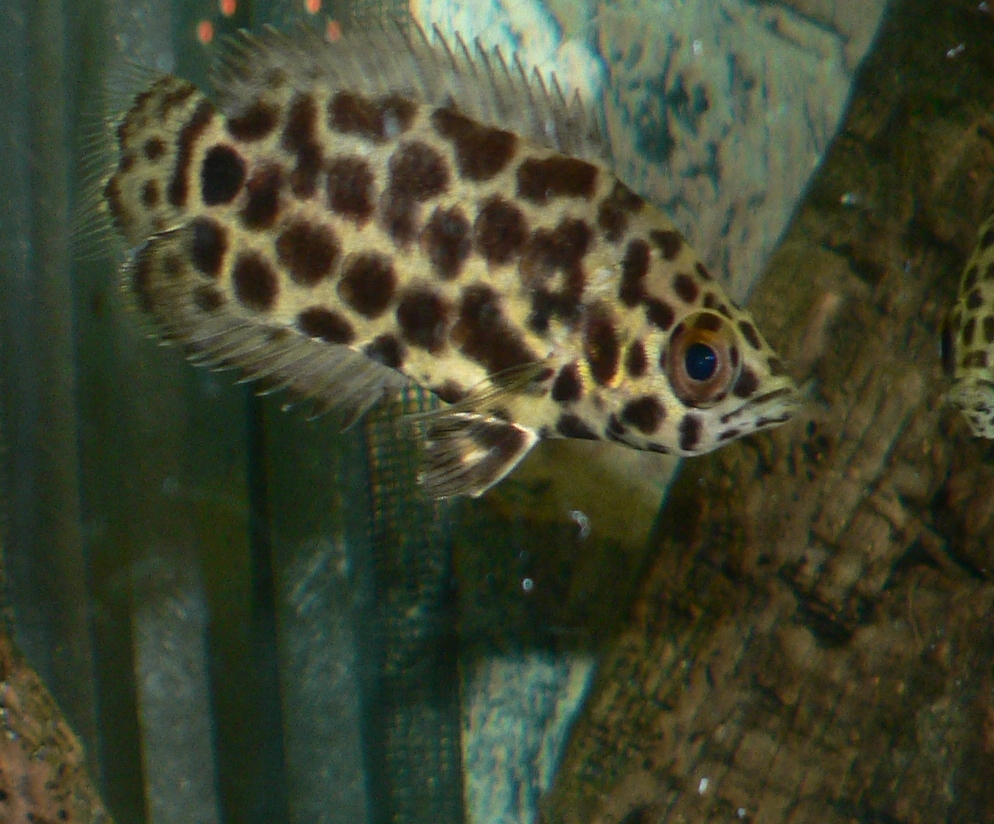
Fish
Leopard Bush Fish
Ctenopoma acutirostre
Origin: The leopard bush fish is endemic to the Congo River basin in Central Africa. It inhabits slow rivers, backwaters, and swampy areas with driftwood, vegetation, and soft, slightly acidic water.
Also known as: Spotted ctenopoma, African leaf fish, Ctenopoma acutirostre
Fact sheet
- Size
- 15 cm
- Lifespan
- 9 years
- Minimum tank size
- 200 L
- Temperature
- 23–28 °C
- pH
- 6–7.5
- Hardness GH
- 4–18 °dH
- Temperament
- Semi-aggressive
- Social behavior
- Solitary
- Swimming zone
- Middle, Bottom
- Diet
- Carnivore
- Jumps out
- Yes
- Eats plants
- No
Overview
The ctenopoma is an African labyrinth fish, a relative of the gouramis, with a striking leopard pattern of dark spots over a golden-brown body. It is a slow, patient ambush predator that stands in cover by day and comes out to hunt at dusk. It can breathe atmospheric air thanks to its labyrinth organ. It is peaceful toward similarly sized fish but swallows small ones. It needs a calm tank with cover, subdued light, and companions that are not small.
Appearance
The body is deep and laterally compressed, up to 15 cm long, with a pointed snout. Colour is golden-brown with large dark-brown spots forming a leopard pattern; an eye-spot usually marks the tail base. Juveniles can vary their colour intensity for camouflage. Sexual dimorphism is weak.
Care
A tank of at least 200 L with driftwood, plants, cover, and subdued light. Temperature 23–28 °C, pH 6.0–7.5, hardness GH 4–18. Free air space above the water for breathing, calm flow, and a tight lid are needed. Good filtration and regular water changes are essential.
Feeding
An ambush predator. It takes live and frozen foods — bloodworm, large daphnia, shrimp, earthworms, and pieces of fish. It is trained onto dry food only with difficulty. It eats slowly and methodically, so feed in the evening, 3–4 times a week.
Compatibility
Peaceful toward fish it cannot swallow, but slow. It mixes well with similarly sized calm species — large tetras, rainbowfish, peaceful cichlids, and catfish. It eats small fish and shrimp. Fidgety or aggressive tankmates stress it.
Breeding
Breeding is difficult and infrequent. Unlike many labyrinth fish it builds no bubble nest: the eggs are buoyant, scattered at the surface, and left to themselves. Breeding needs soft water and stimulation through water changes. The parents do not guard the young.
Fun facts
The leopard colour and slow movement help the ctenopoma camouflage and sneak up on prey. The labyrinth organ lets it breathe air in oxygen-poor water. Juveniles can 'pretend' to be a fallen leaf, swaying in midwater.