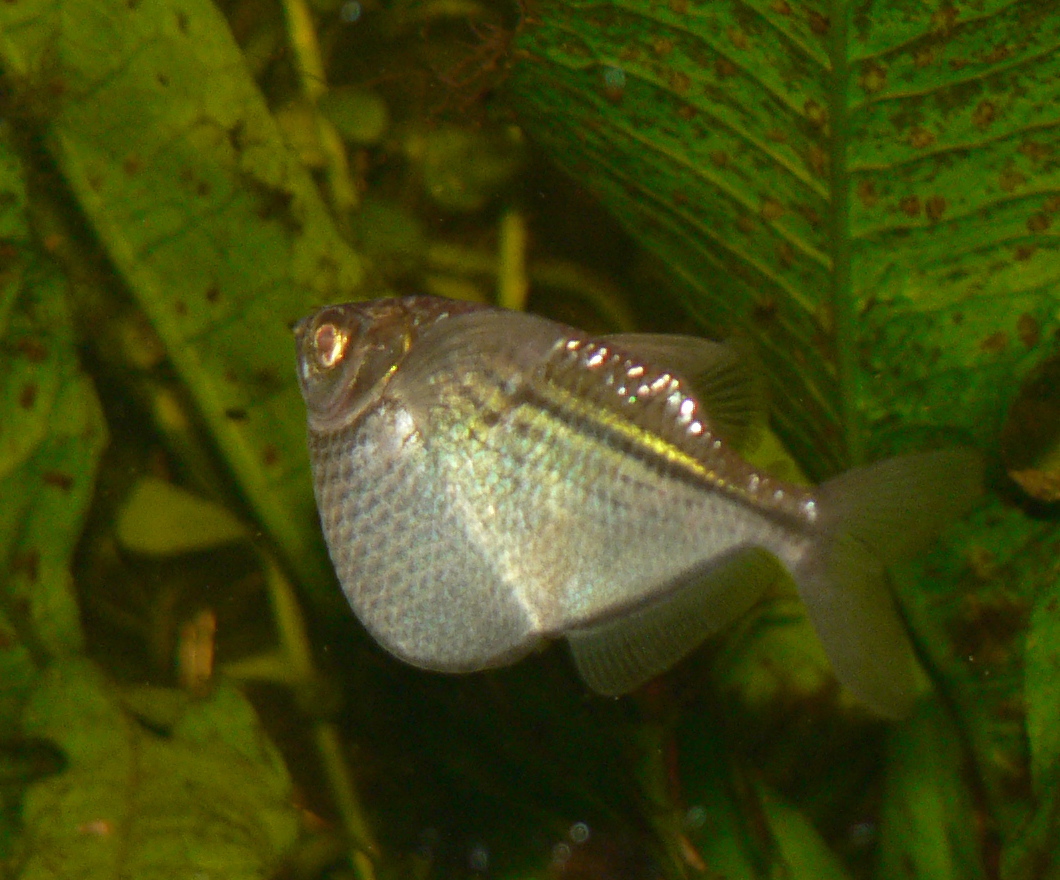
Fish
Common Hatchetfish
Gasteropelecus sternicla
Origin: The common hatchetfish inhabits the Amazon, Orinoco, and Guianas river basins in South America. It lives right at the surface of slow rivers and backwaters with overhanging vegetation, from which it catches falling insects.
Also known as: Silver hatchetfish, River hatchetfish, Gasteropelecus sternicla
Fact sheet
- Size
- 6 cm
- Lifespan
- 4 years
- Minimum tank size
- 100 L
- Temperature
- 23–27 °C
- pH
- 5.5–7
- Hardness GH
- 2–15 °dH
- Temperament
- Peaceful
- Social behavior
- Schooling
- Group size
- 6+ individuals
- Swimming zone
- Top
- Diet
- Carnivore
- Jumps out
- Yes
- Eats plants
- No
Overview
The common hatchetfish is an unusual surface fish with a strongly convex, keel-like chest resembling an axe blade. Powerful chest muscles and wing-like pectoral fins let it leap from the water and glide several metres over the surface to escape predators — it is one of the few truly 'flying' fish. It keeps to a tight shoal at the surface. A peaceful but skittish fish that needs a tank with an open surface and absolutely a tight lid. It is sensitive to water quality.
Appearance
The body is strongly compressed laterally, with a sharply convex keel-like belly and a straight back, up to 6–6.5 cm long. Colour is silvery with a dark longitudinal line along the back and a faint sheen. The pectoral fins are large and wing-like; the mouth is upturned. Sexual dimorphism is barely noticeable.
Care
A tank of at least 100 L with a large surface area, overhanging and floating plants, calm flow, and absolutely a tight, gap-free lid — the fish jump. Temperature 23–27 °C, pH 5.5–7.0, hardness GH 2–15. Soft, clean water and stable parameters are needed.
Feeding
An insectivore feeding strictly from the surface. It takes floating food, live and frozen fruit flies, small insects, bloodworm, and daphnia. It does not pick food from the bottom. Feed once or twice daily in small portions.
Compatibility
A peaceful schooling fish of the upper layers. It mixes well with peaceful residents of the middle and lower layers — tetras, rasboras, corydoras, and dwarf cichlids. Avoid tankmates that compete for the surface. Keep in shoals of at least 6.
Breeding
Breeding in captivity is very difficult and rare. Reliable, repeatable methods are few; the eggs are presumably scattered among floating plants. Most fish in trade are wild-caught.
Fun facts
Hatchetfish are among the few fish capable of true flight: they beat their pectoral fins while gliding over the water. The keel-like chest houses the powerful flight muscles. Because of their jumping, the tank is kept tightly covered.