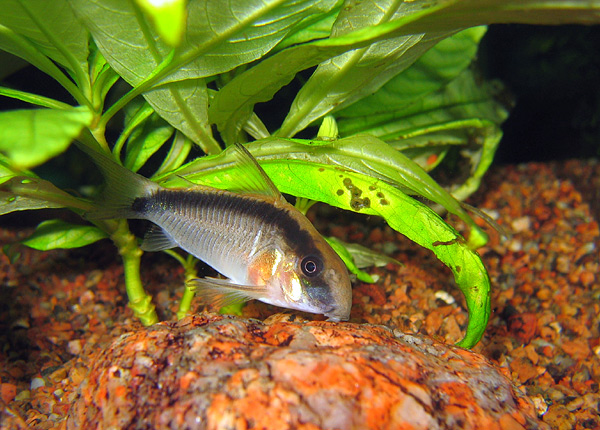
Fish
Skunk Cory
Corydoras arcuatus
Origin: The skunk cory comes from the upper Amazon in Peru and Brazil. It inhabits soft, acidic waters of tributaries and forest streams with sandy beds, driftwood, and leaf litter.
Also known as: Arched cory, Corydoras arcuatus
Fact sheet
- Size
- 6 cm
- Lifespan
- 7 years
- Minimum tank size
- 80 L
- Temperature
- 22–26 °C
- pH
- 5.5–7.5
- Hardness GH
- 2–15 °dH
- Temperament
- Peaceful
- Social behavior
- Schooling
- Group size
- 6+ individuals
- Swimming zone
- Bottom
- Diet
- Omnivore
- Jumps out
- No
- Eats plants
- No
Overview
The skunk cory is easily recognised by the single arched black stripe running from the nose along the back to the tail. It is a peaceful schooling bottom fish kept in a group of at least 6. The species is undemanding and suits a community tank with small peaceful fish. Like all corydoras it constantly roots through soft substrate in search of food.
Appearance
The body is stocky, pale beige with a silvery sheen, up to 5–6 cm long. The key mark is a single arched black stripe running from the snout tip along the upper body to the tail base. The belly is pale and the fins translucent. Females are noticeably larger and fuller than males.
Care
A tank of at least 80 L with soft sandy substrate, driftwood, and plants. Temperature 22–26 °C, pH 5.5–7.5, hardness GH 2–15. Clean water, good filtration, and 25–30% weekly water changes are needed. Use sand or rounded gravel so the barbels are not damaged.
Feeding
An omnivorous bottom catfish. It takes sinking tablets and pellets, live or frozen bloodworm, daphnia, and tubifex. It needs a varied diet and food that reaches the bottom. Feed once or twice daily.
Compatibility
A peaceful schooling fish. Excellent with tetras, rasboras, danios, dwarf cichlids, and shrimp. Large aggressive species are unsuitable. Keep in groups of at least 6.
Breeding
Breeding follows the general corydoras pattern with a cool, soft water change. The female carries the eggs in a pelvic-fin 'pouch' and sticks them to glass and plants. Remove the adults; the fry hatch in 3–5 days.
Fun facts
The name skunk cory refers to the single dark back stripe resembling a skunk's marking. The species name arcuatus means 'arched', for the shape of that stripe. Several similar 'skunk' corydoras exist, differing in the width and curve of the stripe.