Fish
Venezuelan Cory
Corydoras venezuelanus
Origin: The Venezuelan cory comes from Venezuela, from the Lake Valencia basin and coastal rivers. It inhabits slow streams and tributaries with sandy and silty beds and soft to moderately hard water.
Also known as: Venezuela orange cory, Corydoras venezuelanus
Fact sheet
- Size
- 6 cm
- Lifespan
- 7 years
- Minimum tank size
- 80 L
- Temperature
- 22–26 °C
- pH
- 6–7.5
- Hardness GH
- 2–18 °dH
- Temperament
- Peaceful
- Social behavior
- Schooling
- Group size
- 6+ individuals
- Swimming zone
- Bottom
- Diet
- Omnivore
- Jumps out
- No
- Eats plants
- No
Overview
The Venezuelan cory is a striking close relative of the bronze cory, standing out with vivid orange-copper colour and a contrasting blue-green patch on the flank. It is a hardy, undemanding, and very popular bottom fish kept in a group of at least 6. It is excellent for beginners and for a community tank with peaceful species. The orange ('Venezuela orange') form is especially prized.
Appearance
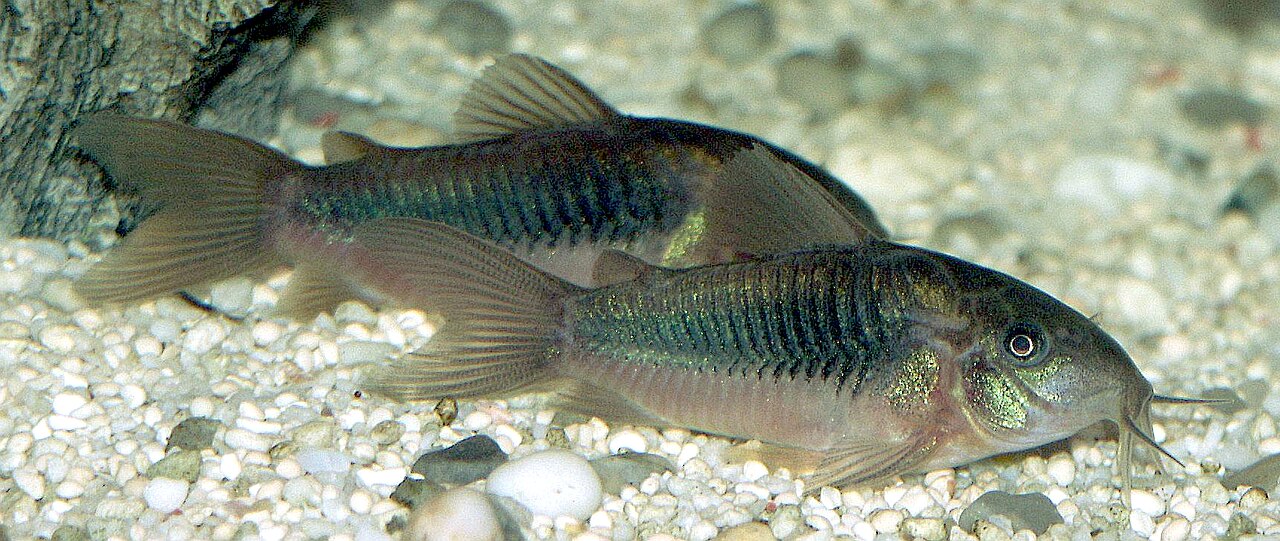
The body is stocky, up to 6 cm long. Colour ranges from copper-orange to intense orange in the selective form; a metallic blue-green patch marks the flank behind the head. The belly is paler and the fins carry an orange tint. Females are larger and noticeably fuller than males.
Care
A tank of at least 80 L with soft sandy substrate and cover. Temperature 22–26 °C, pH 6.0–7.5, hardness GH 2–18. Good filtration, clean water, and 25–30% weekly water changes are needed. The species is hardy and adaptable but dislikes sudden parameter swings.
Feeding
An omnivorous bottom catfish with a hearty appetite. It takes sinking tablets, pellets, and live or frozen bloodworm, tubifex, and daphnia. Feed once or twice daily, making sure food reaches the bottom.
Compatibility
A peaceful schooling fish for a community tank. Excellent with tetras, rasboras, danios, livebearers, and dwarf cichlids. Large aggressive tankmates are unsuitable. Keep in groups of at least 6.
Breeding
It breeds easily, like the bronze cory. Trigger spawning with a cool, soft water change. The female carries the eggs in a pelvic-fin 'pouch' and sticks them to glass and plants. The fry hatch in 3–4 days.
Fun facts
For a long time the Venezuelan cory was considered only a colour form of the bronze cory (Corydoras aeneus), and the group's taxonomy is still debated. The bright orange form was developed and fixed by aquarists. The blue-green flank patch is a characteristic mark of the species.