Fish
Julii Cory
Corydoras julii
Origin: The julii cory comes from coastal rivers of eastern Brazil, mainly the lower reaches of tributaries near the coast. It inhabits clear streams and rivers with sandy beds and moderate flow.
Also known as: Leopard cory, Corydoras julii
Fact sheet
- Size
- 6 cm
- Lifespan
- 7 years
- Minimum tank size
- 80 L
- Temperature
- 23–26 °C
- pH
- 6–7.5
- Hardness GH
- 2–15 °dH
- Temperament
- Peaceful
- Social behavior
- Schooling
- Group size
- 6+ individuals
- Swimming zone
- Bottom
- Diet
- Omnivore
- Jumps out
- No
- Eats plants
- No
Overview
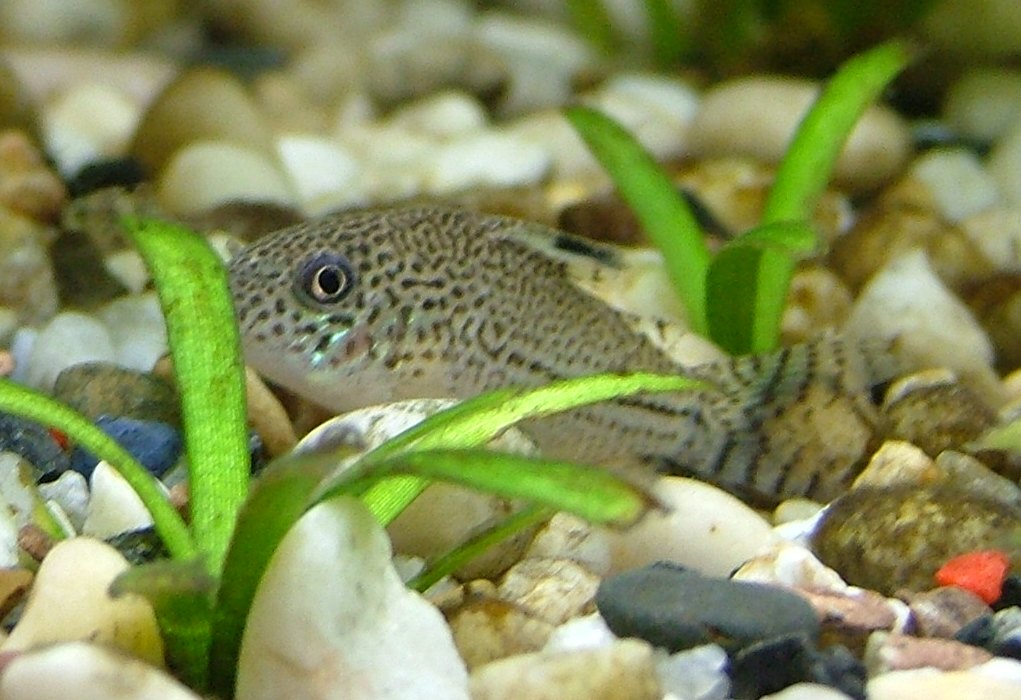
The julii cory is a refined armoured catfish with a delicate pattern of separate dark spots over a silvery body and a longitudinal stripe along the caudal peduncle. The true julii is often confused with the more common three-line cory (false julii): in the true julii the spots do not merge into lines on the head. It is a peaceful schooling bottom fish for a community tank, kept in a group of at least 6.
Appearance
The body is silvery-grey, up to 5–6 cm long, covered with small separate dark spots (rather than a network of lines). A clear horizontal black stripe runs along the caudal peduncle. The dorsal fin has a dark blotch near the top. Females are larger and fuller. In the true julii the head spots remain separate — the main difference from the three-line cory.
Care
A tank of at least 80 L with soft sandy substrate, clean water, and good filtration. Temperature 23–26 °C, pH 6.0–7.5, hardness GH 2–15. Weekly water changes of 25–30% are needed. Use sand or rounded gravel to protect the barbels.
Feeding
An omnivorous bottom catfish. It takes sinking tablets and pellets, live or frozen bloodworm, daphnia, and tubifex. Feed once or twice daily, making sure food reaches the bottom.
Compatibility
A peaceful schooling fish for a community tank. Excellent with tetras, rasboras, danios, and dwarf cichlids. Large aggressive species are unsuitable. Keep in groups of at least 6.
Breeding
Breeding follows the general corydoras pattern with a cool, soft water change. The female carries the eggs in a pelvic-fin 'pouch'. Remove the adults; the fry hatch in 3–5 days. Fish sold as 'julii' are more often the three-line species, which is easier to breed.
Fun facts
Most fish sold as 'julii' are actually Corydoras trilineatus (three-line cory). The true Corydoras julii is rarer in the wild and in trade. They are told apart by the head pattern: separate spots in the true julii, merging lines in the three-line cory.