Fish
Schultze's Cory
Corydoras schultzei
Origin: Schultze's cory comes from the upper Amazon. It is close to the bronze cory and inhabits soft, slightly acidic waters of tributaries and streams with sandy beds.
Also known as: Gold laser cory, Corydoras schultzei
Fact sheet
- Size
- 6 cm
- Lifespan
- 7 years
- Minimum tank size
- 80 L
- Temperature
- 22–26 °C
- pH
- 6–7.5
- Hardness GH
- 2–18 °dH
- Temperament
- Peaceful
- Social behavior
- Schooling
- Group size
- 6+ individuals
- Swimming zone
- Bottom
- Diet
- Omnivore
- Jumps out
- No
- Eats plants
- No
Overview
Schultze's cory is a striking armoured catfish, especially known for its selective 'gold laser' form with a bright golden-green longitudinal line along the back. It is a hardy, peaceful bottom fish kept in a group of at least 6. It is undemanding and suits a community tank with small peaceful species. Close to the bronze cory, it is just as easy to keep.
Appearance
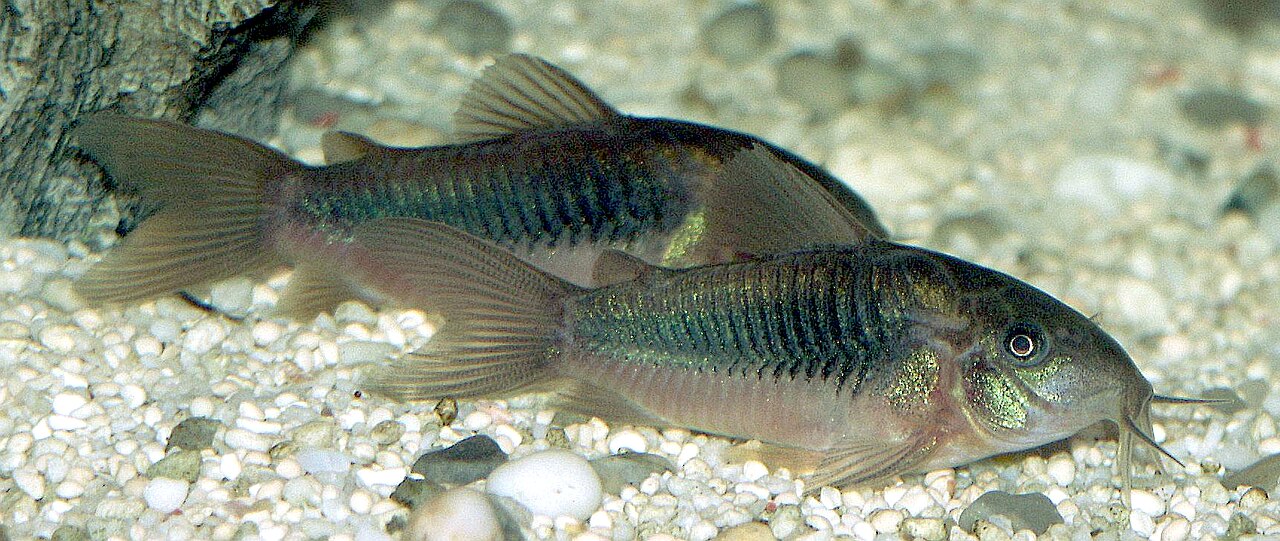
The body is stocky, up to 6 cm long. The wild form is brownish-bronze; the popular 'gold laser' form carries a bright golden-greenish glowing line along the upper body. The belly is pale and the fins translucent. Females are larger and fuller than males.
Care
A tank of at least 80 L with soft sandy substrate and cover. Temperature 22–26 °C, pH 6.0–7.5, hardness GH 2–18. Good filtration, clean water, and 25–30% weekly water changes are needed. Use sand or rounded gravel.
Feeding
An omnivorous bottom catfish. It takes sinking tablets and pellets, live or frozen bloodworm, daphnia, and tubifex. Feed once or twice daily, making sure food reaches the bottom.
Compatibility
A peaceful schooling fish. Excellent with tetras, rasboras, danios, livebearers, and dwarf cichlids. Large aggressive tankmates are unsuitable. Keep in groups of at least 6.
Breeding
It breeds easily, like the bronze cory. Trigger spawning with a cool, soft water change. The female carries the eggs in a pelvic-fin 'pouch'. The fry hatch in 3–4 days. The golden line develops in fry as they grow.
Fun facts
The 'gold laser' selective form was bred for the glowing golden-green line along the back. The taxonomy of corydoras close to the bronze is complex, and schultzei is often treated together with aeneus. The species is named after the fish collector Schultze.