Fish
Dwarf Cory
Corydoras nanus
Origin: The dwarf (nanus) cory comes from coastal rivers of Suriname and neighbouring parts of northern South America. It inhabits tributaries with soft, slightly acidic water, sandy beds, and moderate flow.
Also known as: Nanus cory, Corydoras nanus
Fact sheet
- Size
- 5 cm
- Lifespan
- 7 years
- Minimum tank size
- 80 L
- Temperature
- 22–26 °C
- pH
- 6–7.5
- Hardness GH
- 2–15 °dH
- Temperament
- Peaceful
- Social behavior
- Schooling
- Group size
- 6+ individuals
- Swimming zone
- Bottom
- Diet
- Omnivore
- Jumps out
- No
- Eats plants
- No
Overview
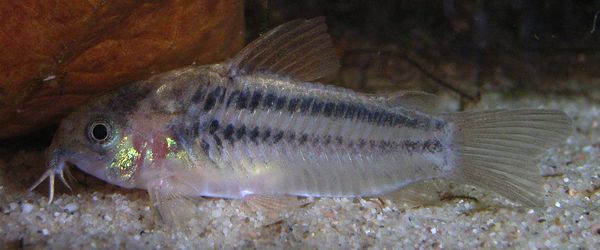
The nanus cory is a small armoured catfish with a longitudinal dark stripe and a net-like pattern on the upper body. Despite the name 'nanus' (dwarf), it is larger than the true pygmy corydoras and lives a typical bottom-dwelling life. It is a peaceful, hardy fish kept in a group of at least 6 in a community tank with small peaceful species.
Appearance
The body is elongated for a cory, up to 5 cm long. Colour is greyish-beige; a dark longitudinal stripe runs along the midline and a finer net pattern covers the back. The dorsal fin has a dark tip. Females are larger and fuller than males.
Care
A tank of at least 80 L with soft sandy substrate and cover. Temperature 22–26 °C, pH 6.0–7.5, hardness GH 2–15. Clean water, good filtration, and 25–30% weekly water changes are needed. Use sand or rounded gravel.
Feeding
An omnivorous bottom catfish. It takes sinking tablets and pellets, live or frozen bloodworm, daphnia, and tubifex. Feed once or twice daily, making sure food reaches the bottom.
Compatibility
A peaceful schooling fish. Excellent with tetras, rasboras, danios, and dwarf cichlids. Large aggressive species are unsuitable. Keep in groups of at least 6.
Breeding
Breeding follows the general corydoras pattern with a cool, soft water change. The female carries the eggs in a pelvic-fin 'pouch'. Remove the adults; the fry hatch in 3–5 days.
Fun facts
The species name nanus means 'dwarf', though the species is larger than true nano corydoras such as the pygmy. The nanus is one of the few corydoras from Suriname. Its longitudinal stripe makes it resemble some striped species, but the net pattern on the back helps identify it.