Plants
Alternanthera
Alternanthera reineckii
Origin: The genus Alternanthera comes from South America; the best-known aquarium species, Alternanthera reineckii, is native to marshy areas and riverbanks of Brazil, Paraguay, and Argentina.
Also known as: Alternanthera reineckii, Scarlet temple
Fact sheet
- Height
- 40 cm
- Temperature
- 22–28 °C
- pH
- 5.5–7.5
- Lighting
- Medium
- CO₂
- Recommended
- Growth rate
- Medium
- Placement
- Midground, Background
Overview
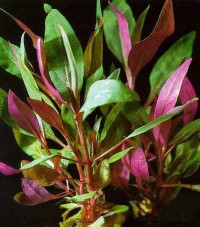
Alternanthera is one of the most popular genera of red aquarium plants, giving an underwater garden a vivid contrast against the greenery. The hobby mainly grows Alternanthera reineckii and its cultivars ('Mini', 'Lilacina', 'Rosanervig'). It is a stem plant of medium difficulty: the rich red-purple colour shows under good light, CO2 dosing, and adequate nutrition. Under weak light the colour fades and lower leaves drop. It looks superb in groups in the mid- and background.
Appearance
Upright stems bear opposite lanceolate or oval leaves. The upper side is olive-green or reddish, the underside rich pink, purple, or crimson. Height is 20–50 cm depending on the cultivar; compact forms ('Mini') of about 5–10 cm exist. Under strong light the internodes are shorter and the colour brighter.
Care
It needs medium to strong light, 22–28 °C, pH 5.5–7.5, and soft to medium-hard water. For rich colour, CO2 dosing and regular fertilisation — especially iron and micronutrients — are advisable. It grows moderately and needs periodic trimming.
Fertilizing
It feeds through both roots and leaves. For red colour, iron and micronutrients (liquid ferts) are important, as are macronutrients (NPK). Nutrient-rich substrate and CO2 dosing markedly improve growth and colour.
Breeding
It propagates by cuttings: stem tops are cut and replanted, and the remaining stem sends out side shoots. This quickly thickens the clump. Trimming stimulates branching.
Fun facts
Alternanthera is one of the few truly red plants that grow reliably underwater. Many species in the genus are not aquatic at all and are used as garden bedding. The depth of the red depends directly on light and available iron.