Plants
Orchid Lily
Barclaya longifolia
Origin: Barclaya longifolia comes from Southeast Asia — Myanmar, Thailand, and Vietnam. It grows in streams and rivers with soft, acidic water, often in shaded forest waters.
Also known as: Barclaya, Barclaya longifolia
Fact sheet
- Height
- 40 cm
- Temperature
- 22–28 °C
- pH
- 5.5–7
- Lighting
- Medium
- CO₂
- Recommended
- Growth rate
- Medium
- Placement
- Midground, Background
Overview
The orchid lily is a striking tuberous rosette plant with long wavy leaves whose colour ranges from olive-green to deep wine-red. It makes a beautiful midground specimen, but it is considered fairly demanding: it likes soft, acidic water, nutrient-rich substrate, and stable conditions. It is prone to a rest period. It can flower underwater and self-pollinate. With good care it forms a sumptuous red rosette that adorns a layout.
Appearance
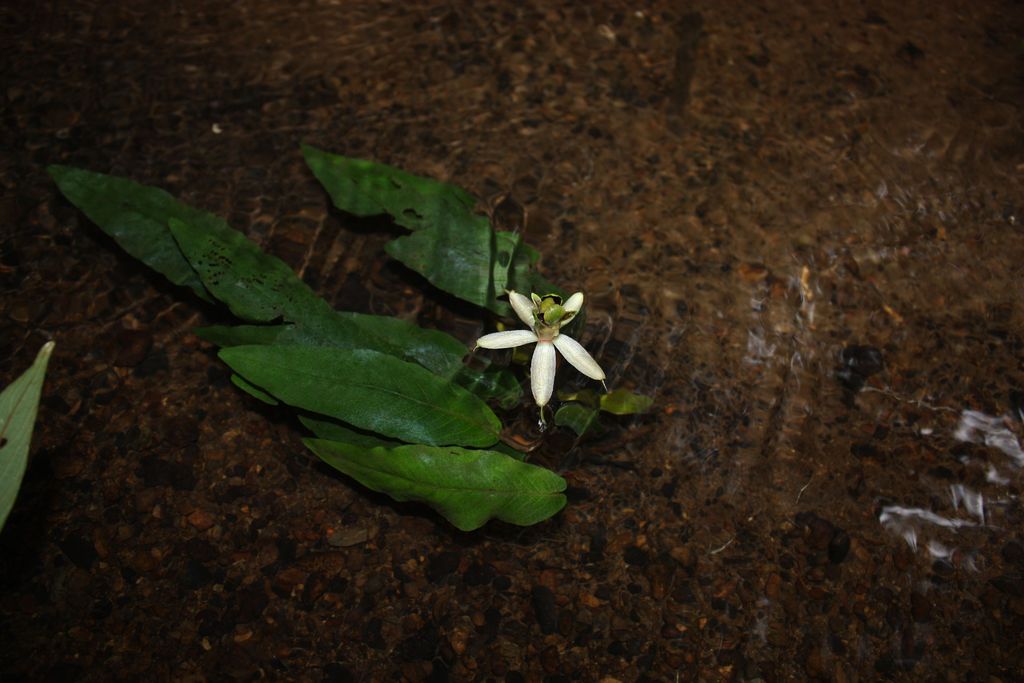
A rosette of long lanceolate leaves on petioles rises from a tuber. The leaves have wavy edges and are 15–30 cm long; colour is green-olive or bronze above and red-violet below, with red forms being wine-coloured throughout. Height is 30–40 cm. It sends up a small flower underwater.
Care
It needs nutrient-rich substrate, soft acidic water (pH 5.5–7.0), 22–28 °C, and moderate light. CO2 improves growth and colour. The plant dislikes being moved or disturbed; under stress it may shed its leaves and go dormant, then regrow.
Fertilizing
A tuberous plant with heavy root feeding: nutrient-rich substrate and root tabs are essential. Liquid fertilisers and iron support the colour. A nutrient reserve is stored in the tuber.
Breeding
It propagates by seed (it flowers and self-pollinates underwater) and sometimes by daughter tubers. Ripe seeds are sown in shallow water. Tuber division is risky because of rot.
Fun facts
Barclaya is capable of cleistogamy — self-pollination within a closed underwater flower. The rest period with leaf die-back is a normal part of the cycle. The red forms are especially prized by aquascapers as a vivid accent.