Plants
Yellow Floating Heart
Nymphoides peltata
Origin: The yellow floating heart is native to Eurasia and widespread across temperate Europe and Asia. It grows in still and slow-flowing waters — ponds, lakes, oxbows — forming leaves that float on the surface.
Also known as: Fringed water lily, Nymphoides peltata
Fact sheet
- Height
- 50 cm
- Temperature
- 10–28 °C
- pH
- 6–8
- Lighting
- Medium
- CO₂
- Not needed
- Growth rate
- Fast
- Placement
- Floating, Background
Overview
The yellow floating heart is a coldwater pond plant with rounded floating leaves resembling miniature water lilies and bright yellow flowers above the water. It is a hardy, fast-growing plant primarily for garden ponds and coldwater setups rather than the tropical aquarium. In many regions outside its native range it is considered an aggressive invasive species, so it must not be released into natural waters. It is decorative and undemanding in a pond.
Appearance
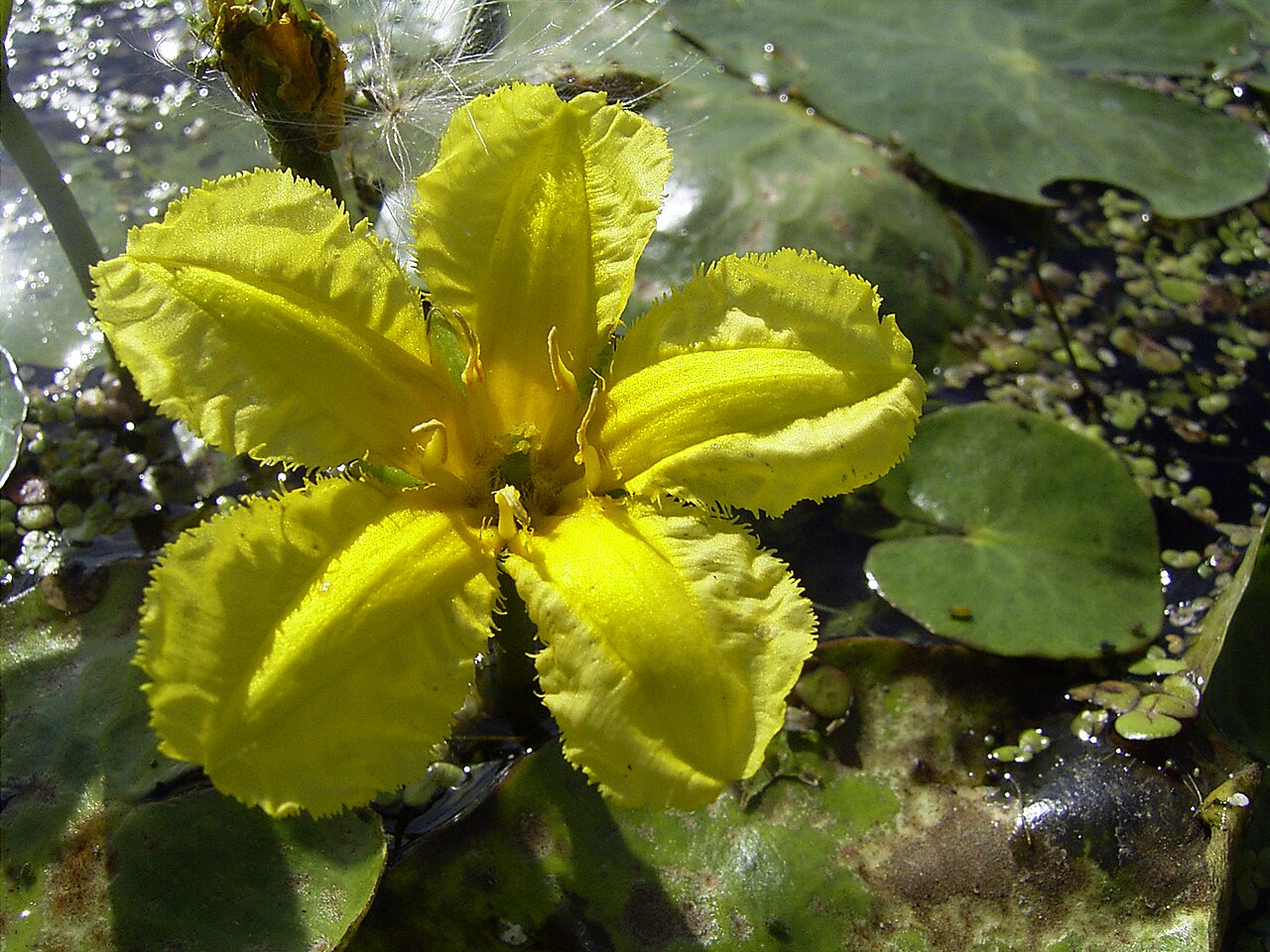
Long stems rise from a creeping rhizome on the bottom and bear floating rounded-heart-shaped leaves 3–10 cm across with a wavy edge, green above and often purple-tinged below. Bright yellow five-petalled flowers with fringed edges open above the water.
Care
A coldwater plant: 10–28 °C, pH 6.0–8.0, moderate to strong light, ideally full sun in a pond. CO2 is not required. It roots in nutrient-rich substrate on the bottom; it spreads quickly and needs control to avoid overrunning the water body.
Fertilizing
Root feeding is the main source: it needs nutrient-rich substrate on the pond floor. Extra fertilisers are usually unnecessary — the plant grows fast as it is.
Breeding
It propagates by creeping rhizome runners, stem fragments, and seed. Detached parts root easily. It spreads very fast.
Fun facts
Because of its aggressive growth, the yellow floating heart is listed as invasive in many countries, including the USA. The fringed yellow flowers last only a single day at the surface. In its native Eurasia it is a common plant of ponds and oxbows.