Plants
Rootless Duckweed
Wolffia arrhiza
Origin: Rootless duckweed occurs in still waters of Europe, Asia, Africa, and the Americas. It floats freely on the surface of warm ponds, marshes, and backwaters, often forming a continuous green film.
Also known as: Spotless watermeal, Wolffia arrhiza
Fact sheet
- Temperature
- 15–30 °C
- pH
- 6–8
- Lighting
- High
- CO₂
- Not needed
- Growth rate
- Fast
- Placement
- Floating
Overview
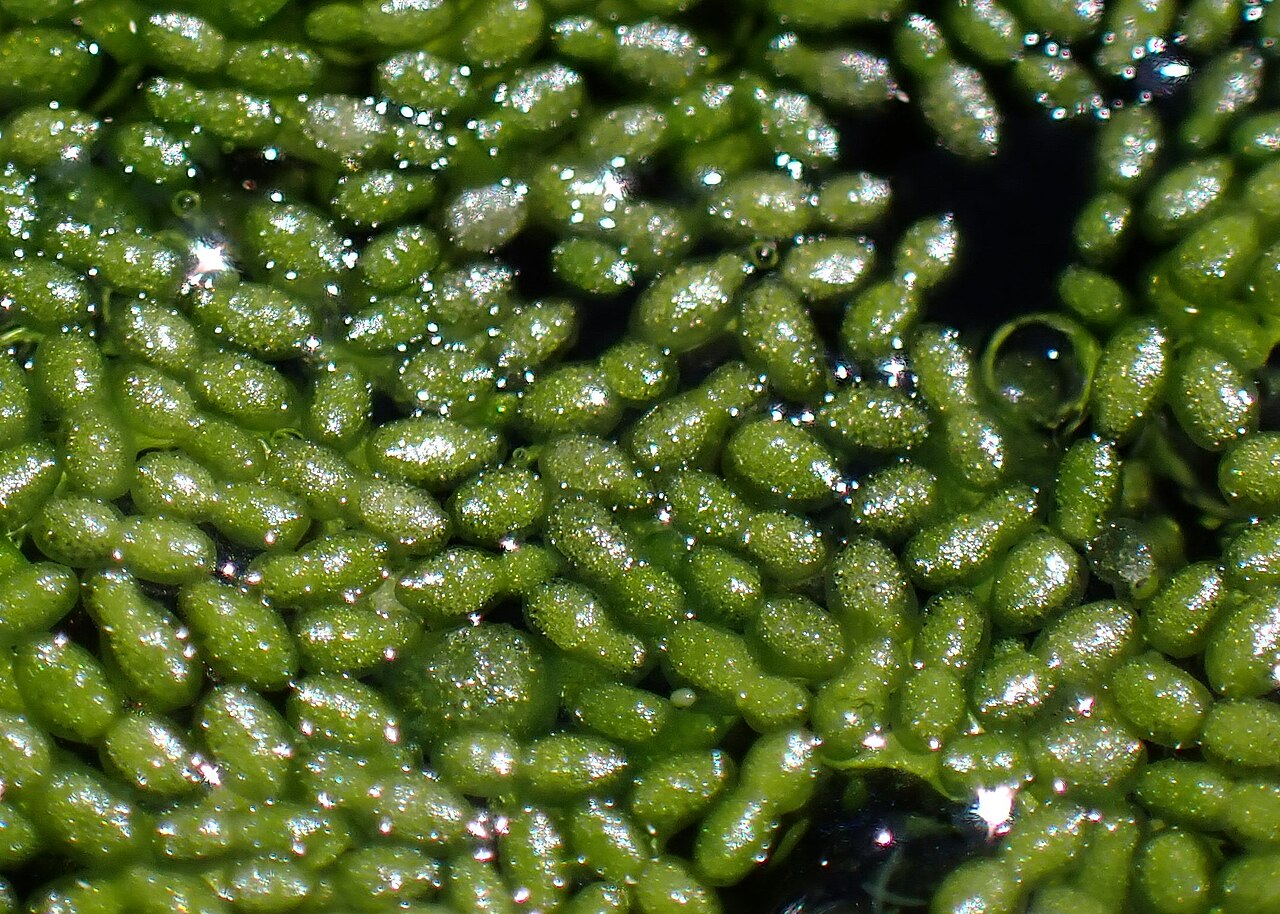
Rootless duckweed is one of the smallest flowering plants on Earth: each plant is a tiny green sphere less than a millimetre across. It floats on the surface in huge masses, forming green 'dust'. In the aquarium it is used as a shading and food plant: goldfish, cichlids, and other herbivorous fish eat it readily. It grows very fast and spreads easily throughout a tank. It is protein-rich and even used as a food product in Southeast Asia.
Appearance
Each plant is an oval-spherical body (thallus) 0.5–1.5 mm across, with no roots and no distinct leaves or stems. It is bright green. Masses look like the finest green grains or film on the water surface.
Care
Very undemanding: 15–30 °C, bright light, pH 6.0–8.0. CO2 is not required. It needs a calm surface without strong flow. It spreads explosively and can shade a tank completely, so excess is removed regularly.
Fertilizing
It absorbs nutrients straight from the water over the whole surface of its body. It takes up excess nitrate and phosphate well, purifying the water. It needs no special fertilisers.
Breeding
It propagates almost entirely vegetatively, by budding: a daughter body splits from the mother. Thanks to this the population doubles within days.
Fun facts
Wolffia is the smallest flowering plant in the world, and its flower is microscopic too. In Thailand and Laos wolffia ('khai nam') is eaten as a protein-rich food. It can photosynthesise and grow at record speed, cleansing water of excess nitrogen.