Plants
Asian Watergrass
Hygroryza aristata
Origin: Hygroryza comes from South and Southeast Asia — India, Bangladesh, Thailand, and neighbouring areas. It is a floating grass growing on the surface of ponds, lakes, and slow rivers, a relative of rice.
Also known as: Hygroryza aristata
Fact sheet
- Height
- 5 cm
- Temperature
- 22–30 °C
- pH
- 6–7.5
- Lighting
- High
- CO₂
- Not needed
- Growth rate
- Fast
- Placement
- Floating
Overview
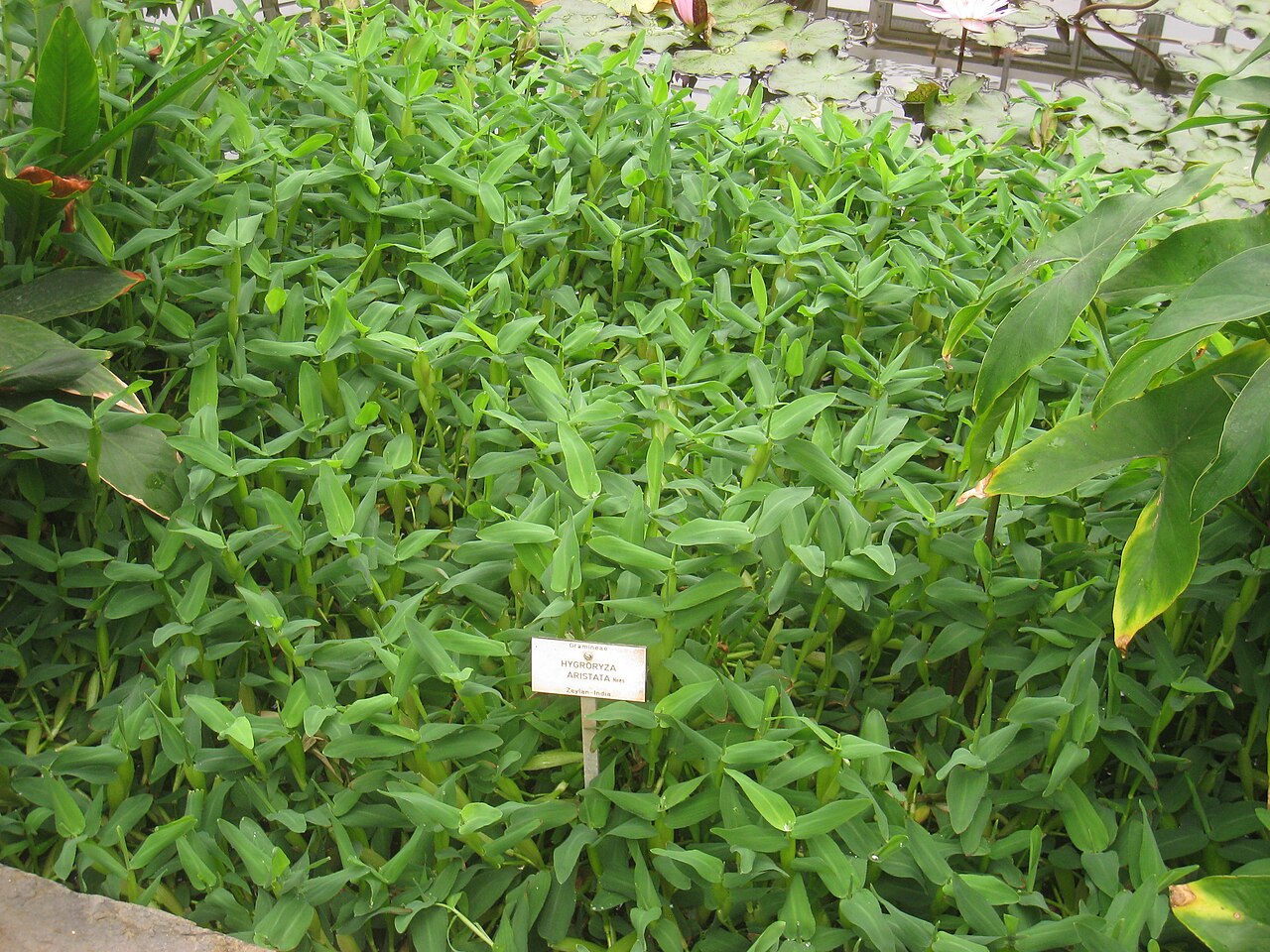
Hygroryza is an unusual floating plant of the grass family, a relative of cultivated rice. It floats on the surface thanks to swollen spongy leaf sheaths, forming floating mats of short lanceolate leaves and roots trailing into the water. In the aquarium it is used as a floating plant that provides shade and cover, and as a decorative feature of open-top tanks and paludariums. It grows fast under bright light, and its trailing roots shelter fry.
Appearance
Horizontal floating shoots bear short broadly lanceolate leaves 2–5 cm long, set alternately. The leaf bases are swollen and filled with air-bearing tissue that keeps the plant afloat. Fine roots trail into the water from the nodes. It may send up spikelet inflorescences above water.
Care
It needs bright light, 22–30 °C, pH 6.0–7.5. CO2 is not required. It needs a calm surface without strong flow and access to air (it is a surface-floating plant). It spreads fast by floating shoots.
Fertilizing
It absorbs nutrients from the water through its trailing roots. It usually needs no special fertilisers; in rich water it grows faster. It takes up excess nitrate.
Breeding
It propagates vegetatively: floating shoots branch and produce daughter plants that are separated. Seed propagation is also possible when flowering.
Fun facts
Hygroryza is a close relative of rice and, like it, belongs to the grasses. The swollen air-filled leaf sheaths act as floats. The trailing roots make excellent refuge for fry and invertebrates.