Plants
Water Hedge
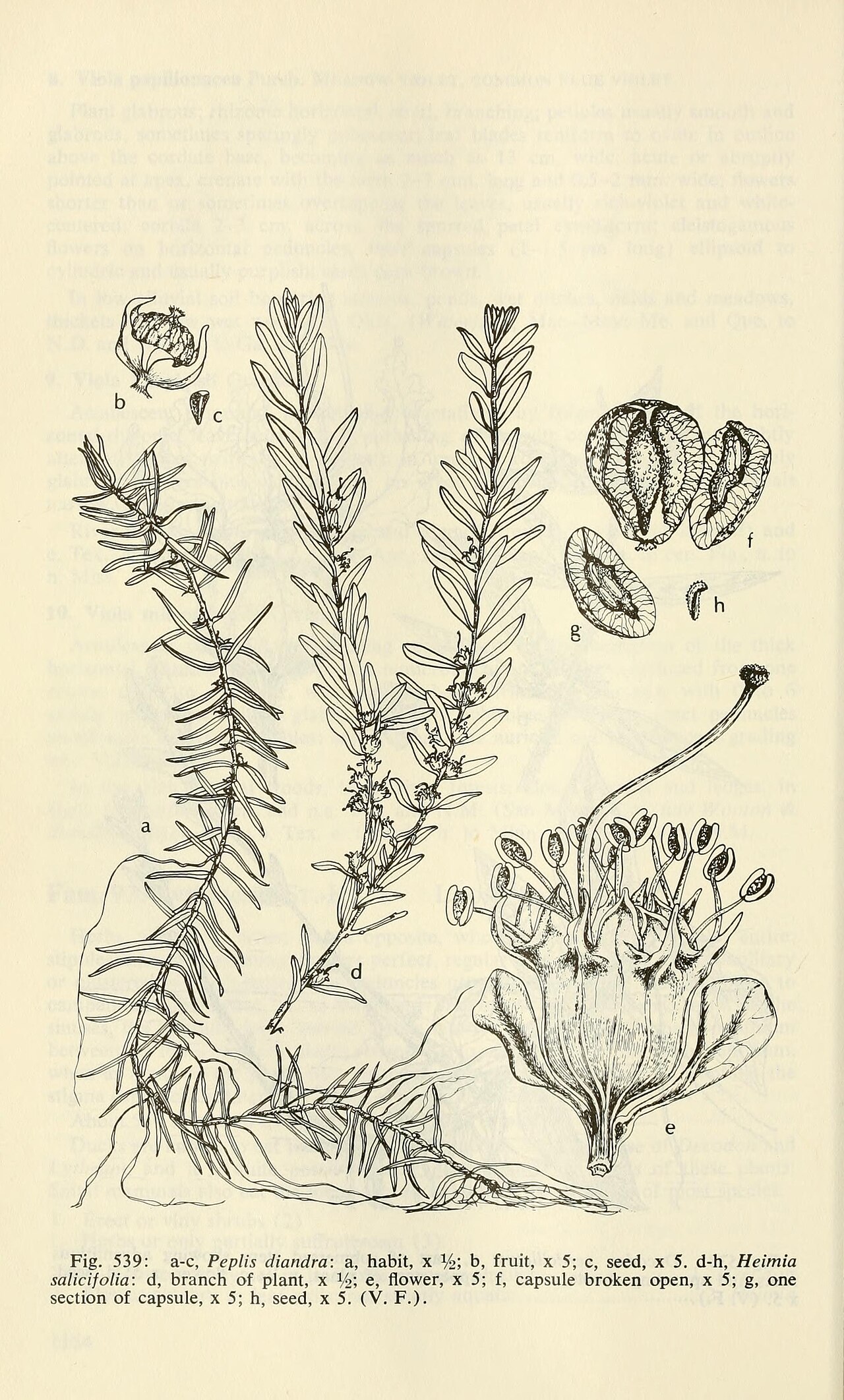
Didiplis diandra
Origin: Water hedge comes from North America, where it grows in marshy shallows and along slow water margins of the southern and eastern USA. It is the only species in its genus.
Also known as: Didiplis diandra, Peplis diandra
Fact sheet
- Height
- 20 cm
- Temperature
- 20–26 °C
- pH
- 5.5–7
- Lighting
- High
- CO₂
- Required
- Growth rate
- Medium
- Placement
- Midground, Background
Overview
Water hedge is a graceful stem plant with fine needle-like leaves forming airy light green thickets; under bright light the tips turn red. It is a plant of medium-to-high difficulty: compact growth and reddish colour need strong light, CO2, and soft water. Without them it stretches, thins, and declines. With good care it forms lush groups in the mid- and background and is considered one of the pretty 'delicate' aquascaping plants.
Appearance
Thin upright branching stems bear whorled-opposite narrow needle-like leaves 1.5–3 cm long. Colour is light green, with orange-red tips under bright light. Height is up to 20 cm. The plant is airy and needle-like, resembling a miniature conifer.
Care
It needs strong light, CO2 dosing, 20–26 °C, pH 5.5–7.0, and soft water. Nutrient-rich substrate and regular fertilisation matter. It is sensitive to a lack of CO2 and nutrients, reacting by disintegrating and stretching. It needs stable conditions.
Fertilizing
It feeds through roots and leaves. CO2, macro- and micronutrients — especially iron — matter for growth and colour. Under a nutrient deficit the plant degrades quickly.
Breeding
It propagates by cuttings: stem tops are cut and replanted, and the stem puts out side shoots. In good conditions it thickens fast.
Fun facts
Didiplis is the only species in its genus and is sometimes placed in Peplis. Its needle-like light green foliage makes it resemble an underwater conifer. Red tips are an indicator of strong light and sufficient CO2.