Plants
Marimo Moss Ball
Aegagropila linnaei
Origin: The marimo moss ball is found in cold lakes of the Northern Hemisphere — in Japan, Iceland, and Northern Europe. In nature, wave action rolls it into velvety green balls on the lake bed.
Also known as: Marimo, Moss ball, Aegagropila linnaei
Fact sheet
- Height
- 8 cm
- Temperature
- 4–24 °C
- pH
- 6–8
- Lighting
- Low
- CO₂
- Not needed
- Growth rate
- Slow
- Placement
- Foreground
Overview
The marimo moss ball is not a plant but a colony of filamentous green algae that grows in the shape of a velvety green ball. It is one of the most undemanding and unusual 'plants' in the aquarium: it needs almost nothing, grows extremely slowly, and lives for decades. Marimo likes cool water and diffuse light, is safe for all fish and shrimp (shrimp eagerly pick food particles off it). The ball is occasionally rotated to keep its shape and light it evenly. It is a popular charm and gift in Japan.
Appearance
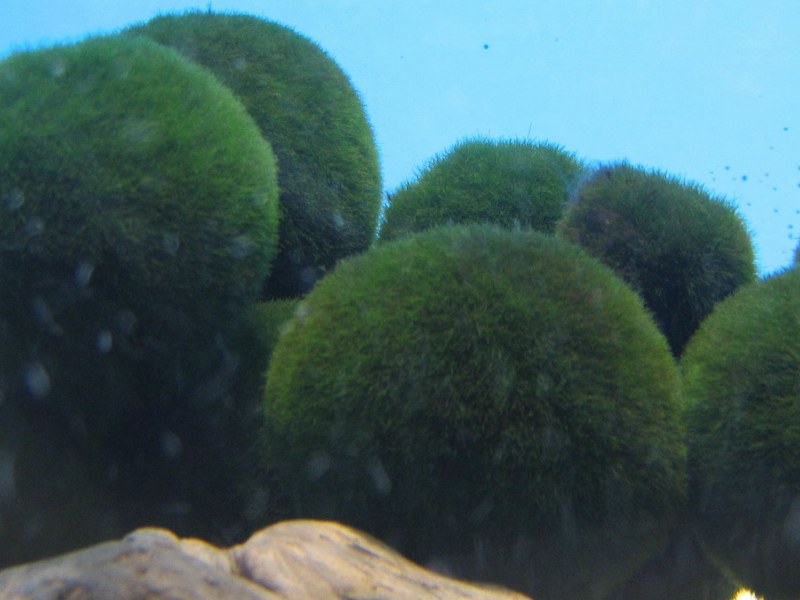
A dense velvety ball of radially growing fine green algal filaments, 2 to 12 cm or more across (growing about 5 mm a year). Bright or dark green. Slow rolling and current give it its shape; in the aquarium this is maintained by turning the ball periodically.
Care
Extremely undemanding: low or diffuse light (bright direct light is harmful), 4–24 °C (it likes it cool and tolerates heat poorly), pH 6.0–8.0. CO2 and fertilisers are not needed. Every 1–2 weeks the ball is rinsed in tank water and gently squeezed back into shape.
Fertilizing
As an alga, it gets everything it needs from water and light. It needs no special fertilisers; in water too rich in organics or too warm it may brown and fall apart. Excess light causes overgrowth by other algae.
Breeding
It propagates by division: a large ball can be cut into pieces and rolled into new balls, lightly tied with thread until firm. It grows very slowly.
Fun facts
Marimo is neither a moss nor a higher plant, but a spherical form of filamentous alga. In Japan marimo is a protected natural monument and a popular good-luck charm. The largest wild balls in Lake Akan reach 30 cm and live over a hundred years.