Fish
Rainbow Shark
Epalzeorhynchos frenatum
Origin: The rainbow shark comes from Southeast Asia — Thailand, Laos, Cambodia, and Vietnam. It inhabits rivers and streams with sand-and-rock beds and moderate flow, moving onto flooded plains in the rainy season.
Also known as: Ruby shark, Red-fin shark, Epalzeorhynchos frenatum
Fact sheet
- Size
- 15 cm
- Lifespan
- 8 years
- Minimum tank size
- 200 L
- Temperature
- 22–26 °C
- pH
- 6.5–7.5
- Hardness GH
- 5–15 °dH
- Temperament
- Semi-aggressive
- Social behavior
- Solitary
- Swimming zone
- Bottom
- Diet
- Omnivore
- Jumps out
- Yes
- Eats plants
- No
Overview
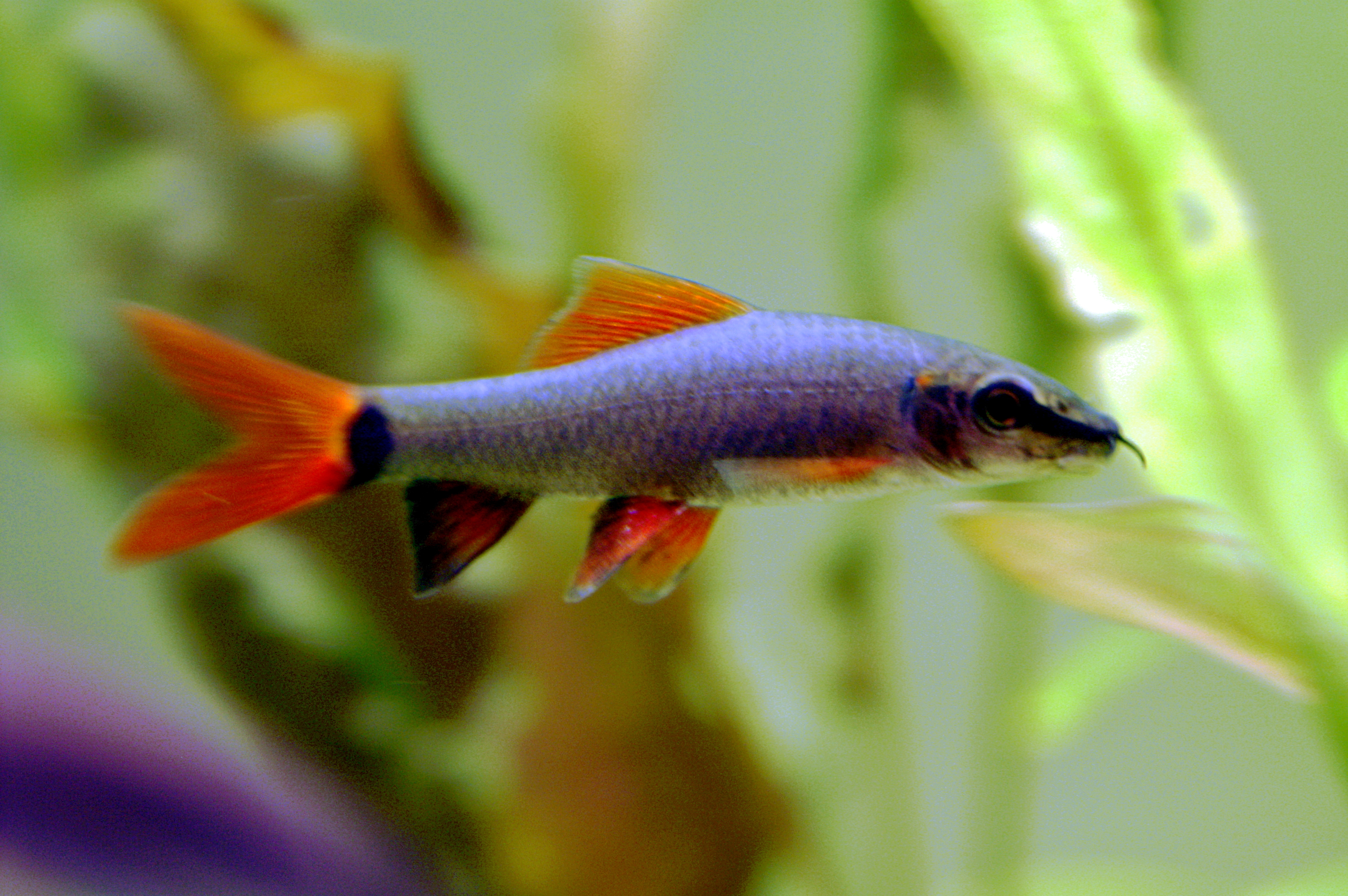
The rainbow shark is a striking bottom fish with a dark olive body and reddish-orange fins. Its shark-like silhouette and bright fins have made it popular, but it is territorial: adults defend their patch and are aggressive toward their own kind and similar bottom fish. It is best kept singly in a spacious tank with cover. With good care it is hardy and active. It suits aquarists ready to account for its territoriality.
Appearance
The body is elongated with a characteristic high back and a pointed snout with barbels, 12–15 cm long. Colour is dark olive or grey-green, with all fins reddish-orange. The underslung mouth is adapted for rasping growth. Males are slimmer with brighter fins; females are fuller in the belly.
Care
A tank of at least 200 L with sandy substrate, driftwood, rocks, and cover, plus a tight lid as the fish jumps. Temperature 22–26 °C, pH 6.5–7.5, hardness GH 5–15. Good filtration, clean water, and open swimming space near the bottom are needed. Break up the territory with cover.
Feeding
An omnivorous bottom fish. It takes sinking pellets and tablets, flakes, live or frozen bloodworm and brine shrimp, plus vegetable matter and biofilm. Feed once or twice daily.
Compatibility
Territorial and aggressive toward its own kind and similar bottom fish (other labeos, loaches). Keep singly. Companions can be active mid- and upper-level fish — barbs, rainbowfish, large rasboras. Avoid slow or bottom-dwelling competitors.
Breeding
It very rarely breeds in a home aquarium because of territoriality and the difficulty of pairing. Commercial farms breed it with hormonal induction. Spawning occurs in cover near the bottom.
Fun facts
The 'rainbow shark' name comes from its shark-like silhouette and bright fins, though it is unrelated to sharks — it is a cyprinid. Territoriality increases with age, so juveniles are more peaceable than adults.