Fish
Black Shark
Labeo chrysophekadion
Origin: The black shark is found in Southeast Asia — the Mekong and Chao Phraya basins, the Indochina peninsula, and the Greater Sunda Islands. It inhabits large rivers and floodplains, migrating in the rainy season.
Also known as: Black sharkminnow, Labeo chrysophekadion
Fact sheet
- Size
- 60 cm
- Lifespan
- 10 years
- Minimum tank size
- 800 L
- Temperature
- 22–28 °C
- pH
- 6.5–7.5
- Hardness GH
- 5–20 °dH
- Temperament
- Semi-aggressive
- Social behavior
- Solitary
- Swimming zone
- Bottom
- Diet
- Herbivore
- Jumps out
- Yes
- Eats plants
- Yes
Overview
The black shark is a large, substantial bottom fish of coal-black colour with a shark-like silhouette. The striking black juvenile often misleads buyers: as an adult the fish reaches 60 cm or more, becomes territorial, and needs a very large aquarium. It is a herbivorous-omnivorous species that rasps growth. It suits only large aquariums and experienced keepers. Size and territoriality increase with age.
Appearance
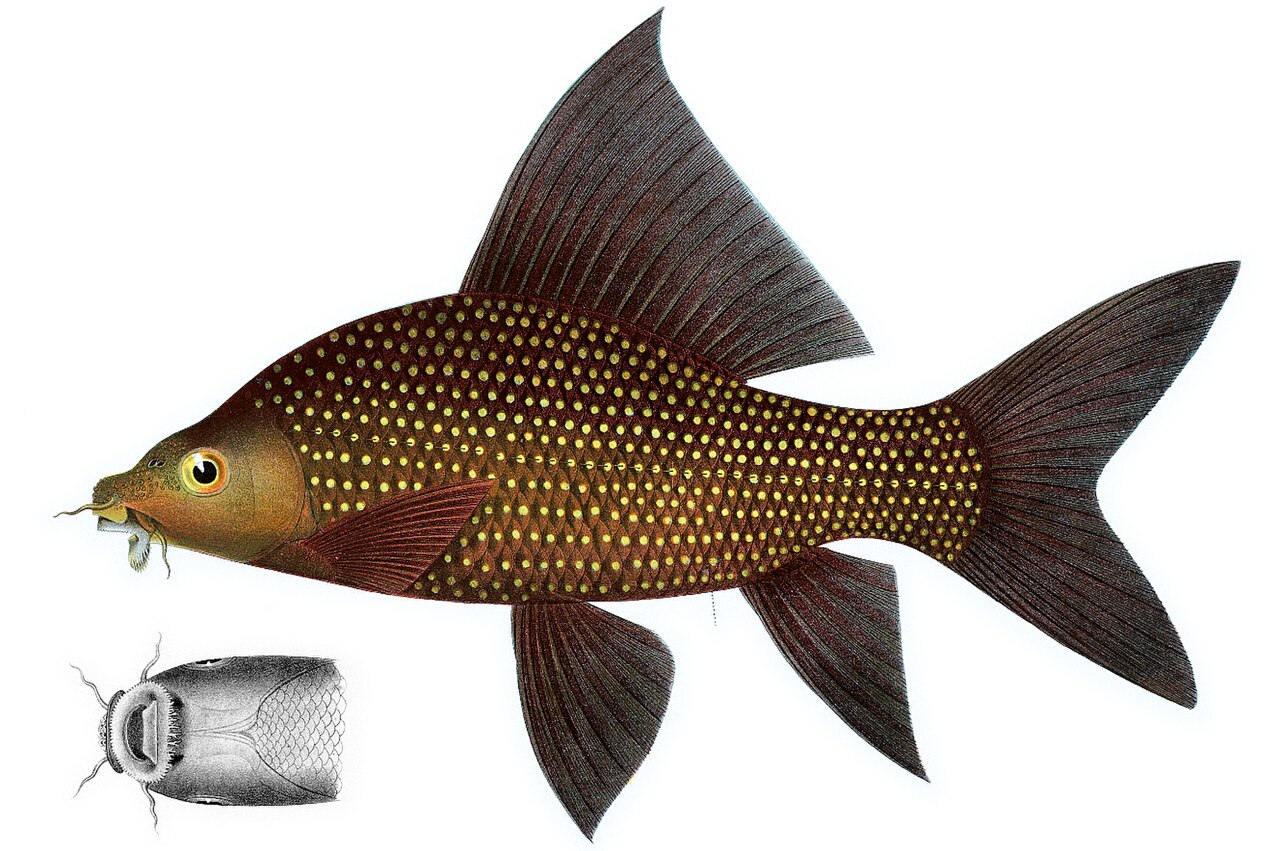
The body is massive and elongated, with a tall dorsal fin and a pointed barbelled snout. Colour is uniformly coal-black or dark grey; juveniles are velvety black with golden speckles over the scales. Adult length is 60 cm or more. The underslung mouth is adapted for rasping algae.
Care
A tank of at least 800 L for an adult (juveniles temporarily in less), with sandy substrate, large rocks and driftwood, and a tight lid. Temperature 22–28 °C, pH 6.5–7.5, hardness GH 5–20. Powerful filtration, flow, and open space near the bottom are needed.
Feeding
An omnivore leaning vegetarian. The diet is based on vegetable tablets and pellets, blanched vegetables, algae, and biofilm; supplement with live and frozen food. Feed once or twice daily.
Compatibility
Territorial, especially with age and toward similar bottom fish. Juveniles can live with large active species, but an adult is often kept singly. Do not combine with small fish. Space is essential.
Breeding
It does not breed in the aquarium because of its large size and migratory spawning. In nature it spawns on floodplains in the rainy season. It is farmed commercially in aquaculture.
Fun facts
The striking black juvenile grows into a 60 cm giant — a classic beginner's mistake. In its homeland it is also a food fish. The golden speckles of juveniles fade with age.