Fish
Labeotropheus trewavasae
Labeotropheus trewavasae
Origin: Labeotropheus trewavasae is a cichlid endemic to Lake Malawi in East Africa. It is a rock-dwelling mbuna: it inhabits rocky shoreline zones, where it rasps algal growth off the rocks.
Also known as: Trewavas's mbuna, Scrapermouth mbuna, Labeotropheus trewavasae
Fact sheet
- Size
- 12 cm
- Lifespan
- 8 years
- Minimum tank size
- 200 L
- Temperature
- 24–28 °C
- pH
- 7.6–8.6
- Hardness GH
- 10–25 °dH
- Temperament
- Aggressive
- Social behavior
- Harem
- Group size
- 4+ individuals
- Swimming zone
- Middle, Bottom
- Diet
- Herbivore
- Jumps out
- Yes
- Eats plants
- Yes
Overview
Labeotropheus trewavasae is a bright Malawi mbuna with a characteristic upturned snout overhanging its underslung mouth, adapted for scraping algae from rocks. The species has a rich palette: blue, orange, and marbled (OB) forms occur, and in many populations the females are orange-blotched. It is an active, territorial, aggressive fish kept in a rocky tank with hard alkaline water as a harem. It suits African-cichlid keepers ready to manage aggression through stocking density.
Appearance
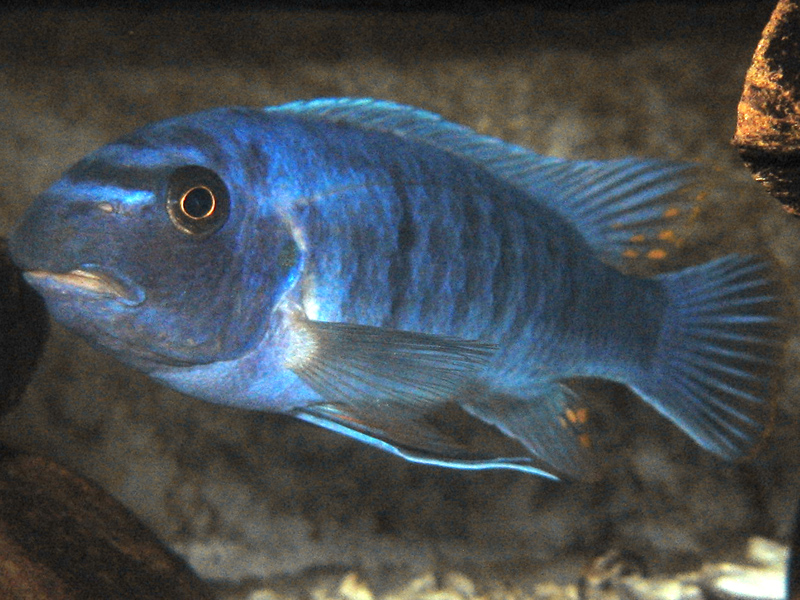
The body is elongated and sturdy, 10–12 cm long. The key mark is the upturned, overhanging snout and the underslung mouth for rasping growth. Colour varies: males are often blue with vertical bars, females and OB forms orange-blotched. The male's anal fin carries egg-spot releasers.
Care
A tank of at least 200 L with abundant rocks forming caves and territories, over a sandy bottom. Temperature 24–28 °C, pH 7.6–8.6, hardness GH 10–25 — hard, alkaline water. Powerful filtration, aeration, and regular water changes are needed. Dense stocking spreads aggression.
Feeding
A herbivorous species (aufwuchs grazer). The diet is based on vegetable flakes and pellets with spirulina, algae wafers, and blanched vegetables. Excess animal protein causes bloat ('Malawi bloat'). Feed small portions once or twice daily.
Compatibility
A territorial, aggressive mbuna. Keep as a harem (one male to 3–4 females) with other moderately aggressive mbuna of similar size. Do not combine with peaceful or small fish. Males are intolerant of each other.
Breeding
The female is a mouthbrooder. After spawning on a rock she takes the fertilised eggs into her mouth and incubates them for 3 weeks without feeding, then releases the fry. Breeding is easy with correct parameters and a harem.
Fun facts
The upturned snout of Labeotropheus is an adaptation for scraping algae at a sharp angle to the rock. The species is named after the ichthyologist Ethelwynn Trewavas. Marbled (OB) orange-and-black forms are especially prized by hobbyists.