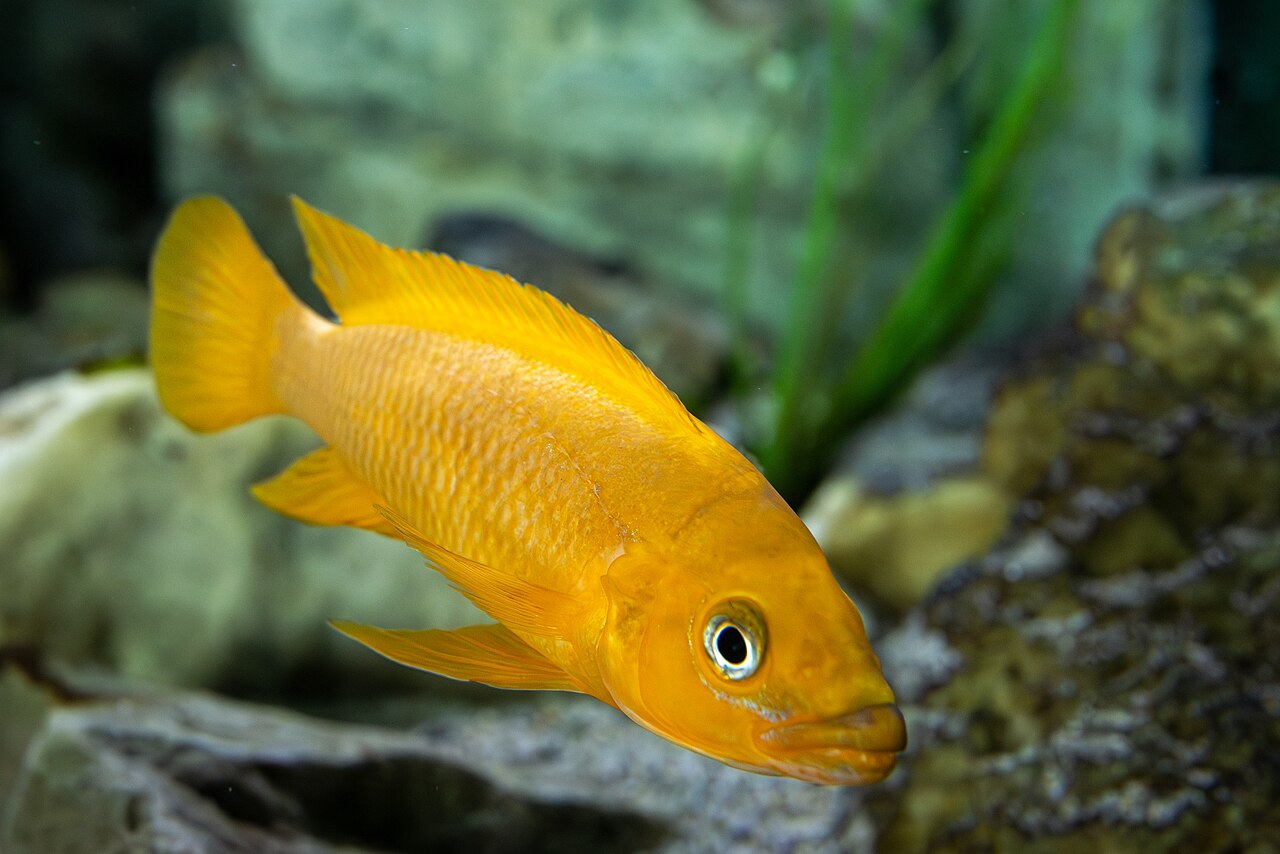
Fish
Lemon Cichlid
Neolamprologus leleupi
Origin: The lemon cichlid is a cichlid endemic to Lake Tanganyika in East Africa. It inhabits rocky areas, keeping to crevices and caves where it hides and spawns.
Also known as: Orange leleupi, Neolamprologus leleupi
Fact sheet
- Size
- 10 cm
- Lifespan
- 8 years
- Minimum tank size
- 115 L
- Temperature
- 23–27 °C
- pH
- 7.5–9
- Hardness GH
- 8–25 °dH
- Temperament
- Semi-aggressive
- Social behavior
- In pairs
- Swimming zone
- Bottom, Middle
- Diet
- Carnivore
- Jumps out
- No
- Eats plants
- No
Overview
The lemon cichlid is an elegant Tanganyikan cichlid famous for its even bright yellow-orange colour, which glows strikingly against dark rocks. It is a cave dweller living in rock crevices. Despite its small size and popularity, it is not so simple: the fish are aggressive toward their own kind and sensitive to water quality. Keep a pair or group in a tank with hard alkaline water, pale substrate, and plenty of cover. Pale substrate helps preserve the bright colour.
Appearance
The body is elongated and torpedo-shaped, up to 10 cm long. Colour is even, from bright yellow to deep orange (depending on population, status, and substrate — it darkens over dark substrate). The fins are the same tone. Sexual dimorphism is weak: males are slightly larger. Sexing juveniles is difficult.
Care
A tank of at least 115 L with pale sandy (aragonite) substrate, rocks, and plenty of caves. Temperature 23–27 °C, pH 7.5–9.0, hardness GH 8–25 — hard, alkaline water. Powerful filtration, stable clean water, and regular water changes are needed. The species is sensitive to deteriorating water.
Feeding
An insectivorous predator. It takes frozen and live foods — cyclops, brine shrimp, mysis, bloodworm — plus quality cichlid pellets. Avoid excess fatty food. Feed small portions once or twice daily.
Compatibility
Territorial and aggressive toward its own kind, especially when spawning. Keep a pair or group with other small Tanganyikan cichlids. It may evict small shell-dwellers from their shells. Do not combine with peaceful small fish.
Breeding
A cave spawner. The female lays eggs in a cave, the male fertilises them, and both parents guard the clutch and fry. Sexing is hard, so for breeding a group of juveniles is kept and a pair allowed to form. Breeding is easy with stable water.
Fun facts
The lemon cichlid's colour depends on the substrate: over pale aragonite it is bright orange, over dark substrate it darkens to brown. The species is easily confused with the close N. longior. It is named after the Belgian zoologist Narcisse Leleup.