Fish
Lamprologus ocellatus
Lamprologus ocellatus
Origin: Lamprologus ocellatus is a cichlid endemic to Lake Tanganyika. It lives on sandy bottoms, occupying empty snail shells that serve as its home, fortress, and spawning site.
Also known as: Ocellated shell-dweller, Lamprologus ocellatus
Fact sheet
- Size
- 6 cm
- Lifespan
- 6 years
- Minimum tank size
- 60 L
- Temperature
- 24–27 °C
- pH
- 7.5–9
- Hardness GH
- 8–25 °dH
- Temperament
- Semi-aggressive
- Social behavior
- In pairs
- Swimming zone
- Bottom
- Diet
- Carnivore
- Jumps out
- No
- Eats plants
- No
Overview
Lamprologus ocellatus is a tiny but very characterful Tanganyikan shell-dwelling cichlid. This fish's whole life revolves around an empty snail shell: it hides in it, guards it, spawns inside it, and constantly shifts sand to shape the entrance. Despite its miniature size, ocellatus is bold and territorial, bravely defending its shell even from large fish. Keep it in a tank with a thick sand layer and scattered shells. It is ideal for a species Tanganyika nano aquarium.
Appearance
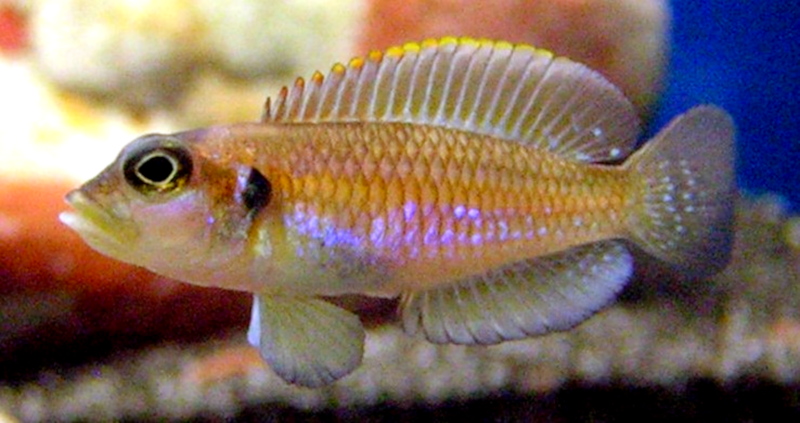
The body is stocky, 4–6 cm long (males larger than females, which barely reach 3–4 cm). Colour is sandy-grey with a pearly sheen; a bright eye-spot (ocellus) behind the eye gives the name. The fins have a blue or yellow edge. The eyes are large and expressive.
Care
A tank of at least 60 L with a thick (5–8 cm) sand layer and several empty snail shells per fish. Temperature 24–27 °C, pH 7.5–9.0, hardness GH 8–25 — hard, alkaline water. Clean water and regular changes are needed. Shells are an essential element.
Feeding
An insectivorous predator. It takes small live and frozen foods — cyclops, brine shrimp, mysis, bloodworm — plus small cichlid pellets. Feed small portions once or twice daily.
Compatibility
Territorial around its shell, but small. Keep a pair or group with enough shells so each has a home. Companions are calm upper-level fish that do not claim the bottom. Males divide the bottom into shell territories.
Breeding
Spawning takes place inside the shell. The female lays eggs in the shell and guards the clutch and fry, while the male defends the territory. A pair and suitable shells are enough to breed. Fry retreat into the shell when threatened.
Fun facts
Ocellatus is a true 'shell-dweller': it cannot live without an empty snail shell. The fish carries sand in its mouth to shape its home's entrance. Despite its 5 cm, it boldly chases fish many times its size.