Fish
Banded Leporinus
Leporinus fasciatus
Origin: The banded leporinus comes from South America — the Amazon and Orinoco basins. It inhabits rivers with flow, keeping to driftwood, rocks, and thickets, where it feeds on growth, plants, and small invertebrates.
Also known as: Black-banded leporinus, Leporinus fasciatus
Fact sheet
- Size
- 30 cm
- Lifespan
- 10 years
- Minimum tank size
- 400 L
- Temperature
- 22–28 °C
- pH
- 5.5–7.5
- Hardness GH
- 2–20 °dH
- Temperament
- Semi-aggressive
- Social behavior
- Solitary
- Swimming zone
- Middle, Bottom
- Diet
- Omnivore
- Jumps out
- Yes
- Eats plants
- Yes
Overview
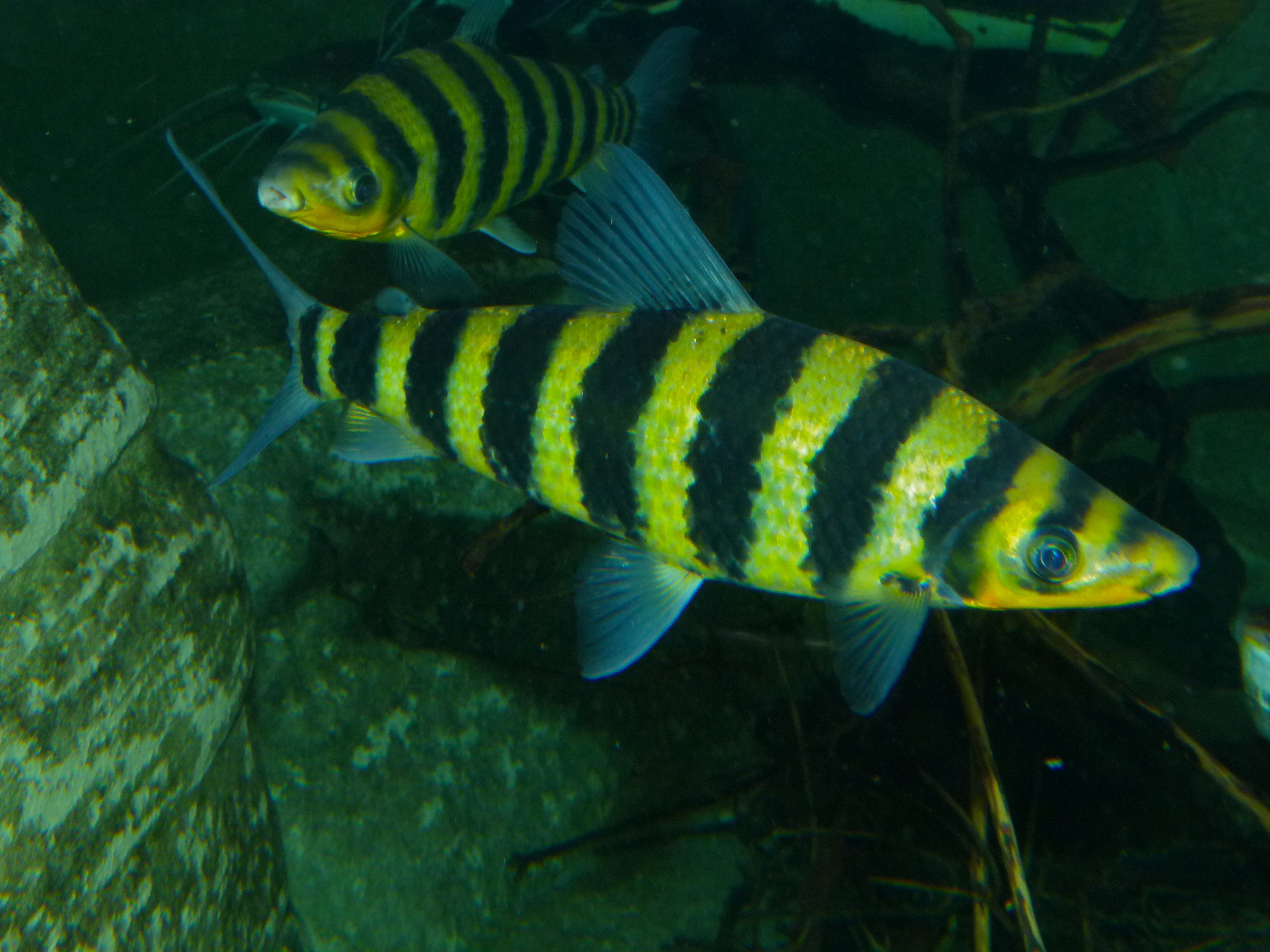
The banded leporinus is a large, striking fish with a golden-yellow body and contrasting black vertical bars. Juveniles are especially showy, but the fish grows to 20–30 cm and needs a large aquarium. It is an active, fast swimmer that jumps well, so the tank is kept tightly closed. The leporinus grazes soft plants and may harass small fish, but it gets along with large, similarly sized species. It suits experienced keepers with spacious tanks.
Appearance
The body is elongated, rounded, and torpedo-shaped, 20–30 cm long. Colour is golden-yellow with several broad black vertical bars; the contrast is sharper in juveniles. The mouth is small with characteristic 'hare' teeth (hence the name Leporinus — 'little hare'). Sexual dimorphism is weak.
Care
A tank of at least 400 L with open swimming space, driftwood, rocks, and absolutely a tight lid as the fish jumps. Temperature 22–28 °C, pH 5.5–7.5, hardness GH 2–20. Powerful filtration, flow, and clean water are needed. Live soft plants will be eaten.
Feeding
An omnivore leaning vegetarian. The diet is based on vegetable flakes and pellets, blanched vegetables, and algae; supplement with live and frozen food. Feed once or twice daily.
Compatibility
Semi-peaceful but active, and may nip fins and harass small tankmates. It gets along with large, similarly sized fish. Leporinus are quarrelsome among themselves, so keep either singly or in a group of 5+ in a large volume. Avoid small fish.
Breeding
It essentially does not breed in a home aquarium because of its large size and migratory spawning. Reliable home-breeding methods are few.
Fun facts
The name Leporinus ('little hare') comes from the large protruding front teeth resembling a hare's. The leporinus is an excellent jumper that readily leaves an open tank. With age the bars may break up into spots.