Fish
Lethrinops
Lethrinops sp.
Origin: Lethrinops are a group of cichlids endemic to Lake Malawi in East Africa. They are sand-dwelling cichlids inhabiting open sandy and transition zones, where they dig small invertebrates from the substrate.
Also known as: Sand-sifting cichlid, Lethrinops spp.
Fact sheet
- Size
- 14 cm
- Lifespan
- 8 years
- Minimum tank size
- 200 L
- Temperature
- 24–28 °C
- pH
- 7.6–8.6
- Hardness GH
- 10–25 °dH
- Temperament
- Semi-aggressive
- Social behavior
- Harem
- Group size
- 4+ individuals
- Swimming zone
- Bottom
- Diet
- Omnivore
- Jumps out
- Yes
- Eats plants
- No
Overview
Lethrinops is a genus of Malawi 'sand' cichlids that feed by sifting sand for small invertebrates. Unlike the aggressive rock-dwelling mbuna, many lethrinops are relatively peaceable, and dominant males take on bright metallic-blue colour with yellow or red. Keep them in a spacious tank with a sandy bottom where they can feed naturally, and with hard alkaline water. Keep as a harem. A good choice for a species or community Malawi tank with calm species.
Appearance
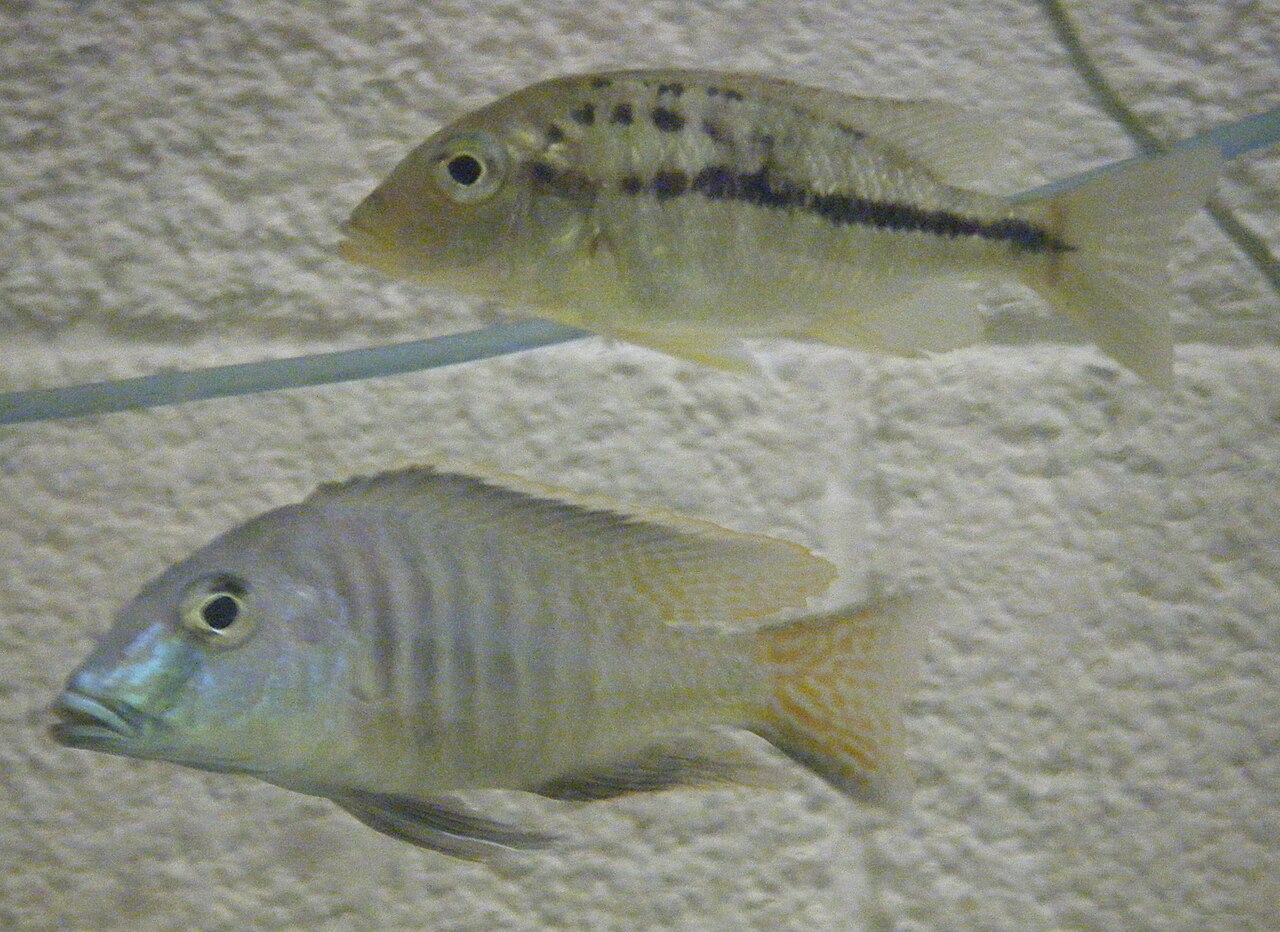
The body is elongated and moderately deep, 11–16 cm depending on the species. Dominant males are brightly coloured — metallic blue with yellow, orange, or red on the body and fins; females and immature fish are silvery-grey. The mouth is slightly protrusible, adapted for sifting sand.
Care
A tank of at least 200 L with a thick sand layer, open space, and groups of rocks. Temperature 24–28 °C, pH 7.6–8.6, hardness GH 10–25 — hard, alkaline water. Powerful filtration, aeration, and regular water changes are needed. A sandy bottom is essential for natural feeding.
Feeding
An omnivore leaning carnivore. In nature it sifts sand for invertebrates. In the aquarium it takes cichlid pellets and frozen brine shrimp, cyclops, and mysis. Feed small portions once or twice daily.
Compatibility
A relatively peaceable Malawi cichlid. It mixes well with aulonocara, utaka, and calm haplochromines of similar size. Keep as a harem (one male to several females). Malawians hybridise easily, so do not mix close species.
Breeding
The female is a mouthbrooder. After the male's display on the sand, the female takes the fertilised eggs into her mouth and incubates them for about 3 weeks, then releases the fry. Breeding is easy with a harem and correct water.
Fun facts
Lethrinops are sand cichlids: they take sand into the mouth and sift it through the gills, keeping the edible matter. The genus includes over two dozen species, split into shallow- and deep-water groups. Many species are more peaceful than typical mbuna.